Water Quality Treatment Trains in SuDS Design
Sustainable Drainage Systems, commonly referred to as SuDS, are designed to manage surface water runoff in a way that mimics natural processes while also protecting the environment. While flood risk management is often the primary driver behind drainage design, water quality is equally important because runoff from urban areas carries pollutants such as sediments, hydrocarbons, heavy metals, and nutrients. A key concept in addressing this is the water quality treatment train, which involves guiding runoff through a sequence of drainage features that progressively remove contaminants before the water is discharged into the environment.
Understanding the Treatment Train Approach
A treatment train is based on the principle that no single drainage component can effectively remove all pollutants. Instead, a series of linked SuDS features work together, each providing a different level of treatment. As water flows through the site, it is slowed down, filtered, stored, and biologically treated. This staged approach improves resilience, as each element contributes to overall performance, and reduces the likelihood of system failure if one component becomes less effective over time. The treatment process typically begins close to where runoff is generated, continues as water moves across the site, and ends at a final storage or discharge feature.
In the UK, the implementation of treatment trains is strongly guided by the CIRIA SuDS Manual C753, which provides a structured and widely accepted methodology for designing water quality treatment. Central to this guidance is the Simple Index Approach, which allows designers to systematically determine how much treatment is required and how it should be provided across a site.
The Simple Index Approach works by comparing the pollution hazard associated with a development to the treatment capability of the proposed SuDS components. The process begins by identifying different land uses within the site, such as roofs, residential roads, car parks, or industrial areas. Each land use is assigned a pollution hazard index for key pollutant groups, typically including sediments, metals, and hydrocarbons. These values reflect the level of contamination likely to be present in runoff from those surfaces.
Once the pollution hazard has been established, appropriate SuDS features are selected and assigned treatment index values based on their ability to remove pollutants. Different components provide varying levels of treatment depending on their design and function. For example, permeable paving, swales, bioretention systems, ponds, and wetlands each contribute a defined level of treatment for different pollutant types.
The key principle is that the sum of the treatment indices provided by all components within the treatment train must equal or exceed the pollution hazard index for each pollutant category. If this requirement is not met, additional treatment stages must be added. This often leads to a multi-stage design, where runoff passes through several SuDS features in sequence, reinforcing the treatment train concept.
This approach encourages designers to distribute treatment across the site rather than relying on a single downstream feature. It also introduces flexibility, as different combinations of SuDS components can be used to achieve the required level of treatment while responding to site constraints and landscape design objectives. Importantly, the Simple Index Approach must be applied early in the design process because it directly influences the number, type, and layout of SuDS features required.
Source Control and Its Role in Early Treatment
The first stage of the treatment train is source control, which deals with runoff at or very near its origin. This stage focuses on preventing pollutants from spreading and reducing the overall volume of runoff entering the wider drainage system. Features such as permeable paving allow water to infiltrate through the surface and into a sub-base, where sediments are trapped and some pollutants begin to break down. Green roofs reduce runoff at roof level while filtering airborne contaminants, and rain gardens or bioretention areas use engineered soils and vegetation to capture and treat water from small drainage areas.
At this stage, finer sediments, hydrocarbons, and initial contaminants carried in the first flush of runoff are addressed. By intercepting pollution early, source control reduces the burden on downstream components and improves the effectiveness of the entire treatment system. It also encourages a distributed approach to drainage, where water is managed across the site rather than concentrated in a single location.
Site Control and the Movement of Water Through the Landscape
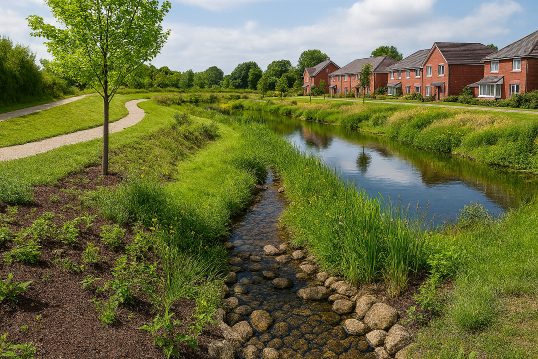
As water leaves individual source areas, it moves into the site control stage, where runoff from larger parts of the development is managed collectively. This stage focuses on conveying water slowly while providing additional opportunities for treatment. Swales are commonly used as shallow vegetated channels that allow water to flow at low velocities, encouraging sediments to settle while vegetation absorbs and filters pollutants. Filter strips provide gently sloping grassed areas that remove sediments as water flows across them, while infiltration trenches and larger bioretention systems offer further filtration and, where appropriate, infiltration into the ground.
At this stage, a broader range of pollutants is removed, including suspended solids, nutrients such as nitrogen and phosphorus, and additional hydrocarbons. Biological processes play a more significant role, with soil microorganisms and plant roots contributing to pollutant breakdown. Site control also helps regulate flows, reducing the risk of erosion and protecting downstream components from excessive sediment loading.
Regional Control and Final Water Quality Polishing
The final stage of the treatment train is regional control, where runoff from across the development is brought together and treated before discharge. This stage typically involves larger features such as detention basins, ponds, and constructed wetlands. These systems are designed to store water for longer periods, allowing fine particles to settle and enabling natural processes to further improve water quality.
Detention basins provide temporary storage and controlled discharge, allowing sedimentation to occur. Ponds introduce permanent water bodies where sunlight and biological activity support pollutant removal. Constructed wetlands are particularly effective, combining shallow water, vegetation, and microbial activity to remove nutrients, pathogens, and residual contaminants. By the time runoff reaches this stage, most pollutants have already been reduced, allowing these features to act as a final polishing step before water leaves the site.
Influence on Landscaping Design
The use of treatment trains has a significant impact on how landscapes are designed. Rather than being separate from drainage infrastructure, the landscape becomes an integral part of the system. Features such as swales, ponds, and basins must be carefully positioned within the site, which influences the layout of roads, buildings, and open spaces. This integration promotes a more natural and visually appealing environment, where SuDS features can also serve as amenity spaces and ecological assets.
Landform design is critical because treatment trains rely on gravity to move water between stages. The ground must be shaped to guide flows through each SuDS feature in sequence, requiring early coordination between engineers and landscape designers. Planting design also becomes more complex, with species selected not only for aesthetics but also for their ability to tolerate varying moisture conditions and contribute to pollutant removal. This often results in more diverse and biodiverse landscapes.
Importance of Early Consideration of Water Quality
Considering water quality at the outset of a project is essential for creating an effective drainage system. Early use of tools such as the Simple Index Approach ensures that the correct number of treatment stages is identified and that suitable SuDS features are incorporated into the layout from the beginning. This allows space to be allocated efficiently and ensures that drainage infrastructure integrates seamlessly with the wider site design.
Early consideration also reduces costs by avoiding late-stage redesign and minimising conflicts with other infrastructure. It supports compliance with planning requirements, as approving bodies expect clear demonstration that water quality objectives will be met. By embedding treatment trains into the initial design, projects can achieve better environmental performance while also delivering high quality public spaces.
Consequences of Late Consideration
When water quality is not considered early in the design process, a number of problems can arise. Drainage systems may fail to provide adequate treatment, allowing pollutants to enter watercourses and potentially causing environmental harm. A key risk is that local authorities or approving bodies may refuse to approve the drainage strategy if sufficient treatment stages are not demonstrated in line with guidance such as the CIRIA SuDS Manual. This can lead to planning delays, requests for redesign, or additional conditions being imposed, all of which can affect programme and cost.
Retrofitting treatment stages into an established layout is often difficult and inefficient. SuDS features may be poorly located, oversized, or disconnected from the landscape. This not only increases construction costs through redesign and rework, but also reduces the overall quality of the development. Opportunities to create attractive, multifunctional spaces are often lost, and the scheme may fall short of both environmental and placemaking objectives.
Conclusion
Water quality treatment trains are a fundamental aspect of SuDS design, providing a structured and effective way to manage runoff pollution. By progressing through source control, site control, and regional control stages, these systems gradually improve water quality while managing flow and enhancing resilience. The CIRIA Simple Index Approach provides a clear framework for applying this concept in practice, ensuring that the level of treatment provided matches the pollution risk. Considering water quality at an early stage allows for integrated, efficient, and visually appealing solutions, while failure to do so can lead to increased costs, design compromises, delays in approval, and reduced environmental performance.