What the National SuDS Standards Actually Mean for Your Development
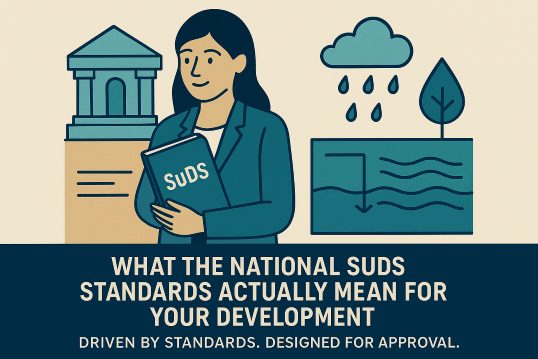
Most drainage strategies do not fail because they are poorly designed. They fail because the standards were not properly understood.
The National SuDS Standards are often treated as a checklist, but in reality they are a framework for decision-making. Understanding how they are applied is what separates a compliant design from one that secures approval quickly.
At a high level, the standards require developments to:
- Restrict runoff to greenfield rates
- Prioritise on-site management of surface water
- Prevent increased flood risk both on and off site
- Incorporate exceedance planning
- Ensure systems are maintainable over their lifetime
However, compliance is not simply about meeting these points in isolation. It is about demonstrating how they have been achieved logically and proportionately for your specific site.
For example, greenfield runoff rates must be calculated using recognised methods such as IH124 or FEH. Simply stating a discharge rate without justification is unlikely to satisfy a reviewing authority.
Similarly, the requirement to manage runoff on site often leads to confusion. It does not mean eliminating discharge entirely, but it does mean proving that infiltration, storage, and reuse opportunities have been properly considered before discharging elsewhere.
The standards also place increasing emphasis on designing for failure scenarios. Exceedance flow routes should not be an afterthought. They should be embedded in the site layout to ensure that when systems are overwhelmed, water moves safely away from buildings and critical infrastructure.
Perhaps the most misunderstood element is justification. Every decision in a drainage strategy should answer the question: why is this the most appropriate solution for this site?
That is what planning authorities are really assessing.