Common SuDS Design Mistakes and How to Avoid Them
Why Mistakes in SuDS Design Still Occur
Despite the widespread adoption of the CIRIA SuDS Manual and increasing familiarity with its principles, design mistakes are still common across many projects. This is rarely due to a lack of technical capability. More often, it results from how and when SuDS is considered within the design process. When drainage is treated as a secondary issue or introduced too late, the opportunity to deliver an effective and integrated solution is significantly reduced.
In many developments, time pressures, competing priorities, and fragmented responsibilities can lead to compromises. These compromises often result in systems that meet basic requirements on paper but fail to deliver the full benefits of SuDS in practice. Understanding these common pitfalls is an important step towards avoiding them and achieving better outcomes.
Over-Reliance on Underground Storage
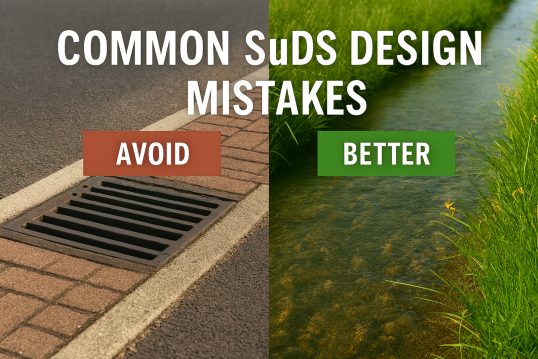
One of the most frequent mistakes is the overuse of underground storage systems such as tanks or oversized pipe networks. While these solutions can be effective in controlling flow rates, they usually fail to address the broader objectives of SuDS, particularly water quality, amenity, and biodiversity.
This approach often emerges when there is insufficient space allocated for surface features or when drainage is introduced after the site layout has already been fixed. Underground systems can appear to be a convenient solution because they require less visible space, but they do not provide the same level of multifunctional benefit.
In addition, underground structures can be more expensive to construct and maintain, and they offer limited flexibility for future adaptation. By contrast, surface-based solutions such as swales and basins can be more adaptable and provide additional value to a development.
Avoiding this mistake requires early planning and a willingness to prioritise surface features as part of the overall design, rather than treating them as optional extras.
Considering SuDS Too Late in the Design Process
Timing is one of the most critical factors in successful SuDS integration. When drainage is considered only after the layout, levels, and land use have been established, design options become constrained. This often leads to reactive solutions rather than proactive design.
Late-stage integration can result in inefficient layouts, missed opportunities for infiltration, and increased reliance on engineered solutions. It can also lead to delays in planning approval if the drainage strategy does not meet regulatory expectations.
The key to avoiding this issue is to bring SuDS into the design discussion at the earliest possible stage. At concept level, decisions about site layout, building placement, and open space can be informed by how water will be managed. This allows SuDS to shape the design rather than being forced into it.
Ignoring Water Quality Requirements
Another common mistake is focusing primarily on hydraulic performance while giving insufficient attention to water quality. It is often assumed that controlling flow rates is enough to satisfy requirements, but the CIRIA SuDS Manual clearly emphasises the need for pollution control.
Failing to incorporate adequate treatment stages can lead to non-compliance with environmental regulations and may result in objections from regulators. It can also reduce the long-term effectiveness of the system, as untreated pollutants can accumulate and cause degradation.
Avoiding this issue involves understanding the pollution risk associated with different land uses and designing an appropriate treatment train. This ensures that water is progressively treated as it moves through the site, rather than relying on a single point of intervention.
Poor Integration with Site Layout and Levels
Even when appropriate SuDS components are selected, their effectiveness can be undermined by poor integration with the site layout. Features that are placed in unsuitable locations, disconnected from natural flow paths, or constrained by surrounding development may not perform as intended.
Levels are particularly important in this context. Surface water drainage relies heavily on gravity, and poorly designed levels can lead to inefficient conveyance, ponding in unintended areas, or excessive reliance on pipework.
Successful integration requires a clear understanding of how water will move across the site. This involves coordinating site grading, road design, and landscape features so that SuDS components are positioned where they can function most effectively. Early collaboration between disciplines is essential to achieve this.
Neglecting Exceedance and Emergency Planning
Many designs focus on managing specific design storms but fail to adequately consider what happens when these conditions are exceeded. This is a critical oversight, as extreme rainfall events are becoming more frequent due to climate change.
Without a clear exceedance strategy, water may flow unpredictably across a site, potentially causing damage to buildings and infrastructure. This can lead to significant safety and financial risks.
The SuDS Manual emphasises the importance of designing controlled exceedance routes that direct water safely away from vulnerable areas. Incorporating these routes into the site layout ensures that even when systems are overwhelmed, the impact is minimised.
Inadequate Consideration of Maintenance
Maintenance is often overlooked during the design stage, leading to systems that are difficult or costly to manage over time. Features may be inaccessible, overly complex, or poorly detailed, which can result in reduced performance and eventual failure.
This issue is particularly common when responsibility for maintenance is not clearly defined or when adopting bodies are not consulted early in the process. As a result, systems may not meet adoption requirements, creating complications at a later stage.
To avoid this, designers must consider how each component will be maintained and ensure that access, safety, and practicality are built into the design. Maintenance plans should be developed alongside the drainage strategy, not added as an afterthought.
Lack of Collaboration Between Disciplines
SuDS design requires input from multiple disciplines, including engineering, architecture, and landscape design. When these disciplines work in isolation, opportunities for integration are often missed, and conflicts can arise.
For example, a drainage engineer may propose a feature that conflicts with the architectural layout, or a landscape design may not fully account for hydraulic requirements. These issues can lead to redesign, delays, and suboptimal outcomes.
Effective collaboration ensures that all aspects of the design work together. By involving key stakeholders from the outset, it is possible to create solutions that meet both technical and aesthetic objectives, resulting in more cohesive and successful developments.
Misunderstanding the Purpose of SuDS
A more fundamental issue is a lack of understanding of what SuDS is intended to achieve. If it is seen solely as a drainage requirement, its potential benefits may be overlooked. This can lead to minimal compliance rather than best practice.
The CIRIA SuDS Manual promotes a holistic approach that considers water quantity, quality, amenity, and biodiversity together. Designs that fail to address all four pillars are unlikely to deliver the full value of SuDS.
Improving awareness and understanding across project teams is therefore essential. This includes educating clients, designers, and stakeholders about the benefits of SuDS and how it can contribute to better development outcomes.
Practical Steps to Avoid Common Mistakes
Avoiding these common issues does not require radically different approaches but rather a consistent application of best practice principles. Early integration, adherence to the drainage hierarchy, and commitment to surface-based solutions are key starting points.
Clear communication and collaboration between disciplines help ensure that designs are coordinated and effective. Regular review and quality assurance processes can identify potential problems before they become embedded in the design.
Most importantly, adopting a mindset that views SuDS as an opportunity rather than a constraint can transform how projects are approached. By embracing its principles, designers can create systems that are more efficient, resilient, and beneficial to both people and the environment.
Why Getting It Right Matters
The consequences of poor SuDS design can be significant, ranging from planning delays and increased costs to long-term performance issues and environmental harm. Conversely, well-designed systems can enhance developments, support regulatory compliance, and deliver lasting value.
For architects and designers, understanding these common mistakes and how to avoid them is an important step towards delivering better projects. It ensures that SuDS is fully integrated, performs as intended, and contributes positively to the built environment.