Drainage Consultant vs Civil Engineer: Key Differences
When facing a drainage problem, understanding the difference between a drainage consultant and civil engineer can mean the difference between a compliant solution and costly delays. These professionals approach water management differently, and choosing the right one depends on your project’s scope and regulatory requirements. At The Drainage Designers (Woodvale consulting Ltd), we work alongside both specialists to ensure homeowners and developers get the expertise they need.
Scope of Work and Specialisation
A drainage consultant focuses exclusively on water management systems, designing surface water drainage, foul drainage, and flood mitigation strategies tailored to specific sites. They conduct site visits, analyse ground conditions, and create detailed drainage plans compliant with Local Authority and Lead Local Flood Authority requirements.
Civil engineers take a broader infrastructure view, managing structural integrity, site grading, foundations, and utilities alongside drainage. For large-scale commercial development, a civil engineer oversees drainage as one component of a much larger project. The key distinction: a drainage consultant is a specialist, whilst a civil engineer is a generalist. For residential drainage design, a consultant’s focused expertise often proves more efficient. For large-scale commercial development, a civil engineer’s integrated approach becomes invaluable.
Pro TipIf your project involves only drainage concerns, a specialist consultant typically delivers faster turnaround times and more cost-effective solutions. If drainage is one of many infrastructure challenges, a civil engineer provides unified project management.
Professional Qualifications and Licensing
Drainage consultants typically hold qualifications in civil engineering, hydrology, or environmental science but don’t always require Professional Engineer (PE) licensing. Many operate as independent consultants with specialist training in drainage design and hydraulic analysis.
Civil engineers must be licensed as Professional Engineers in most jurisdictions, requiring formal education, years of experience, and passing rigorous examinations. State-specific licensing requirements vary considerably, some regions require a PE stamp on drainage plans submitted to local authorities, whilst others accept drainage consultant reports without PE involvement.
Watch OutSubmitting drainage plans without the required PE signature can result in planning rejection and costly redesigns. Always verify your Local Authority’s specific licensing requirements before hiring.
What is a Drainage Consultant?
A drainage consultant is a specialist professional who designs, assesses, and manages water drainage systems for residential and commercial properties. They evaluate site conditions, predict water behaviour, and create solutions that protect properties from flooding whilst meeting environmental regulations.
Key Responsibilities
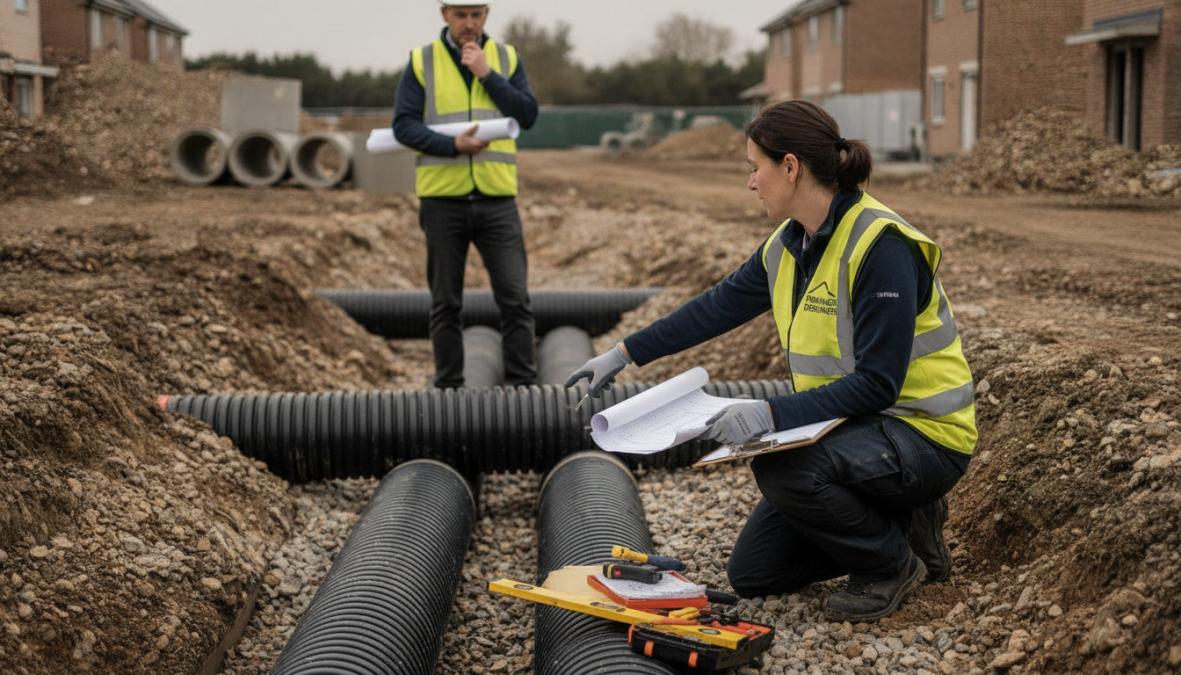
Drainage consultants conduct site surveys to understand topography, soil conditions, and existing infrastructure. They perform hydraulic analysis to calculate water flow rates and system capacity, design drainage networks including pipes, channels, and retention systems, and prepare detailed engineering drawings and specifications for construction. They also manage flood risk assessments, analysing historical flooding data and rainfall patterns to predict site performance during extreme weather.
When Drainage Consultants are Essential
Drainage consultants become essential when water management is your project’s primary challenge. Any residential extension requiring new surface water drainage, properties in flood-risk zones needing detailed flood mitigation strategies, and domestic renovations affecting existing drainage systems all benefit from specialist input. Commercial developments with surface water issues and residential subdivisions needing comprehensive stormwater management planning warrant consultant involvement.
Key Takeaway
Drainage consultants excel when water management is your project’s core challenge. Their specialist knowledge delivers faster solutions and regulatory compliance at lower cost than generalist engineers.
Defining Civil Engineering Scope in Drainage Projects
Civil engineering encompasses a much broader discipline than drainage alone. Civil engineers design roads, bridges, buildings, water treatment facilities, and infrastructure systems. Within drainage projects, they manage the water management component whilst coordinating with structural, geotechnical, and environmental specialists.
Broader Infrastructure Role
When a civil engineer leads a drainage project, they typically manage multiple interconnected systems. On a residential extension, they might coordinate drainage, foundation design, and site grading simultaneously. On a commercial development, they oversee drainage alongside structural elements, utilities, and accessibility requirements. This integrated approach works well for complex projects but means drainage receives proportional attention rather than specialist focus.
Civil Engineer Drainage Report Requirements
Civil engineers use industry-standard software like Autodesk Civil 3D for complex drainage modelling, enabling advanced pipe network modelling and hydraulic analysis. The civil engineer’s report carries PE liability and insurance protection, which matters significantly for projects requiring formal design certification, though it increases costs compared to specialist consultant reports.
Residential Drainage Design Services: Which Professional Do You Need?
Most residential drainage projects suit drainage consultants perfectly. A domestic extension typically needs surface water drainage to direct roof runoff safely away from foundations. A drainage consultant conducts a site visit, assesses existing drainage, designs new systems, and secures Local Authority approval in weeks rather than months.
Domestic Extension and Renovation Projects
When does a residential project need a civil engineer instead? When it involves significant site grading, foundation changes, or complex interactions with existing infrastructure. The decision framework is straightforward: if your residential project’s primary concern is water management, engage a drainage consultant. If your project involves structural changes or comprehensive site redesign, consider a civil engineer.
When Local Authority Approval Requires a Civil Engineer
Some Local Authorities require PE-stamped drawings for drainage submissions. Before engaging any professional, contact your Local Authority and Lead Local Flood Authority to understand their specific requirements. This single step prevents costly redesigns.
Pro Tip
Contact your Local Authority before hiring a professional. Their specific requirements determine whether you need a PE-licensed civil engineer or a specialist drainage consultant.
Drainage Consultant Cost and Project Economics
Professional fees for drainage work vary based on project complexity, site conditions, and required analysis. Site complexity drives cost differences, a simple extension on well-drained property requires minimal analysis, whilst a property in a flood-risk zone with complex topography demands extensive assessment. Project scale matters significantly, with small residential projects costing less than large commercial developments requiring extensive modelling.
Value of Professional Expertise
Investing in professional drainage design prevents far costlier problems. A poorly designed drainage system leads to foundation damage, basement flooding, and expensive remediation. Professional expertise also simplifies Local Authority approvals, a well-designed, properly documented drainage plan typically secures approval on first submission. The professional fee represents insurance against far more expensive outcomes.
Regulatory Compliance, Permitting, and State-Specific Licensing Requirements
Drainage projects operate within a complex regulatory framework. Building Regulations govern drainage design standards. Local Authorities enforce those standards and may add site-specific requirements. Lead Local Flood Authorities review flood-risk implications. Environmental regulations protect water quality.
Local Authority and Lead Local Flood Authority Standards
Every Local Authority has specific drainage standards documented in their Local Plan and Building Regulations guidance. Lead Local Flood Authorities assess surface water drainage and flood risk, reviewing proposals for new development to ensure adequate stormwater management. Understanding your specific regional requirements is essential before project planning begins.
Building Regulations and Environmental Compliance
Building Regulations Part H covers drainage and waste disposal, specifying design standards, testing requirements, and maintenance provisions. Environmental regulations protect watercourses and groundwater, with Sustainable Drainage Systems (SuDS) increasingly required for new development.
Watch Out Attempting drainage design without professional guidance risks Building Regulations rejection and environmental enforcement action. Professional expertise ensures compliance from initial design through construction completion.
Stormwater Management and Flood Mitigation: Professional Expertise Required
Modern stormwater management emphasises retention, infiltration, and gradual release to reduce flooding and protect water quality. Proper stormwater management requires hydraulic analysis calculating rainfall intensity, runoff volumes, and pipe capacities. Site assessment informs this analysis, evaluating soil permeability, groundwater levels, and topography.
Commercial Development and Large-Scale Projects
Commercial projects introduce complexity demanding professional expertise. Large buildings generate substantial stormwater runoff from roofs, parking areas, and hardscaping. Commercial developments often require detailed stormwater management plans demonstrating compliance with environmental regulations and Local Authority standards.
Large-scale projects frequently benefit from civil engineering oversight for integrating drainage with site grading, utilities, and structural systems. However, even within large projects, specialist drainage consultants often lead the water management component.
How to Decide: Drainage Consultant vs Civil Engineer for Your Project
The decision framework rests on three factors: project scope, regulatory requirements, and complexity.
Decision Framework and Project Assessment
Start by defining your project’s primary challenge. Is water management the core issue, or is it one of several infrastructure concerns? Next, verify regulatory requirements by contacting your Local Authority and Lead Local Flood Authority to confirm whether PE certification is required. Finally, assess site complexity, straightforward sites with good drainage need less specialist expertise, whilst complex sites in flood-risk zones require detailed analysis.
| Project Factor | Favours Drainage Consultant | Favours Civil Engineer |
|---|---|---|
| Primary focus | Water management only | Multiple infrastructure systems |
| Site complexity | Simple, well-drained | Complex, flood-prone |
| Regulatory requirement | No PE certification required | PE certification mandated |
| Project scale | Small residential | Large commercial |
| Timeline priority | Fast turnaround needed | Coordinated design preferred |
Liability, Insurance, and Professional Protection
Professional liability differs significantly between drainage consultants and licensed civil engineers. Civil engineers carry PE insurance covering design errors and professional negligence. Before engaging any professional, confirm their liability insurance coverage. This protection matters if design errors cause property damage or regulatory problems.
Key Takeaway
The decision between drainage consultant and civil engineer depends on whether drainage is your project’s primary challenge, whether your Local Authority requires PE certification, and whether your site involves complex interactions between multiple systems. Most residential projects benefit from specialist drainage consultants. Complex commercial projects typically need civil engineers.
Drainage challenges often seem straightforward until you navigate Local Authority requirements, hydraulic calculations, and regulatory compliance. The right professional transforms a potentially frustrating process into a simplified path toward approval and successful implementation. The Drainage Designers (Woodvale consulting Ltd) brings specialist drainage expertise to every project, from straightforward residential extensions through complex commercial developments. Their team handles site assessments, hydraulic analysis, detailed design, and Local Authority coordination, ensuring your drainage solution meets all compliance requirements whilst delivering long-term performance. Get in touch with The Drainage Designers (Woodvale consulting Ltd) and move your project forward with confidence.
Frequently Asked Questions
What does a drainage consultant do?
A drainage consultant specialises in designing drainage systems and solutions for specific projects. They conduct site assessments, analyse water runoff patterns, create drainage plans, and ensure compliance with local authority requirements. Drainage consultants focus on hydrology, site grading, and stormwater management to solve drainage-specific challenges without necessarily addressing broader civil infrastructure needs.
Do I need a civil engineer for residential drainage design services?
Not always. For simple residential drainage projects, a drainage consultant may be sufficient. However, if your project involves structural changes, complex site conditions, integration with building foundations, or specific local authority requirements, a civil engineer’s broader expertise in infrastructure and structural integrity becomes necessary. Check with your local planning authority for their specific requirements.
What is the difference between a drainage consultant and a civil engineer?
A drainage consultant specialises exclusively in drainage design, water management, and hydrology. A civil engineer has broader expertise covering drainage alongside site infrastructure, structural design, and large-scale development projects. Civil engineers typically hold professional engineer (PE) qualifications and can sign off on complex engineering works. Drainage consultants offer focused expertise and are often more cost-effective for drainage-specific tasks.
What should a civil engineer drainage report include?
A civil engineer’s drainage report must include site assessment findings, topography analysis, hydraulic calculations, proposed drainage design with construction documents, flood risk assessment, regulatory compliance verification, and recommendations for implementation. The report should address stormwater management, soil stability, environmental regulations, and permitting requirements. It serves as the basis for local authority approval and construction.
How much does a drainage consultant cost compared to a civil engineer?
Drainage consultant fees typically depend on project complexity, site size, and scope of work required. Civil engineers may charge differently based on broader infrastructure involvement. Rather than fixed costs, both professionals base fees on project assessment, design complexity, and deliverables needed. Contact professionals directly for quotes tailored to your specific project requirements and location.