
Managing Surface Water on Clay Soil: 7 Proven Solutions
Managing surface water on clay soil presents a genuine challenge for property owners across the UK. Clay’s poor drainage characteristics mean that water sits on the surface rather than percolating downward, creating waterlogged conditions that damage landscaping, compromise structural integrity, and create safety hazards. This guide from The Drainage Designers (Woodvale consulting Ltd) explains the practical solutions that work, the common mistakes to avoid, and when professional intervention becomes necessary.
Why Clay Soil Struggles with Surface Water
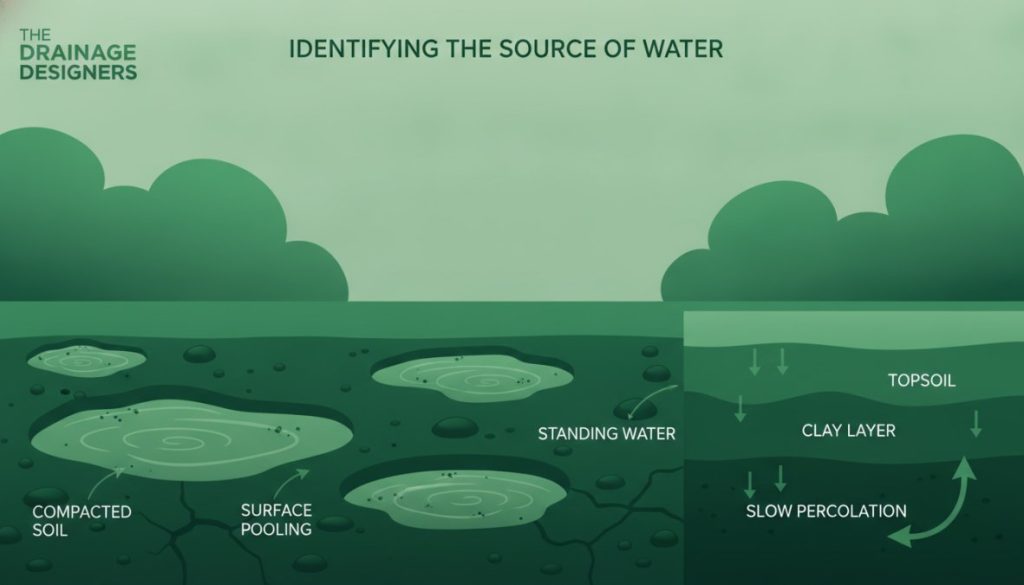
Clay particles are extremely fine and pack tightly together when wet, creating a dense, impermeable barrier that prevents water from draining downward. Unlike sandy soils, which allow water to percolate quickly, clay soil becomes saturated and remains wet for extended periods. Compacted clay can take weeks or months to dry out after rain, and in poorly graded areas, water may never drain at all.
Pro Tip
If your garden stays wet for more than 48 hours after rain, clay compaction is almost certainly the culprit. Test this by digging a small hole and filling it with water. If it drains within 24 hours, your issue is surface runoff rather than soil permeability.
Identifying the Source of Water on Your Property
Before implementing any solution, determine whether your water problem originates from rainfall, groundwater, uphill runoff, or poor grading on your own property. The source dictates which strategy will actually work.
Visual diagnostic signs
Waterlogged clay soil displays specific patterns. Look for areas where grass remains dark and spongy days after rain, patches where moss and algae thrive, or visible pooling in low spots. Check your property’s topography, water naturally flows downhill, so if your garden slopes toward your house or sits in a depression, you’re collecting runoff from surrounding areas.
Common water sources
Roof runoff from gutters and downspouts often concentrates water in specific zones. If downspouts discharge directly onto clay soil near your foundation, you’ve identified a major source. Water from neighbouring properties may also drain onto yours if your garden sits lower than adjacent land.
Groundwater is different from surface water. If water appears in your garden even during dry spells, you’re dealing with a high water table rather than poor drainage, which requires different solutions.
Watch OutNever assume your water problem is purely a drainage issue. If water appears without recent rainfall, your water table may be naturally high. Professional assessment can determine whether you’re facing surface water or groundwater problems.
Improving Drainage in Heavy Clay Soil: Soil Amendment Strategies
Amending clay soil improves its structure and water-holding capacity, making it less prone to waterlogging. This medium-to-long-term approach works best combined with other strategies.
Adding organic matter and topsoil
Incorporating organic matter breaks up clay’s dense structure. Compost, well-rotted manure, or leaf mould mixed into the top 150-200mm of soil improves porosity and allows water to move more freely. For severely waterlogged areas, consider removing the top 100-150mm of clay and replacing it with a mixture of 40% topsoil, 30% coarse sand, and 30% compost.
Aeration and compaction relief
Mechanical aeration breaks up compacted clay by puncturing the soil surface or removing small cores. Core aeration (removing small plugs of soil) provides better long-term results than spike aeration because it doesn’t compact surrounding soil further. Deep aeration at 150-200mm is most effective for clay soil.
| Aeration Method | Depth | Best Timing | Frequency |
|---|---|---|---|
| Spike aeration | 75-100mm | Autumn or spring | Annual |
| Core aeration | 150-200mm | Autumn or spring | Annual to biennial |
| Deep cultivation | 200-300mm | Spring | Once or twice |
Key Takeaway
Aeration alone won’t solve severe waterlogging, but combined with organic matter incorporation and proper grading, it significantly improves drainage over time. Annual aeration for three to five years creates noticeable improvement in clay soil structure.
French Drain Installation for Clay Soil
A French drain is a subsurface drainage system that collects water and directs it away from problem areas. It consists of a perforated pipe surrounded by gravel, installed in a sloped trench. Water enters through perforations and flows downhill to a discharge point.
For clay soil, the gravel layer is critical. Clay particles can migrate into the gravel and clog the drain over time. Installing a geotextile membrane between the clay and gravel prevents this migration while allowing water through.
French drains work best when installed at a slope of at least 1:100 (1 metre of drop for every 100 metres of length). If your property lacks sufficient slope, you may need a sump pump to discharge water uphill.
Digging a trench through compacted clay is labour-intensive. Professional contractors with excavation equipment complete the work efficiently. The trench should be 300-400mm wide, with the perforated pipe resting on 50mm of gravel. Backfill with 150mm of gravel around the pipe, then add the geotextile membrane before backfilling with topsoil.
The discharge point matters as much as the drain itself. Water must exit to a lower point where it won’t create problems elsewhere. In some cases, local authority approval is required before discharging to a watercourse.
How to Amend Clay Soil for Better Drainage
Long-term soil improvement requires patience but creates permanent improvement to your property’s drainage characteristics.
Long-term amendment schedules
Effective soil amendment happens gradually over multiple seasons. In year one, add 25-50mm of compost or organic matter to the surface and aerate heavily. In year two, repeat the process and consider adding coarse sand at a ratio of 1 part sand to 3 parts organic matter. By year three, your soil structure should noticeably improve. Continue annual aeration and organic matter addition to maintain improvements.
For vegetable gardens or planting beds, raised beds filled with amended soil offer faster results without waiting for in-situ soil amendment.
Percolation testing and monitoring
A simple percolation test measures how quickly water drains through your soil. Dig a hole 300mm deep and 300mm diameter, fill it with water, and measure drainage time. Clay soil typically takes 24-72 hours; improved soil drains within 12-24 hours. Repeat tests annually to track improvement.
Best Plants for Wet Clay Soil
Rather than fighting clay’s moisture-retention properties, selecting plants that thrive in wet conditions makes waterlogging less problematic. Moisture-loving plants like willows, alders, and dogwoods naturally grow in wet conditions. For smaller spaces, astilbe, hostas, and sedges tolerate persistent moisture better than conventional garden plants.
This approach doesn’t solve the water problem but works well for designated wet zones.
Structural Solutions: Regrading, Permeable Pavers, and Rain Gardens
Structural solutions address surface water management by changing how water moves across your property.
Regrading and low spot management
Regrading involves reshaping your landscape to ensure water flows away from buildings and problem areas. Even a 1-2% slope creates significant improvement. For existing properties, this usually means raising low spots by adding topsoil and compacting it properly. Fill low spots gradually using a mixture of topsoil and sand to improve drainage of the fill material itself.
Permeable pavers and surface water runoff
Permeable paving allows water to drain through the surface rather than running off. Effectiveness depends on what lies beneath the pavers. Install a drainage layer beneath: 100-150mm of coarse gravel or recycled aggregate allows water to move laterally and eventually percolate downward or flow to a drainage system.
Rain gardens and swales for clay
A rain garden is a shallow depression planted with moisture-tolerant plants that collects and filters runoff. For clay soil, it must include amended soil (topsoil and compost mixture) to ensure water actually drains. The garden should be 150-200mm deep.
A swale is a shallow channel that directs water downhill toward a discharge point. Unlike a rain garden, which absorbs water, a swale moves water across your property. Both require proper grading to function naturally.
DIY vs. Professional Drainage Design: Cost and Compliance Considerations
Simple solutions like aeration and organic matter addition are manageable DIY projects. French drains, regrading, and subsurface drainage systems require professional expertise.
Professional drainage designers assess your site’s slope, soil conditions, water source, and local regulations to recommend solutions that actually work. For properties with persistent water problems, professional assessment typically costs less than trial-and-error DIY attempts that don’t solve the issue.
Legal and zoning requirements for drainage
Discharging water to a watercourse, ditch, or neighbouring property requires consent in many areas. Your local authority may require planning permission or building regulation approval for drainage works. Connecting to public sewers requires water company approval. Understanding these requirements before designing your drainage system prevents costly mistakes.
Professional drainage designers navigate these regulations as part of their service, ensuring your drainage system is compliant.
Managing surface water on clay soil requires understanding your property’s specific conditions and choosing solutions that address the actual problem. Some properties benefit from simple grading improvements and aeration; others need French drains or soil amendment; most require a combination of approaches applied over time. If your property has persistent waterlogging despite your efforts, professional assessment becomes worthwhile. The Drainage Designers (Woodvale consulting Ltd) provides expert drainage design, site assessment, and compliance support to ensure your property drains properly.
Frequently Asked Questions
Why does clay soil hold so much water and make managing surface water more difficult?
Clay soil particles are extremely small and tightly packed, leaving little space for water to drain through. This soil compaction and low percolation rate means water sits on the surface rather than soaking into the ground. Clay also has a high water table, meaning groundwater sits closer to the surface, further limiting drainage. When managing surface water on clay soil, understanding this behaviour is essential to choosing the right solution.
What is the best way to amend clay soil for better drainage?
The most effective approach combines multiple strategies. Add organic matter such as compost or well-rotted manure to improve soil structure and percolation. Aerate compacted areas to relieve soil compaction and allow water to infiltrate. Top-dress with quality topsoil mixed with sand or grit to create a more porous layer. For heavy clay, consider installing a subsurface drainage system like a French drain. Amendments work best as part of a long-term seasonal maintenance schedule rather than a one-off fix.
Can I install a French drain myself on clay soil, or do I need professional help?
French drain installation for clay soil is technically possible as a DIY project if you have experience with excavation and understand local drainage regulations. However, clay soil presents challenges: you must ensure proper grading to prevent water pooling, install a catch basin or dry well correctly, and comply with local authority and Lead Local Flood Authority requirements. Professional drainage designers can assess your site’s water table, hydrostatic pressure, and zoning constraints to ensure the system functions properly and meets all legal requirements.
What are the best plants for wet clay soil that can help manage surface water?
Moisture-loving plants such as willows, alders, and dogwoods thrive in wet clay and help manage surface water by absorbing excess moisture through their root systems. Perennials like astilbes, hostas, and sedges are also excellent choices. These plants not only tolerate poor drainage but actively reduce standing water and erosion. Combining moisture-loving plants with structural solutions like rain gardens or swales creates an integrated landscape design that naturally manages runoff and improves visual appeal.