
Managing Infiltration Issues During Construction: A Practical Guide
Construction sites face a persistent challenge that undermines both project timelines and long-term drainage performance: managing infiltration issues during construction. When soil becomes compacted under heavy machinery, sediment clogs infiltration systems, and water management fails during the build phase, the consequences ripple through the entire project lifecycle. At The Drainage Designers (Woodvale consulting Ltd), we’ve tracked how these problems develop and, more importantly, how to prevent them before they become expensive remediation work.
This guide covers the practical strategies that keep infiltration systems functioning throughout construction. Below, we’ll walk through equipment management, dewatering techniques, subgrade preparation, and real-time monitoring approaches that separate successful projects from those that face costly rework.
Understanding Infiltration Challenges on Construction Sites
The real problem with infiltration on construction sites isn’t that it’s complicated, it’s that most teams treat it as an afterthought rather than a critical workflow. Soil compaction and sediment clogging aren’t minor issues; they fundamentally alter how water moves through your site, reducing infiltration capacity by 50% or more in affected areas.
How soil compaction affects infiltration capacity
Soil compaction reduces the pore space that allows water to percolate downward. When a bulldozer passes over an infiltration trench or future drainage layer, the soil’s bulk density increases, and hydraulic conductivity drops sharply. A soil that originally accepted water at 2 inches per hour may drop to 0.2 inches per hour after compaction, a tenfold reduction that persists even after construction ends.
The problem compounds because compacted soil is difficult to restore. Scarification and soil restoration work can help, but they’re expensive and don’t always return the soil to its original infiltration rate. Prevention is far more cost-effective than remediation.
Sediment clogging and pollutant overloading risks
During construction, sediment enters infiltration systems through surface runoff, exposed subgrades, and inadequate site stabilization. This sediment clogs the aggregate storage layer, geotextile fabric, and the soil matrix itself. Once clogged, water backs up, creating ponding and hydrostatic pressure that can damage adjacent structures or trigger flooding.
Pollutant overloading, excess nutrients, oils, or contaminants from construction activities, also degrades infiltration performance. These pollutants bind to sediment particles and accumulate in the BMP (Best Management Practice) system, further reducing permeability.
Watch Out
A single rainfall event during an unprotected construction phase can introduce months’ worth of sediment into your infiltration systems. Once clogged, cleaning out the system costs 3-5 times more than preventing the problem upfront.
Equipment Load and Traffic Management to Prevent Soil Compaction
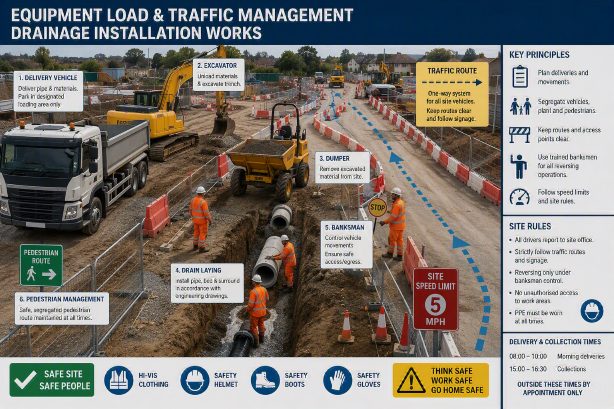
The single biggest driver of soil compaction on construction sites is uncontrolled equipment movement. Bulldozers, excavators, and haul trucks don’t distinguish between designated pathways and critical drainage zones unless you mark them clearly and enforce the boundaries.
Load-bearing capacity assessment and sequencing
Before any equipment arrives on site, conduct a load-bearing capacity assessment of your subgrade. This identifies which areas can withstand heavy loads and which need protection or rerouting. Construction sequencing then becomes your primary control tool: schedule excavation and compaction-sensitive work before heavy traffic phases, and protect finished subgrades with temporary matting or aggregate cover.
Designating haul routes before mobilisation saves weeks of remediation. Equipment operators need clear, marked pathways that avoid infiltration zones, future BMP locations, and areas where scarification would be impractical later.
Designated haul routes and traffic control
Mark haul routes with temporary fencing, painted lines, or signage. Enforce them consistently, one operator cutting across a protected zone can undo weeks of careful planning. Rotate haul routes periodically to distribute load-bearing stress across a wider area, reducing peak compaction in any single location.
For sites with tight constraints, consider temporary access roads built from aggregate or recycled asphalt. These distribute loads more evenly and can be removed and reused elsewhere on site.
Pro Tip
Assign one person on site as the “drainage protection lead” responsible for enforcing haul routes and flagging compaction risks daily. This single role prevents most infiltration problems before they happen.
Construction Dewatering Techniques for Infiltration Control
Dewatering, removing water that accumulates during excavation and construction, is essential for protecting both the work environment and infiltration systems. Poor dewatering practices introduce sediment into groundwater and surrounding infiltration zones.
Dewatering system design and pump selection
Dewatering system design depends on site hydrogeology, excavation depth, and the volume of water expected. A shallow 2-metre excavation in low-permeability soil requires different dewatering than a deep cut in sandy material with high groundwater.
Pump selection matters: submersible pumps work well for sump collection, while centrifugal pumps handle higher volumes. Filtration is critical, sediment-laden dewatering discharge damages receiving infiltration systems. Use settling tanks, sediment bags, or filter fabrics to remove particles before discharge.
Managing I&I (Inflow and Infiltration) in temporary systems
Inflow and Infiltration (I&I) in temporary dewatering systems occurs when surface runoff and groundwater both enter the sump simultaneously. During heavy rainfall, I&I can overwhelm your pump capacity, causing backup and flooding. Size your dewatering system for peak I&I conditions, not average conditions, and include redundancy, a backup pump or larger capacity sump, for safety.
Temporary systems should discharge to a sediment control device (sediment trap, sediment bag, or filter fabric) before entering the stormwater system or infiltration zone. Never discharge directly from the pump to the infiltration area.
Waterproofing Construction Methods and Subgrade Preparation
Subgrade preparation sets the foundation for long-term infiltration performance. Compacted, contaminated, or poorly prepared subgrades fail to accept water effectively, no matter how well-designed the BMP system above them.
Geotextile fabric specification and installation
Geotextile fabric serves two functions: it separates aggregate layers from soil, preventing fine particles from migrating downward, and it protects the subgrade from sediment clogging during construction. Specify geotextile with an appropriate opening size (typically 70-100 microns for infiltration applications) and install it before any aggregate is placed.
Installation quality matters. Wrinkled or improperly overlapped fabric allows sediment to bypass it. Overlap all seams by at least 30 centimetres and secure edges to prevent uplift during heavy rain.
Excavation depth and drainage layer design
Excavation depth determines the volume of aggregate storage available for infiltration. Deeper trenches hold more water but require more complex dewatering during construction. Design your excavation depth based on site constraints, soil permeability, and the design storm volume.
The drainage layer, the aggregate storage zone above the subgrade, should be sized to handle the 95th percentile rainfall event for your region. This typically means 300-500 millimetres of aggregate depth for most UK sites. Specify clean, washed aggregate (typically 20-40 millimetre stone) to maximise porosity and hydraulic conductivity.
Key Takeaway
Subgrade preparation is where infiltration performance is won or lost. A compacted, clean subgrade with properly installed geotextile and correctly sized aggregate layers will perform for decades. Shortcuts here cost multiples more in remediation later.
Stormwater Management Construction BMPs and Infiltration Design
Stormwater infiltration BMPs are designed to capture and percolate runoff, recharging groundwater and reducing flooding. Their effectiveness depends entirely on how well they’re constructed and protected during the build phase.
Infiltration trenches and French drain systems
Infiltration trenches are shallow, linear excavations filled with aggregate and designed to accept surface runoff. French drains are similar but often serve dual purposes, managing subsurface water and percolating surface runoff. Both rely on clean aggregate, proper geotextile installation, and undisturbed subgrades.
During construction, infiltration trenches and French drains are vulnerable to sediment clogging. Protect them with temporary caps, sediment fencing, or temporary covers until the site stabilises and final landscaping is complete. Never allow construction traffic to cross these zones.
BMP sizing based on hydraulic conductivity and site constraints
BMP sizing depends on the soil’s hydraulic conductivity, how quickly water percolates through it. Sandy soils with high hydraulic conductivity (2-5 inches per hour) require smaller BMPs. Clay-heavy soils with low hydraulic conductivity (0.1-0.5 inches per hour) need larger storage volumes or supplementary drainage systems.
Site constraints, bedrock depth, groundwater elevation, proximity to buildings, further limit BMP sizing. Work with a drainage designer early in the project to confirm that your site’s soil properties and constraints allow the infiltration strategy you’ve planned.
Moisture Control Construction Best Practices and Upland Stabilisation
Uncontrolled surface runoff during construction carries sediment, pollutants, and debris into infiltration zones. Upland stabilisation, protecting exposed soil and controlling runoff before it reaches your BMPs, is the first line of defence.
Erosion control and site runoff management
Erosion control measures include temporary seeding, erosion control matting, dust suppressants, and sediment fencing. These slow runoff velocity, allowing sediment to settle before water reaches your infiltration systems.
Site runoff management requires grading that directs water away from infiltration zones during construction. Use temporary swales, berms, or temporary sediment basins to intercept runoff and allow settling. Only after the site is stabilised should runoff be directed toward permanent infiltration systems.
Scarification and soil restoration after compaction
Scarification, ripping or tilling compacted soil to restore porosity, is often necessary after heavy construction traffic. Scarification works best when soil moisture is moderate (not saturated or bone-dry) and is most effective on sandy or silty soils. Clay-heavy soils may not respond well to scarification alone.
After scarification, allow 4-8 weeks for soil to settle and re-establish structure before final landscaping. In some cases, soil replacement is more cost-effective than scarification, particularly if the compacted zone is shallow or if the underlying soil has poor infiltration properties.
Common Infiltration Failure Modes and Real-Time Monitoring
Infiltration systems fail for predictable reasons: sediment clogging, compaction, hydrostatic pressure, and design inadequacy. Recognising these failure modes early allows intervention before the system stops functioning entirely.
Identifying bulk density increases and permeability loss
Bulk density increases signal soil compaction. A simple field test, driving a metal rod into the soil, reveals compacted zones quickly. Permeability loss is harder to spot visually but shows up as ponding, slower infiltration during rainfall, or water backing up into the BMP.
Conduct soil testing during construction to establish baseline permeability. Repeat testing after heavy traffic phases to quantify any loss. If permeability drops below design specifications, scarification or soil replacement may be necessary.
Real-time monitoring technologies for early detection
Modern construction sites increasingly use real-time monitoring to track infiltration performance. Soil moisture sensors, water level sensors in BMPs, and automated data logging systems provide early warning of problems.
A water level sensor in your infiltration trench alerts you if water is not draining as expected. Soil moisture sensors in the subgrade show whether water is actually percolating downward. These systems cost relatively little to install and can prevent expensive failures by triggering corrective action before problems become severe.
Pro Tip
Install one water level sensor in your primary infiltration zone during construction. If water level stays high 24-48 hours after rainfall, you have a clogging or permeability problem that needs immediate attention.
Cost-Benefit Analysis: Prevention versus Remediation
The economics of infiltration management are straightforward: prevention costs a fraction of remediation. A day of site supervision focused on haul route enforcement costs far less than excavating and replacing a clogged infiltration system after construction.
Preventive measures, temporary sediment control, geotextile protection, careful sequencing, typically add 2-5% to construction costs. Remediation, excavation, sediment removal, soil replacement, or system redesign, can add 15-30% and cause project delays measured in months.
The cost-benefit case for prevention is overwhelming. Invest in upfront protection, and your infiltration systems will function as designed for decades. Neglect prevention, and you’ll face emergency repairs and potential regulatory liability if flooding or groundwater contamination occurs.
Managing infiltration issues during construction requires coordination across equipment operations, dewatering, subgrade preparation, and real-time monitoring. The stakes are high: poor construction practices compromise infiltration performance permanently, creating liabilities that extend far beyond the build phase.
The Drainage Designers (Woodvale consulting Ltd) specialises in helping construction teams navigate these challenges. From site visits and drainage assessments to construction supervision and post-build testing, we ensure your infiltration systems are protected throughout the build process and function reliably afterward. Our nationwide expertise in both commercial and domestic projects means we’ve solved these problems across diverse soil types, site constraints, and climates.
Get in touch with The Drainage Designers (Woodvale consulting Ltd) to discuss how we can protect your infiltration systems during construction and deliver compliant, high-performing drainage that lasts.
| Infiltration Challenge | Preventive Strategy | Estimated Cost Impact |
|---|---|---|
| Soil compaction | Haul route designation, traffic control | +1-2% construction cost |
| Sediment clogging | Temporary protection, geotextile installation | +1-3% construction cost |
| Subgrade contamination | Erosion control, site stabilisation | +2-4% construction cost |
| Permeability loss | Scarification, soil restoration | +3-8% if required post-construction |
| System failure | Remediation, replacement | +15-30% and project delays |
EXTERNAL SOURCES:
According to the UK Environment Agency guidance on construction drainage, sediment control during construction is a legal requirement for projects affecting drainage systems.
Research from the CIRIA guide to sustainable drainage design demonstrates that soil compaction reduces infiltration capacity by 40-70% depending on soil type and equipment load.
The British Standards Institution guidance on geotextile specification specifies installation standards that prevent sediment bypass and protect subgrades during construction.
Frequently Asked Questions
What are the main causes of infiltration problems during construction?
Infiltration issues during construction stem primarily from soil compaction caused by heavy equipment traffic, which reduces soil porosity and hydraulic conductivity. Sediment clogging from erosion and site runoff can also block drainage layers and reduce infiltration capacity. Poor subgrade preparation, inadequate geotextile fabric placement, and failure to maintain upland stabilisation further compound these problems. Understanding these root causes helps site teams implement preventative measures before issues escalate.
How does construction sequencing help prevent infiltration failure?
Strategic construction sequencing minimises infiltration problems by scheduling activities in an order that protects sensitive drainage areas. Key practices include completing subgrade preparation and geotextile installation before heavy traffic phases, establishing designated haul routes early, and performing scarification or soil restoration after compaction-heavy work. Sequencing also allows teams to stabilise upland areas and implement erosion control before stormwater management systems become active, reducing sediment overloading and pollutant infiltration into drainage systems.
What role do Best Management Practices (BMPs) play in managing infiltration during construction?
BMPs are essential control measures that address stormwater management and infiltration design during construction. Infiltration trenches, French drains, and sediment control devices are sized based on site constraints, hydraulic conductivity, and expected runoff volumes. Properly designed BMPs prevent sediment clogging, manage site runoff effectively, and maintain infiltration rate performance. BMPs also reduce pollutant overloading of groundwater and drainage systems, protecting both the construction site and surrounding environments whilst meeting local authority and Lead Local Flood Authority requirements.
How can real-time monitoring improve infiltration management on construction sites?
Real-time monitoring technologies track bulk density changes, soil porosity, and infiltration rate performance throughout the construction phase. Sensors can detect early signs of soil compaction, sediment clogging, or permeability loss before they become critical failures. This data allows site supervisors to adjust equipment traffic patterns, trigger remediation like scarification, or modify drainage system operation promptly. Early detection significantly reduces remediation costs and prevents delays caused by infiltration failures that might otherwise require extensive mitigation strategies.
What is the cost-benefit case for preventing infiltration problems rather than fixing them later?
Prevention is substantially more cost-effective than remediation. Preventative measures such as load-bearing capacity planning, designated haul routes, and proper subgrade preparation require upfront investment but avoid expensive later-stage repairs. Remediation, including scarification, soil restoration, and potential system redesign, disrupts construction schedules and increases labour and material costs significantly. Sites that implement infiltration prevention strategies typically see faster project completion, reduced rework, and lower overall drainage system costs, making prevention a sound investment in project success.
What construction dewatering techniques are most effective for managing infiltration?
Effective dewatering techniques depend on site conditions and groundwater levels. Pump-and-treat systems manage I&I (Inflow and Infiltration) by controlling temporary water accumulation during excavation. Sump pits with appropriate hydraulic capacity prevent water from saturating infiltration areas. Proper dewatering system design must account for site constraints, soil permeability, and expected inflow rates. Coordinating dewatering with construction sequencing ensures that infiltration areas remain dry enough for compaction control and BMP installation, preventing hydrostatic pressure issues that can compromise infiltration performance.
How do I identify and prevent soil compaction in infiltration areas?
Prevent soil compaction by assessing load-bearing capacity before construction begins and establishing restricted-access zones around infiltration areas. Designate specific haul routes away from sensitive drainage zones and enforce traffic control strictly. Monitor bulk density changes using field testing; if compaction occurs, schedule scarification and soil restoration promptly to restore porosity and hydraulic conductivity. Upland stabilisation techniques and erosion control measures also reduce compaction risk by minimising heavy equipment movement across infiltration zones during rain events or when soils are saturated.