
Water Pooling Near Foundations: Impact & Solutions
Understanding the Impact of Water Pooling on Foundations
Water pooling near your foundation is far more serious than a cosmetic problem. Standing water exerts constant pressure on foundation walls and floor slabs, creating cracks, leaks, and structural movement that can cost tens of thousands of pounds to repair. This guide explains what happens when water accumulates around your foundation, why it occurs, and the solutions that actually work.
Pro Tip
The first sign of trouble is often subtle: slight efflorescence (white salt deposits) on basement walls or a faint musty smell. Don’t wait for visible cracks. Early intervention prevents structural damage and keeps repair costs manageable.
How Hydrostatic Pressure Damages Structural Integrity
Hydrostatic pressure is the force exerted by water pressing against your foundation from all sides. When soil becomes saturated, this pressure increases dramatically. A single cubic metre of water weighs 1,000 kilogrammes, and when that water sits against your foundation wall for weeks or months, the accumulated force can crack concrete and push walls inward.
Concrete is porous. Even “waterproofed” concrete allows moisture to migrate through capillary action. When hydrostatic pressure is applied, water penetrates faster and reaches deeper into the structure. Foundation settling accelerates as water erodes the soil beneath your slab.
Watch Out
Ignoring hydrostatic pressure is expensive. Structural engineers report that foundations exposed to chronic water pooling can settle by 25-50 millimetres within 5-10 years, triggering cascading damage to walls, windows, and floors.
Foundation Settling and Soil Erosion Risks
Water doesn’t just sit still; it flows through soil, carrying fine particles downward and sideways. Over time, this removes the structural support beneath your foundation. When soil beneath your slab becomes saturated, it loses bearing capacity and compresses unevenly, causing differential settlement that creates diagonal cracks, sticking doors and windows, and structural misalignment.
Soil type matters enormously. Clay soils, common across much of the UK, retain water far longer than sandy soils. If your property is built on clay, water pooling creates an especially dangerous situation because clay holds water like a sponge, maintaining hydrostatic pressure for months after heavy rain.
Identifying Foundation Water Damage Signs
Visible cracks and leaks in basement or crawl space are the most obvious warning signs. However, many property owners miss earlier indicators that reveal water pooling damage before it becomes structural.
Start by inspecting your basement walls and floor. Look for hairline cracks running vertically (pressure cracks), diagonal cracks radiating from corners (settlement cracks), horizontal cracks (extremely serious, indicates bowing walls), water staining or tide marks on the concrete, damp patches that appear after rain, and pooling water in the basement floor corner.
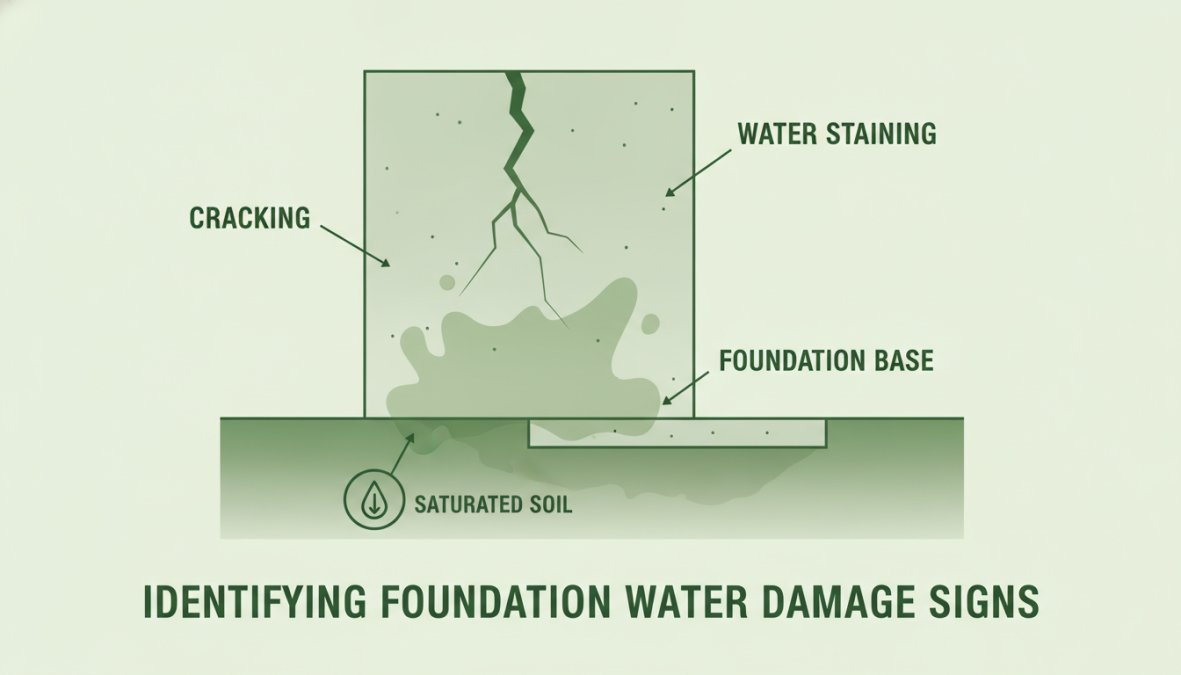
Efflorescence is a white, chalky deposit on your basement walls, indicating that your moisture barrier is failing and water is actively penetrating your foundation. In crawl spaces, look for standing water, soggy soil, and mould growth on wooden joists. Check your gutters and downspouts next. Blocked gutters allow water to pour directly down your external walls. Downspouts that terminate within 1.5 metres of your foundation dump water right where it pools.
Key Takeaway
The most important early warning sign is moisture on your basement walls after rain. If water appears within 48 hours of rainfall, your foundation drainage is failing and needs immediate attention.
Why Standing Water Occurs: Common Causes
Poor grading is the number one cause of water pooling near foundations. Proper grading slopes downward at least 1 in 20 (a 50 millimetre drop per metre of distance) for at least 2 metres away from your foundation. Most older properties don’t meet this standard, and over time, soil settles and compacts, flattening the slope.
Gutter and downspout failures are equally common. Blocked gutters cause water to overflow and pour down your walls. Downspouts that terminate too close to the foundation create localised flooding. Soil saturation and water table issues create a more persistent problem in areas with naturally high groundwater or poor drainage soil.
French drains and subsurface drainage systems fail when they become blocked or when the soil around them becomes compacted. Landscape design mistakes often make the problem worse, planting beds against your foundation trap water, mulch holds moisture and prevents evaporation, and paving that slopes toward your house directs water toward your walls.
How to Fix Water Pooling Around Your Foundation
Fixing water pooling requires a systematic approach. Start with the simplest, lowest-cost solutions. If those don’t resolve the problem, move to more complex subsurface drainage systems.
Step 1: Correct Soil Grading and Slope Away from the House
Measure the slope around your house using a long level and measuring tape. Place the level on the soil surface 1 metre from your foundation and measure the vertical drop over a horizontal distance of 1 metre. You need at least 50 millimetres of drop per metre (1 in 20 slope).
If the slope is flat or slopes toward your foundation, add topsoil or clay to build up the grade. Compact it gently in layers. The slope should extend at least 2 metres from your foundation. This simple fix costs very little and solves water pooling problems in many cases.
Step 2: Extend Downspouts and Maintain Gutters
Downspouts should terminate at least 1.5 to 2 metres away from your foundation. Install gutter guards to prevent leaf accumulation and clean gutters twice yearly. Check that gutters slope toward downspouts and replace any sagging sections. Use rigid or flexible extensions that carry water away from your foundation.
Step 3: Install Subsurface Drainage Systems
When grading and gutter maintenance don’t fully resolve water pooling, subsurface drainage becomes necessary. French drains intercept groundwater and direct it away from your foundation. A French drain is a trench filled with gravel and a perforated pipe, typically installed at the foundation perimeter.
Curtain drains are shallow trenches dug uphill from your property to intercept surface water before it reaches your foundation. Sump pump systems collect water in a sump pit and pump it away from your foundation, essential in areas with high water tables. The choice between these systems depends on your specific situation.
Professional Drainage Solutions for Foundations
When DIY solutions don’t work, professional drainage design becomes essential. French drains designed by professionals include critical details that DIY installations often miss: pipe slope, gravel type, filter fabric, and outlet location all affect performance. A professional French drain system typically includes a perforated pipe surrounded by coarse gravel, wrapped in filter fabric to prevent sediment clogging, sloping toward an outlet at a minimum gradient of 1 in 100.
Waterproofing membranes protect your foundation walls from moisture penetration. Modern membranes are synthetic and highly effective when properly installed. Landscape design for water management integrates drainage into your overall property plan. A swale is a shallow, vegetated channel that collects and slowly filters surface water.
Sump pump systems require careful design. The pump must be sized for your property’s water accumulation rate, the discharge line must extend far enough from your foundation to prevent water from pooling again, and the system should include a check valve and battery backup.
Pro Tip
Professional drainage design includes compliance with the Local Authority and Lead Local Flood Authority requirements. This is especially important if your property is in a flood risk area or if you’re planning significant construction work.
Cost-Benefit Analysis: Foundation Repair Investment
The cost of fixing water pooling varies depending on the solution. Grading correction might cost a few hundred pounds. A comprehensive subsurface drainage system with sump pump can cost several thousand pounds. However, the cost of NOT fixing water pooling is far higher. Structural repairs triggered by foundation damage can cost £20,000 to £50,000 or more.
Early intervention protects property value. A property with a dry basement and no foundation cracks is worth significantly more than one with water damage. A £3,000 investment in a French drain system prevents £30,000 in structural repairs.
| Solution | Estimated Cost | Installation Time | Effectiveness | Best For |
|---|---|---|---|---|
| Grading correction | £500-£1,500 | 2-3 days | High for surface water | Properties with poor slope |
| Gutter cleaning and extension | £200-£800 | 1 day | High for gutter overflow | Downspout termination issues |
| Interior French drain | £4,000-£8,000 | 5-7 days | High for basement water | Existing homes with water intrusion |
| Exterior French drain | £3,000-£6,000 | 5-7 days | High for groundwater | New construction or major renovation |
| Sump pump system | £2,000-£4,000 | 2-3 days | High for high water table | Persistent groundwater issues |
| Waterproofing membrane | £2,000-£5,000 | 3-5 days | High for moisture penetration | Foundation walls with efflorescence |
Seasonal Maintenance: Preventing Water Pooling Year-Round
Spring maintenance is critical. After winter, inspect your property for damage, clear gutters of debris, verify that grading hasn’t settled, and look for new cracks. Spring is the ideal time to install or repair drainage systems before the rainy season intensifies.
Summer is the time for landscape adjustments. Trim tree roots that may affect your drainage system and remove mulch pushed against your foundation. Autumn requires thorough gutter cleaning after leaves have fallen to prevent winter ice dams. Winter monitoring is important, check your basement for water intrusion after heavy snow melt or rain.
Year-round, maintain proper grading. Soil compacts and settles over time, flattening the slope. Every 2-3 years, add fresh topsoil to maintain the proper slope away from your foundation.
When to Call a Professional: Assessing Drainage Issues
Call a professional if you observe horizontal cracks in your foundation, water pooling in your basement after every rainfall, efflorescence or salt deposits on basement walls, visible mould or mildew in crawl spaces, foundation walls that appear to be bowing inward, doors or windows that stick or won’t close properly, or cracks that are growing.
A structural engineer can assess whether your foundation has suffered permanent damage. A drainage specialist can design a system tailored to your property’s soil type, water table, and topography. For properties in flood risk areas or those with complex drainage challenges, professional design is essential.
Water pooling near your foundation is a solvable problem when addressed early and systematically. Start with grading and gutter maintenance. If water persists, invest in professional drainage design. The Drainage Designers (Woodvale consulting Ltd) offers nationwide expertise in foundation drainage, from site assessment through to council approvals and installation oversight. Contact The Drainage Designers (Woodvale consulting Ltd) today to schedule a site visit and receive a tailored drainage solution that protects your property’s structural integrity and long-term value.
UK Building Regulations Part C Site Preparation and Resistance to Moisture
Lead Local Flood Authority guidance on residential drainage
Royal Institution of Chartered Surveyors foundation assessment standards
Frequently Asked Questions
What happens if water pools around your foundation?
Water pooling near foundations creates hydrostatic pressure that forces moisture through cracks and pores in concrete and masonry. This leads to basement leaks, foundation settling, soil erosion beneath the slab, and structural movement. Over time, standing water can cause foundation cracks to widen, compromise the moisture barrier, and create conditions for mold growth in crawl spaces. Early intervention prevents costly repairs and protects your property value.
What are the main signs of foundation water damage?
Common foundation water damage signs include visible cracks in basement walls or floors, persistent moisture or leaks, efflorescence (white mineral deposits on concrete), musty odours in crawl spaces, and bowing or leaning walls. You may also notice peeling paint, rust stains, or a damp smell near the foundation perimeter. If soil saturation is severe, the ground may remain wet long after rainfall, indicating poor drainage and a rising water table around your home.
How much does it cost to fix foundation water damage?
Foundation repair costs vary widely depending on the damage severity, soil type, and chosen solution. Simple fixes like extending downspouts or grading correction are relatively affordable, whilst installing French drains, weeping tiles, or professional waterproofing membranes requires greater investment. Early detection through seasonal maintenance and prompt drainage system installation typically costs less than addressing advanced structural damage. Request a site assessment to understand your specific needs and investment required.
Can I fix water pooling issues myself, or do I need a professional?
Minor improvements like gutter cleaning, downspout extensions, and grading adjustments can be DIY projects. However, subsurface drainage systems such as French drains, curtain drains, and sump pump installation require professional expertise to ensure proper slope, soil compatibility, and local council compliance. A structural engineer should assess foundation cracks and water intrusion before attempting repairs. Professional drainage design ensures your solution accounts for regional soil types, water table conditions, and long-term property protection.