
Permeable paving vs traditional drainage: UK comparison
Table of Contents
- Permeable paving vs traditional drainage: what’s the difference?
- Key benefits: permeable paving and traditional drainage compared
- Sustainable Drainage Systems (SuDS) UK and permeable paving
- UK planning permission for permeable paving: what you need to know
- Permeable driveway cost UK: capital expenditure and whole life costs
- Permeable paving maintenance: long-term performance and failure rates
- Professional installation vs DIY: which approach suits your project?
- Conclusion
Last Updated: July 28, 2026
Permeable paving vs traditional drainage: what’s the difference?
Understanding permeable paving vs traditional drainage systems is essential when managing surface water on your property. Both prevent flooding and manage runoff, but work in fundamentally different ways. Traditional drainage relies on impermeable surfaces and linear systems to channel water away. Permeable paving lets water soak through the surface into specially designed sub-bases below.
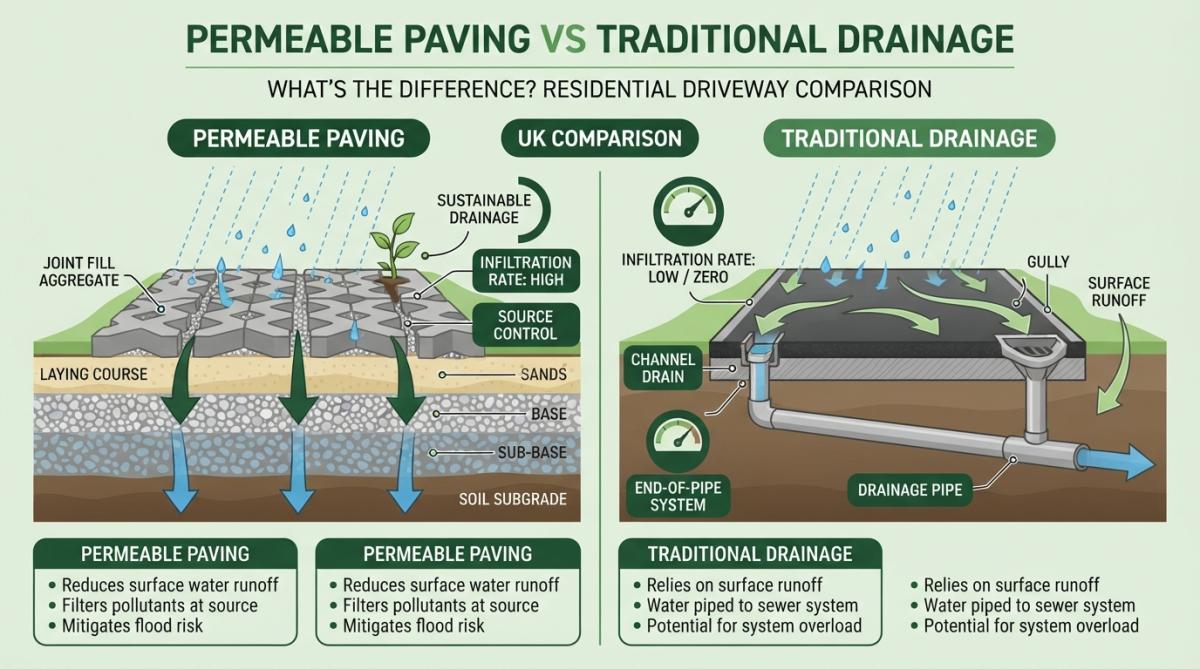
How permeable paving works
Permeable paving systems use specially designed blocks with nibs, small raised edges, that create gaps between each unit. Water flows through these gaps into permeable jointing material, then down through a carefully calculated sub-base layer of aggregates that allow water to infiltrate slowly into the ground or be stored temporarily for gradual release.
The entire system relies on hydraulic conductivity, the ability of materials to allow water to pass through them. Products like Marshalls Priora and Brett Omega Flow achieve this through their nib design, offering superior drainage performance. Permeable paving enables groundwater recharge, replenishing aquifers and reducing strain on municipal drainage networks, aligning with Sustainable Drainage Systems (SuDS) principles promoted by the Environment Agency across the UK.
How traditional drainage systems work
Traditional drainage systems move water away from the surface as quickly as possible through linear channels, gullies, and pipes that direct runoff toward a main drain or soakaway. Concrete, tarmac, and standard impermeable paving shed water entirely, creating high volumes of rapid run-off that can overwhelm local authority drains during heavy rainfall, contributing to surface water flooding.
Traditional drainage doesn’t recharge groundwater. Every drop of rain is moved away rather than absorbed, placing increasing pressure on already-stretched municipal systems, particularly during intense rainfall events becoming more common across the UK.
Key benefits: permeable paving and traditional drainage compared
Flood prevention and surface water management
Both systems prevent flooding through different mechanisms. Permeable paving reduces flood risk by slowing water movement and allowing infiltration, reducing the peak volume entering drainage systems during heavy rain. Research into SuDS effectiveness shows that permeable surfaces significantly reduce both the volume and velocity of run-off, meaning less strain on local authority systems and lower risk of backing up into properties.
Traditional systems work immediately and don’t depend on infiltration rates or ground conditions. In areas with poor drainage soil or high water tables, traditional drainage remains the more reliable choice.
Environmental impact and sustainability
Permeable paving demonstrates clear environmental advantages. By allowing water to infiltrate, these systems reduce pollutant issues associated with traditional run-off. When water flows rapidly across impermeable surfaces, it picks up oil, sediment, heavy metals, and other contaminants. Permeable paving naturally filters these through the sub-base, improving water quality before it reaches aquifers.
Groundwater recharge is another environmental win. Permeable systems replenish water tables depleted by urban development and climate change. The carbon footprint consideration is nuanced. Permeable paving blocks often require more manufacturing than standard paving, but products made from recycled materials like Wavin AquaCell Eco, manufactured from 100% recycled polypropylene, offset this advantage.
Sustainable Drainage Systems (SuDS) UK and permeable paving
The UK planning system now actively encourages SuDS, a hierarchy of approaches that prioritises infiltration first, then attenuation, then discharge to watercourses, and finally discharge to sewers. Permeable paving sits at the top of this hierarchy because it infiltrates water on-site.
Local authorities and the Environment Agency expect new developments to incorporate SuDS principles. For homeowners, permeable paving is increasingly the preferred option from a regulatory standpoint. Many councils now require SuDS designs as a condition of planning approval. The Lead Local Flood Authority in your area has specific guidance on acceptable drainage approaches. In most cases, permeable paving meets these requirements without requiring additional justification.
Before committing to either system, contact your Local Authority’s drainage team to understand their specific SuDS requirements. Some areas have published guidance that makes one approach clearly preferred over the other.
UK planning permission for permeable paving: what you need to know
When planning permission is not required
Permeable paving for driveways typically doesn’t require planning permission under permitted development rights, provided it meets specific criteria. If you’re replacing an existing driveway with permeable blocks and the area is under 5 square metres, or creating a new driveway with permeable paving on a property without an existing one, planning permission is usually not needed. The critical requirement is that the permeable system must be properly designed and installed to meet SuDS standards.
When you must seek approval
Planning permission becomes necessary when permeable paving forms part of a larger development, affects the character of a conservation area, or when local authority guidance specifically requires it. If your property sits in a flood risk area (Flood Zones 2 or 3), the Environment Agency may require a Flood Risk Assessment before approving any drainage solution.
Permeable driveway cost UK: capital expenditure and whole life costs
Installation and material costs
Permeable paving costs more upfront than traditional impermeable paving. The additional cost reflects the sub-base engineering required. A permeable system demands a properly calculated aggregate sub-base, often 150-200mm deep, with geotextile layers to prevent sedimentation and maintain hydraulic conductivity.
Initial cost is higher for permeable paving, but whole life costs often favour it because maintenance is simpler and you avoid potential flooding damage to your property.
Long-term cost considerations
Whole life costs tell a different story. Traditional drainage systems require regular maintenance, clearing blocked gullies, jet-cleaning pipes, and replacing damaged channels. Permeable paving, once properly installed, needs routine sweeping to prevent sedimentation blocking the joints, but major repairs are rare.
The real financial advantage emerges when flooding occurs. A single flood event can cost tens of thousands in property damage, temporary accommodation, and remedial work. Properties with permeable paving systems experience significantly lower flood risk. Maintenance failure rates for traditional systems increase over time. After 10-15 years, pipes may crack, subsidence can affect gradients, and sediment accumulation reduces capacity. Permeable systems, if installed correctly, maintain consistent performance because they don’t rely on pipes or complex infrastructure that degrades.
Permeable paving maintenance: long-term performance and failure rates
Routine maintenance requirements
Permeable paving requires less maintenance than traditional drainage, but it isn’t maintenance-free. The primary task is preventing sedimentation, fine particles blocking the joints and reducing infiltration capacity. Routine maintenance involves sweeping the surface quarterly to remove debris and sediment, pressure washing annually to clear accumulated dirt, checking for black ice formation in winter, and inspecting the perimeter for erosion or subsidence.
These tasks take a few hours per year and can be managed by the property owner without specialist equipment. Traditional drainage requires professional drain cleaning every 3-5 years, costing significantly more.
Common maintenance failures and how to prevent them
The most common failure mode for permeable paving is sedimentation blocking the joints. Prevention is straightforward: maintain a regular sweeping schedule. Quarterly sweeping prevents sedimentation from becoming a problem. If sedimentation does occur, pressure washing can restore infiltration.
Subsidence is another potential issue, though less common with permeable systems than traditional ones. Choosing a qualified installer like The Drainage Designers (Woodvale consulting Ltd), who provide comprehensive site visits and design oversight, minimises this risk. Properly installed permeable paving systems maintain functionality for 20+ years with routine maintenance.
Professional installation vs DIY: which approach suits your project?
When professional design and installation is essential
For any permeable paving project larger than a small patio, professional design is essential. The sub-base calculation depends on rainfall intensity, infiltration rates, and ground conditions specific to your site. Professional installers have access to site investigation data, soil testing, water table assessments, and ground permeability measurements that DIY approaches can’t replicate. They also understand local authority requirements and can navigate planning permission nuances.
For commercial projects or properties in flood risk areas, professional design is non-negotiable. The Drainage Designers (Woodvale consulting Ltd) provides site visits, flood risk assessments, and council liaison to ensure designs meet Local Authority and Lead Local Flood Authority requirements.
Regional climate suitability and ground conditions
Permeable paving works best in areas with good drainage soil, chalk, sandy loam, or well-draining clay. In regions with heavy clay or high water tables, infiltration rates may be too slow, and water could sit in the sub-base, creating wet conditions and potential subsidence.
The UK’s regional variations matter. Southeast England, with chalk and sandy soils, is ideal for permeable paving. Parts of the Midlands and North, with heavier clay, may require hybrid approaches, permeable paving with attenuation (temporary storage) rather than full infiltration. Professional site assessment determines whether permeable paving is suitable for your specific location. If ground conditions are poor, alternatives like geocellular attenuation (Wavin AquaCell Eco systems) can be combined with permeable paving to achieve SuDS compliance without relying on infiltration alone.
Conclusion
Permeable paving vs traditional drainage isn’t a simple choice. It depends on your property’s location, ground conditions, budget, and regulatory environment. Permeable paving offers environmental benefits, lower long-term maintenance, better flood prevention, and increasing planning favour. Traditional drainage provides immediate, reliable water removal and works in challenging ground conditions.
For most UK properties, permeable paving is the strategic choice because it aligns with SuDS principles, reduces flooding risk, and delivers better whole life value. However, ground conditions and local authority requirements sometimes make traditional drainage the only viable option.
The Drainage Designers (Woodvale consulting Ltd) provides site visits, flood risk assessments, and design expertise tailored to your property’s specific conditions and your local council’s requirements. Our team simplifies the planning process and delivers compliant drainage systems designed to keep your project on schedule. Get in touch with The Drainage Designers (Woodvale consulting Ltd) to discuss your drainage needs and find the solution that works for your property.
| System | Annual Maintenance | Flood Prevention | Environmental Impact | Planning Ease |
|---|---|---|---|---|
| Permeable Paving | Sweeping, annual wash | Excellent | Excellent (infiltration, recharge) | Usually not required |
| Traditional Drainage | Pipe cleaning, gully clearing | Good | Moderate (rapid discharge) | Often required |
| Hybrid (Permeable + Attenuation) | Moderate | Excellent | Very good | Depends on design |
Supporting Research & Sources
Understanding the landscape of permeable paving vs traditional drainage in the UK requires reference to current guidance and proven products. According to Environment Agency guidance on Sustainable Drainage Systems, permeable surfaces are the preferred approach in the SuDS hierarchy because they infiltrate water on-site and reduce strain on municipal systems.
Product performance data comes from manufacturers with proven track records. Marshalls Priora permeable paving technical specification demonstrates that modern permeable blocks achieve the structural performance of traditional paving whilst delivering superior drainage. Similarly, Wavin AquaCell Eco geocellular systems provide evidence that modular attenuation systems can complement permeable paving in challenging ground conditions.
For property owners navigating planning requirements, guidance from your Local Authority’s drainage team and the Lead Local Flood Authority is essential. The specific requirements vary by region, but the principle remains consistent: SuDS-compliant solutions are increasingly expected in new developments and major renovations across the UK.
Frequently Asked Questions
What is the main difference between permeable paving and traditional drainage?
Permeable paving allows water to infiltrate through the surface into a specially prepared sub-base, where it is filtered and recharges groundwater. Traditional drainage systems use impermeable surfaces with linear channels or underground pipes to collect and convey surface water away from the site. Permeable paving reduces run-off and flood risk at source, whilst traditional systems manage water after it has already accumulated on the surface.
Do I need planning permission for permeable paving on my UK driveway?
In most cases, permeable paving for residential driveways does not require planning permission, provided it complies with SuDS guidance and your Local Authority's requirements. However, if your property is in a conservation area, a listed building, or subject to specific flood risk conditions, you may need to seek approval from your Local Authority or Lead Local Flood Authority. It is essential to check with your council before commencing work to avoid delays or enforcement action.
Is permeable paving more expensive than traditional drainage in the UK?
Permeable paving typically has a higher upfront capital expenditure than standard impermeable paving, often 15-30% more. However, whole life costs may be comparable or lower because permeable systems can reduce the need for additional linear drainage infrastructure and may require fewer repairs over time. The exact cost depends on ground conditions, sub-base specification, material choice, and site complexity. Contact a drainage specialist for a detailed cost comparison relevant to your project.
What maintenance does permeable paving require compared to traditional drainage?
Permeable paving requires regular maintenance to remain effective. Key tasks include clearing debris from the surface and joints to prevent sedimentation and blockages, typically 2-4 times per year depending on local conditions. Traditional drainage systems require periodic inspection and cleaning of channels and pipes. Permeable systems may require occasional pressure washing or specialist cleaning if infiltration rates decline. Proper maintenance prevents hydrostatic pressure build-up and extends the lifespan of both systems.
How does permeable paving fit within Sustainable Drainage Systems (SuDS) requirements in the UK?
Permeable paving is a key component of SuDS, designed to manage surface water at source through infiltration and pollutant filtration. It reduces peak run-off, supports groundwater recharge, and improves water quality by allowing sediment and contaminants to settle in the sub-base before water reaches the water table. Many UK Local Authorities now require SuDS compliance for new developments and major renovations. Permeable paving helps developers and homeowners meet these regulations whilst reducing flood risk and environmental impact.
This article was written using GrandRanker