
Best Soakaway Crates for Residential: 2026 Guide
Table of Contents
- What Are Soakaway Crates and How Do They Work?
- Top Soakaway Crates for Residential Applications
- 1. Wavin AquaCell Eco – best for non-trafficked gardens
- 2. ACO StormBrixx – best for driveways and patios
- 3. Graf EcoBloc Inspect Flex – best for inspectable systems
- 4. Polypipe Permavoid – best for shallow installations
- 5. JDP RAINBOX 3SR – best for light vehicular traffic
- 6. Envirocrate 100L – best for limited excavation depth
- Soakaway Crates Capacity: Sizing Your System Correctly
- Soakaway Crates Installation: Step-by-Step Process
- Soakaway Regulations UK: Building Control and SuDS Compliance
- Soakaway Crates Reviews: What Homeowners Report
- DIY vs. Professional Installation: Cost-Benefit Analysis
- Environmental Impact and Sustainability Benefits
Best Soakaway Crates for Residential: 2026 Guide
Last Updated: July 31, 2026
What Are Soakaway Crates and How Do They Work?
Soakaway crates are geocellular storage units made from recycled polypropylene that sit underground to capture and infiltrate surface water runoff. Rather than overwhelming your drainage system, these modular boxes create underground reservoirs where rainfall percolates slowly into surrounding soil. Each crate holds between 100 and 400 litres depending on the model, and you can stack multiple units to handle larger catchment areas.
A well-designed system works invisibly for decades, reducing flood risk whilst supporting sustainable drainage principles that local authorities now require for most new residential developments. A poorly sized or installed system fails silently, water backs up during heavy rain, and you face costly remedial work.
Infiltration vs. attenuation explained
Infiltration means water soaks directly into the ground through the crate’s base and sides. This only works if your soil has adequate permeability; sandy or gravelly soils drain quickly, whilst clay soils drain poorly. You must carry out a soil percolation test to establish drainage speed at your specific site before committing to an infiltration-only system.
Attenuation temporarily stores water during heavy rainfall, then releases it slowly over hours or days as soil gradually absorbs it. This approach works in almost any soil type because it doesn’t depend on rapid percolation. Many modern residential projects use hybrid systems combining both principles, maximising flexibility across varying soil types.
Why modular design matters for residential projects
Modular crates have transformed residential drainage. Rather than pouring concrete tanks on site, you assemble lightweight plastic modules by hand. A single person can move most crates, and assembly happens in hours rather than days. You pay only for the storage capacity you need, and you can expand the system later without excavating the original installation.
Top Soakaway Crates for Residential Applications
1. Wavin AquaCell Eco, best for non-trafficked gardens
The Wavin AquaCell Eco is purpose-built for garden applications where vehicular traffic isn’t a concern. Each unit stores 195.5 litres and is manufactured from recycled polypropylene. Installation requires minimal site preparation: excavate a trench, lay a geotextile membrane, position the crates, and backfill with topsoil. BBA approval confirms it meets UK technical standards for stormwater management.
The AquaCell Eco is not load-bearing, so it cannot be used beneath driveways or patios. The system requires complementary components including geotextile membrane and pipe fittings, which increase total project cost.
2. ACO StormBrixx, best for driveways and patios
The ACO StormBrixx is engineered for trafficked areas where load-bearing capacity matters. Its brick-bonded stacking design and cross-bracing create a rigid structure that supports vehicles, whilst the 95-97% void ratio maximises water storage within a compact footprint. The open cell structure allows access for maintenance and high-pressure jetting if sediment accumulates.
The system requires careful design; you need side panels and top covers for a complete installation. For a driveway project, budget for professional design input to ensure correct sizing and specification.
3. Graf EcoBloc Inspect Flex, best for inspectable systems
The Graf EcoBloc Inspect Flex combines high load-bearing capacity (60 tonnes) with integrated inspection channels that simplify maintenance. At 205 litres per module, it delivers substantial storage without excessive excavation depth. The integrated channel allows you to inspect and jet the entire installation from a single location, significantly reducing long-term maintenance effort.
The EcoBloc is made from 100% recycled material and holds BBA Agrément certification. Contact suppliers for exact pricing on this model.
4. Polypipe Permavoid, best for shallow installations
Polypipe Permavoid is engineered for sites where excavation depth is limited. Its 95% void ratio allows maximum water storage in shallow depths, and the system forms a rigid structural raft capable of supporting significant loads. The design incorporates up to 90% recycled polypropylene and can integrate biomats for pollution control.
Permavoid is primarily designed for shallow applications, typically under 1.5 metres. If your site requires deeper storage, alternative systems may be more practical.
5. JDP RAINBOX 3SR, best for light vehicular traffic
The RAINBOX 3SR is purpose-designed for residential driveways and landscaped areas experiencing light to moderate vehicular traffic up to 30 tonnes Gross Vehicle Weight. At 287 litres per crate, it offers substantial storage capacity. The crate is supplied flat-packed and assembled on site, minimising transport costs. The 95% void ratio ensures efficient water storage, and the system is inspectable and jettable for ongoing maintenance.
Installations in trafficked areas require a structural design check prior to installation. Work with a drainage designer or structural engineer to confirm correct design for your specific driveway loading and soil conditions.
6. Envirocrate 100L, best for limited excavation depth
The Envirocrate 100L is a low-profile shallow soakaway crate designed for sites where deep excavation is impractical. At 100 litres per unit, storage capacity is modest, but the shallow profile makes installation straightforward in constrained locations.
Lower capacity means you need more units to handle larger catchment areas. For a substantial driveway or large roof area, this crate alone will not suffice.
Soakaway Crates Capacity: Sizing Your System Correctly
Undersizing your soakaway system is a common and costly mistake. A system that works during light rain fails catastrophically during heavy downpours. Proper sizing requires understanding three key factors: void ratio, soil percolation rate, and catchment area.
Understanding void ratio and storage volume
Void ratio is the percentage of the crate’s total volume that can actually store water. Most modern crates achieve 90-97% void ratios, meaning a 200-litre crate stores approximately 180-194 litres of water. The remaining volume is occupied by the plastic structure itself.
This distinction matters for sizing calculations. If you calculate your required storage volume as 1,000 litres, you must divide by the actual storage capacity, typically around 190 litres per crate, which means you need six crates to achieve your target storage. Always use the actual storage volume figure when sizing your system.
Soil percolation testing for your site
Before finalising your soakaway design, you must understand how quickly water drains through your specific soil. A percolation test establishes this rate by measuring how fast water level drops in a test pit over a defined period.
Soils vary dramatically; sandy soils may drain 50mm per hour, whilst clay soils may drain only 5mm per hour. This 10-fold difference fundamentally changes your design approach. If your soil percolates slowly, you cannot rely on infiltration alone and need attenuation capacity to store water temporarily.
For any residential project requiring planning approval, a percolation test is essential. Local authorities increasingly demand evidence of percolation testing before approving drainage designs.
Calculating soakaway volume from catchment area
Your catchment area is the surface that drains into the soakaway, typically your roof, driveway, patio, and any other impermeable surfaces. Multiply the roof area by the annual rainfall for your location. UK residential areas receive between 600mm and 1,200mm of rainfall annually.
Building regulations typically require storage for a 1-in-100 year rainfall event. For most UK locations, this translates to a 40-50mm rainfall event. For a 150m² roof in a 40mm event, you need to store approximately 6,000 litres. Dividing by the actual crate storage capacity (typically 190 litres) gives you about 32 crates.
A drainage designer uses detailed calculations incorporating your specific location, catchment area, soil percolation rate, and local authority requirements to determine the exact system size. This professional input prevents undersizing and the flooding that follows.
Soakaway Crates Installation: Step-by-Step Process
Correct installation is as critical as correct sizing. A well-designed system installed poorly will fail.
Pre-installation requirements and site preparation
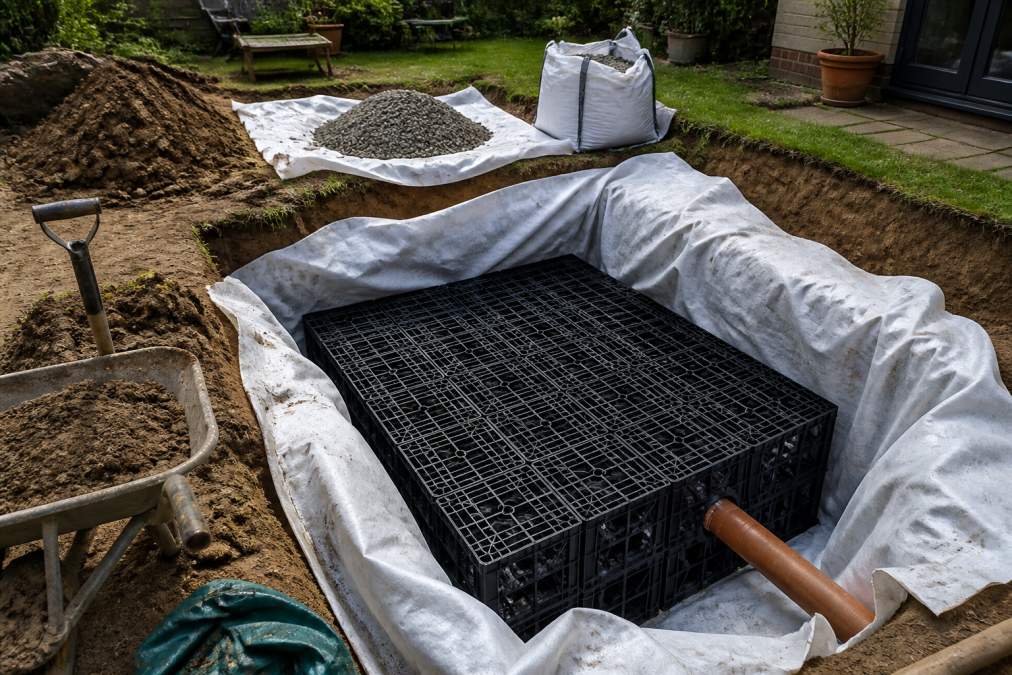
Mark out the excavation area based on your design drawings, ensuring the system sits at least 1 metre away from building foundations and at least 10 metres from any watercourse or public sewer. Excavate the trench to the specified depth. The base must be level; sloping bases cause uneven water distribution and compromise system performance.
Remove any rocks, roots, or debris from the trench base that might puncture the geotextile membrane. Inspect the trench base for compaction; loose soil beneath the crates can settle over time, causing crates to shift.
Geotextile membrane and backfill best practice
Lay a geotextile membrane across the entire base and sides of the excavation. This membrane prevents soil particles from washing into the crate’s void spaces and distributes backfill pressure evenly. The membrane must be continuous and overlap at seams by at least 300mm.
Position your crates according to the design layout and interconnect them as specified. Backfill gradually in 150-200mm layers, compacting each layer lightly with a hand tamper. Avoid driving excavators or dumpers directly over the installation. Use clean, stone-free soil or sand for backfill to prevent puncturing the geotextile or damaging crate walls.
As you backfill, fold the geotextile membrane up the sides, ensuring it covers the entire crate system. Once backfilling is complete, the membrane should extend above the final crate level, creating a barrier between the crates and the overlying soil or surface.
Common installation failures and how to avoid them
The most frequent failure is undersizing. The second most common is poor geotextile installation; if the membrane is torn during backfill, soil infiltrates the crate void spaces, reducing storage capacity by 10-30% within a few years.
Inadequate compaction of backfill material causes loose backfill to settle over months, creating voids above the crates. Incorrect connection to inflow and outflow pipes is another frequent issue; pipes must connect at the correct level and angle. Finally, many installations fail because they lack proper maintenance access. Inspection chambers must be positioned where they’re actually accessible, not buried under a patio or hidden behind a garden shed.
Soakaway Regulations UK: Building Control and SuDS Compliance
Residential soakaway systems are increasingly mandatory for new builds and major extensions under UK building regulations and sustainable drainage systems (SuDS) policy. Building Regulations Part H requires that surface water from new buildings be managed sustainably, typically through infiltration into the ground via soakaways or temporary storage in attenuation systems.
Your local authority and Lead Local Flood Authority enforce these requirements through the planning and building control process. Before you excavate, you need approval from both bodies. A professional drainage designer familiar with your specific local authority’s requirements can navigate these demands efficiently, avoiding rejections and costly redesigns.
SuDS compliance is particularly important if your property is in a flood risk area. Lead Local Flood Authorities increasingly require soakaway systems to incorporate silt traps and pollution control measures, particularly if the catchment area includes parking or vehicle movement.
Soakaway Crates Reviews: What Homeowners Report
In sandy and gravelly soils, infiltration-only systems perform exceptionally well. Water drains rapidly, crates empty within hours of rainfall, and systems remain trouble-free for years. In clay soils, attenuation systems are essential; homeowners who attempted infiltration-only systems in clay areas report failures, with water remaining in the crates for days or weeks after rain.
Long-term durability is generally excellent. Crates installed 10-15 years ago continue to perform reliably, with minimal maintenance. The primary maintenance task is clearing debris from inspection chambers and, occasionally, high-pressure jetting if sediment accumulates. Failure cases typically involve undersizing or poor installation, both of which are preventable through correct design and careful installation.
DIY vs. Professional Installation: Cost-Benefit Analysis
DIY installation is feasible for small, straightforward systems in accessible locations with good soil conditions. However, DIY becomes problematic when systems are larger, soil conditions are poor, or the installation is in a trafficked area.
Sizing calculations require understanding rainfall statistics, catchment area measurement, soil percolation rates, and building regulation requirements. Errors in these calculations are expensive; an undersized system that fails during a storm costs thousands to remediate.
Professional installation includes site assessment, percolation testing, design calculations, building regulation compliance verification, and installation supervision. A drainage designer ensures your system is correctly sized for your specific site and complies with local authority requirements. When to hire a professional: if your project requires planning approval, if soil conditions are uncertain, if the system is large or complex, or if you’re installing in a trafficked area. The Drainage Designers (Woodvale consulting Ltd) provides site visits and design services for exactly these scenarios, ensuring your system is correctly engineered before installation begins.
Environmental Impact and Sustainability Benefits
Soakaway systems deliver genuine environmental benefits beyond flood risk reduction. By infiltrating water into the ground, they recharge groundwater aquifers that supply drinking water to millions of UK residents. By reducing discharge to public sewers, they decrease the load on wastewater treatment plants, reducing energy consumption and chemical treatment requirements.
Most modern soakaway crates are manufactured from recycled polypropylene, converting waste plastic into functional infrastructure. Soakaway systems also support biodiversity by maintaining groundwater levels and reducing peak flows in watercourses. From a climate resilience perspective, soakaway systems are increasingly essential as UK rainfall patterns become more extreme.
| Soakaway Crate Model | Storage per Unit | Best Application | Load Rating | Key Feature |
|---|---|---|---|---|
| Wavin AquaCell Eco | 195.5L | Garden, non-trafficked | Pedestrian only | Recycled material, BBA approved |
| ACO StormBrixx | 200-250L (est.) | Driveways, patios | Vehicular | Inspectable, high void ratio |
| Graf EcoBloc Inspect Flex | 205L | Trafficked areas | 60 tonnes | Integrated inspection channel |
| Polypipe Permavoid | 180-200L (est.) | Shallow sites | High load | 95% void, shallow depth |
| JDP RAINBOX 3SR | 287L | Driveway, light traffic | 30 tonnes GVW | Flat-pack, cost-effective |
| Envirocrate 100L | 100L | Limited depth | Pedestrian | Shallow profile, compact |
Conclusion
Selecting the best soakaway crates for residential applications requires balancing capacity, soil conditions, installation constraints, and regulatory compliance. A system that works perfectly in one location may fail in another if soil conditions differ or if sizing calculations don’t account for actual catchment area.
The complexity of these decisions, percolation testing, design calculations, building regulation compliance, and soil-specific engineering, is exactly why professional drainage design adds measurable value. The Drainage Designers (Woodvale consulting Ltd) specialises in site assessment, system design, and regulatory navigation for residential drainage projects across the UK. From initial site visits to final building control approvals, our team ensures your soakaway system is correctly engineered, compliant, and built to perform reliably for decades. Get in touch with The Drainage Designers (Woodvale consulting Ltd) today to discuss your residential drainage requirements and receive expert guidance tailored to your specific site conditions.
Frequently Asked Questions
What are the UK regulations for residential soakaways?
Residential soakaway systems must comply with Building Regulations and sustainable drainage systems (SuDS) guidance from your Local Authority and Lead Local Flood Authority. Most systems require a percolation test to confirm soil infiltration rates. For new builds or extensions, you will typically need planning approval and building control sign-off. Your Local Authority may have specific requirements for depth, distance from boundaries, or geotextile membrane use. Professional drainage design ensures compliance and avoids costly rejections.
How do I calculate the correct soakaway crates capacity for my home?
Soakaway capacity depends on three factors: your roof and paved surface catchment area (in square metres), rainfall intensity for your region, and soil percolation rate. A soil percolation test determines how quickly water drains through your ground. Most residential systems use the formula: Volume (cubic metres) = Catchment Area x Rainfall Depth / Infiltration Rate. Individual crate storage volumes range from 100 to 400 litres. You will typically need multiple crates combined to meet design requirements. A drainage specialist can calculate the exact number needed for your site.
What is the difference between soakaway crates and traditional rubble soakaways?
Traditional rubble soakaways use loose stone or aggregate in an excavated pit, offering poor structural integrity and inconsistent void ratios. Modern soakaway crates are modular, rigid geocellular systems with 95+ per cent void ratio, delivering predictable storage volume and load-bearing capacity. Crates are easier to inspect, maintain via jetting, and comply with modern SuDS standards. They offer better hydraulic performance, require less excavation space, and provide reliable long-term performance. For residential applications, crates are the preferred solution for planning approval.
Can I install a soakaway crate system myself, or should I hire a professional?
Simple non-trafficked systems in suitable soil may be installed by experienced DIYers, but most residential projects require professional design and installation. You must obtain planning approval and building control sign-off, which require certified drainage design. Soil percolation testing, depth calculations, and geotextile membrane specification need expert assessment. Incorrect installation causes flooding, planning rejection, or structural failure. Professional installation also ensures warranty compliance and future maintenance access. For extensions or new builds, hiring a drainage specialist is strongly recommended to avoid costly mistakes.
What is a geotextile membrane and why is it used with soakaway crates?
A geotextile membrane is a permeable fabric layer placed above and around soakaway crates. It prevents fine soil particles (silt) from entering the crate void spaces, which would reduce storage capacity and cause system failure over time. The membrane allows water to pass through while filtering contaminants and sediment. Most residential installations require geotextile wrapping for long-term hydraulic performance and compliance with Building Regulations. It is particularly important in clay or silty soils where infiltration is slow. Professional design specifies the correct membrane grade for your soil type and drainage requirements.
This article was written using GrandRanker