Top-Rated Drainage Consultancy Firms for UK Architects
Table of Contents
- What Architects and Developers Should Expect from Top Drainage Consultancy Firms
- Key Services Offered by Leading Drainage Consultants
- Drainage Strategy for Planning Permission: How Consultants Help
- SuDS Compliance for Developers: Meeting Local Authority Standards
- Evaluating Drainage Consultancy Firms: What Sets the Top-Rated Apart
- How to Choose the Right Drainage Design Partner for Your Project
- Conclusion: Secure Your Planning Approval with the Right Expertise
- Frequently Asked Questions
Last Updated: September 6, 2026
What Architects and Developers Should Expect from Top Drainage Consultancy Firms
For architects and property developers, drainage is rarely the most glamorous part of a project, yet it is frequently the reason planning applications stall or fail. A drainage consultancy firm provides the technical design, flood risk analysis, and compliance documentation needed to satisfy local planning authorities.
The best drainage consultancy firms do more than draw pipe runs. They act as a bridge between your architectural vision and the regulatory requirements set by local councils and Lead Local Flood Authorities. They identify constraints early, propose sustainable solutions, and produce the reports that planning officers expect to see. Without this input, projects face costly delays, conditions attached to consent, or outright refusal on drainage grounds.
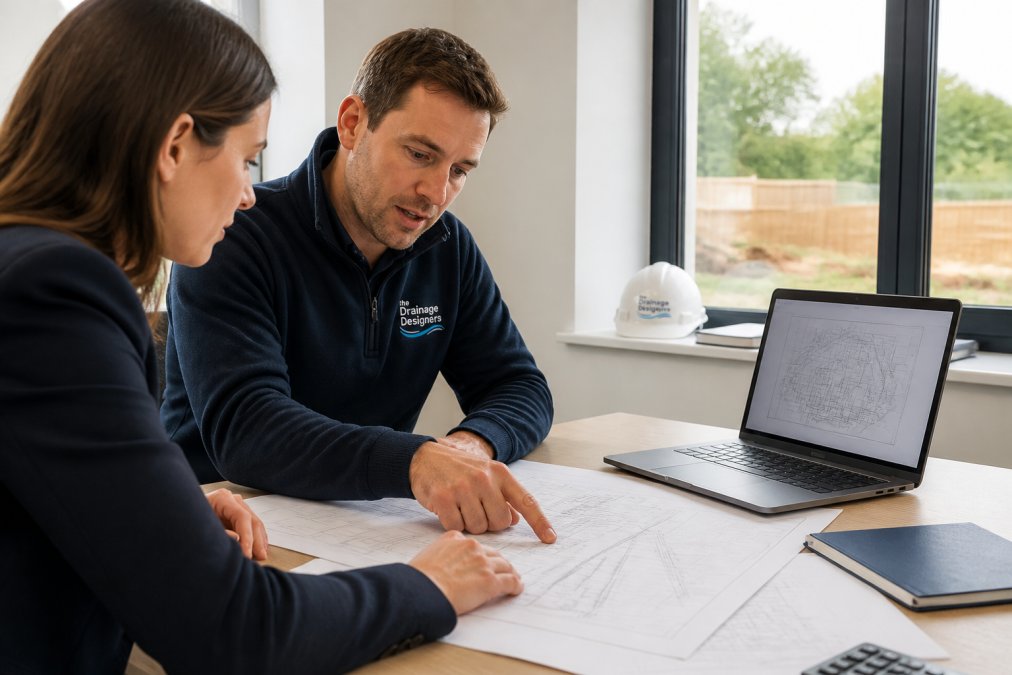
What separates a genuinely top-rated drainage consultancy from the rest comes down to three things: depth of technical knowledge, familiarity with local authority expectations, and the ability to communicate complex engineering in plain language. Architects need documentation that supports the design intent. Developers need certainty on timelines and costs. A strong consultant delivers both.
Key Services Offered by Leading Drainage Consultants
Leading drainage consultancy firms offer a comprehensive service that begins before detailed design work starts. The scope typically covers site appraisal, drainage strategy production, flood risk assessment, SuDS design, and liaison with statutory consultees. Each service feeds into the planning submission, creating a complete evidence pack for the local authority.
Site Visits and Feasibility Studies
A site visit is the foundation of any reliable drainage design. Consultants inspect ground conditions, identify existing drainage infrastructure, check for watercourses or ponds, and assess topography. This informs whether infiltration techniques will work or whether attenuation and pumped solutions are necessary. Feasibility studies then test these findings against the proposed development layout, flagging potential issues before significant design fees are spent.
Flood Risk Assessment Requirements Explained
Flood risk assessment requirements vary depending on site location, size, and the flood zone designation set out in the National Planning Policy Framework. A flood risk assessment must demonstrate that the development is safe from flooding, does not increase flood risk elsewhere, and where possible reduces flood risk overall (gov.uk). For sites in flood zones 2 or 3, or those exceeding one hectare, the assessment becomes more detailed and must accompany the planning application (gov.uk). Consultants prepare these documents to the standard expected by the Environment Agency and the local planning authority.
Drainage Strategy for Planning Permission: How Consultants Help
A drainage strategy for planning permission is the document that shows how surface water and foul water will be managed on site. Planning officers use it to check that the proposed system is feasible, sustainable, and compliant with local policy. Many drainage consultancy firms produce this as a standalone report early in the design process, which helps architects refine layouts before submitting a full application.
The strategy typically covers the drainage hierarchy, starting with infiltration and moving through attenuation, discharge to watercourses, and finally connection to public sewers (gov.uk). It demonstrates how the design meets the sequential approach to surface water management and includes calculations for storm events, including climate change allowances. For brownfield sites, it also addresses any existing contamination or drainage constraints that could complicate development.
Delays often occur when a drainage strategy is submitted late in the process or fails to align with the SuDS requirements of the local authority. Engaging a consultant at concept stage avoids this. They assess the site early, recommend the most viable discharge method, and ensure the design integrates cleanly with the architectural and highways drawings.
SuDS Compliance for Developers: Meeting Local Authority Standards
Sustainable Drainage Systems, or SuDS, are no longer an optional extra in most parts of the UK. SuDS compliance for developers is now a standard condition of planning permission across many local authorities, and getting it wrong leads to refusal or onerous conditions. SuDS aim to manage surface water as close to its source as possible, using techniques that mimic natural drainage rather than routing everything into sewers.
Common SuDS features include permeable paving, rain gardens, swales, detention basins, and underground attenuation tanks. The chosen approach depends on ground conditions, site area, and the capacity of the receiving watercourse or sewer. A drainage consultancy firm assesses which combination of features will meet the local authority’s standards while remaining practical to build and maintain.
The maintenance aspect is where many developers get caught out. Local authorities increasingly require a management plan demonstrating who will maintain the SuDS features for the lifetime of the development. Consultants prepare these plans, covering inspection schedules, maintenance activities, and responsible parties. This removes a common reason for planning conditions being applied.
| Drainage Service | When It’s Needed | Main Benefit |
|---|---|---|
| Site visit and feasibility study | Pre-design stage | Identifies constraints before design costs escalate |
| Flood risk assessment | Sites in flood zones or over one hectare | Satisfies planning policy requirements |
| Drainage strategy | All planning applications | Demonstrates compliant surface water management |
| SuDS design and management plan | Where local policy requires sustainable drainage | Avoids planning conditions and delays |
Evaluating Drainage Consultancy Firms: What Sets the Top-Rated Apart
Choosing between drainage consultancy firms requires looking beyond the headline services. The top-rated firms share characteristics that make them reliable partners through the full planning cycle. They understand that architects and developers operate under commercial pressure, and they structure their work accordingly.
Experience with Local Councils and Lead Local Flood Authorities
Firms with established relationships across multiple local authorities anticipate what each council will request. Requirements differ noticeably between regions, and a consultant who knows the specific expectations of your local planning team will produce a submission that clears the first review. This local knowledge also helps when conditions are attached to consent, as the consultancy can negotiate practical amendments rather than accepting unreasonable requirements.
Turnaround Times and Project Timeline Management
Planning timelines are rarely flexible. A drainage consultant who delivers a flood risk assessment in six weeks when your application deadline sits at four is not a viable partner. Firms state their turnaround times clearly and commit to them in writing. They also flag early where a site condition, such as a high water table or restricted sewer access, might require additional investigation that extends the programme.
How to Choose the Right Drainage Design Partner for Your Project
Start by asking prospective drainage consultancy firms about their experience with projects similar to yours. A practice that handles large commercial schemes may not suit a single residential extension, and vice versa. Ask how many applications they have submitted to your specific local authority and what the outcome was. Request examples of drainage strategies and flood risk assessments they have prepared for comparable developments.
Look for transparency in how they charge and what the fee covers. The clearest arrangement is a fixed fee for a defined scope, with any additional work agreed in advance. This protects small practices from surprise costs and gives developers confidence when budgeting. The Drainage Designers (Woodvale consulting Ltd) operates on a transparent and ethical customer charter, ensuring clients understand exactly what they are paying for and what they will receive.
Finally, check whether the consultant will remain available after the planning decision. Conditions on drainage approval often require revised drawings or additional technical information. A partner who stays engaged through to discharge of conditions is considerably more valuable than one who disappears once the application is submitted.
Conclusion: Secure Your Planning Approval with the Right Expertise
Drainage is a technical discipline where mistakes are expensive. The right drainage consultancy firms save architects and developers time, money, and the frustration of rejected applications. They translate complex regulations into clear, buildable designs and manage the relationship with local authorities on your behalf.
The Drainage Designers (Woodvale consulting Ltd) provides nationwide drainage design services for homeowners, architects, and developers across the UK. From the first site visit through flood risk assessments to final council approvals, our team manages the entire process with precision. We handle both commercial and domestic projects, ensuring compliance with Local Authority and Lead Local Flood Authority requirements while keeping your project on schedule.
Frequently Asked Questions
What does a drainage consultant do for property developers?
A drainage consultant ensures your development meets all the necessary regulations for planning permission. They prepare the drainage strategy, conduct flood risk assessments, and design compliant SuDS features. Their role is to navigate the technical requirements of the Local Authority and Lead Local Flood Authority, providing the necessary documentation to maximise the chance of your plans being approved first time.
Why is a flood risk assessment required for planning permission?
A flood risk assessment is required to demonstrate that your development will be safe from flooding and will not increase flood risk elsewhere. It is a key part of the planning application for many sites. Top-rated drainage consultancy firms prepare these assessments to satisfy the requirements of the Local Planning Authority and the Environment Agency, covering sources such as rivers, surface water, and groundwater.
How do drainage consultants assist with SuDS compliance?
SuDS compliance for developers is now a standard requirement for most new developments. A drainage consultant designs Sustainable Drainage Systems that manage surface water runoff on-site, reducing pressure on public sewers. They ensure your design meets the mandatory standards for water quality, quantity, and biodiversity, creating a system that is both compliant and practical for your site.
When should a drainage consultant be appointed in the design process?
You should appoint a drainage consultant early, ideally before the initial design is finalised. Bringing them in at concept stage allows them to identify potential constraints, such as ground conditions or flood zones, that could affect the layout. This proactive approach ensures the drainage strategy for planning permission is integrated into the design from the start, preventing costly revisions and delays later.
Securing planning permission depends on getting the technical details right, and drainage is often the detail that trips projects up. Working with a consultancy that understands both the engineering and the local authority landscape makes the difference between a smooth approval and a protracted battle. Get in touch with The Drainage Designers (Woodvale consulting Ltd) to discuss your project and see how our approach simplifies the drainage design process from start to finish.