
How to Discharge Pre-Commencement Drainage Conditions
Table of Contents
- What Are Pre-Commencement Drainage Conditions?
- Why You Cannot Start Work Until Conditions Are Discharged
- Preparing Your Planning Condition Discharge Application
- Developing a Drainage Strategy for Planning Permission
- Submitting Surface Water Drainage Details to Your Local Authority
- Understanding Planning Condition Approval Timescales
- What Happens If a Drainage Condition Is Not Discharged
- Conclusion
- Frequently Asked Questions
Last Updated: October 10, 2026
What Are Pre-Commencement Drainage Conditions?
Understanding how to discharge pre-commencement drainage conditions in the UK is essential, as these are requirements imposed by your local planning authority that must be satisfied before you start any building work on your development. They require you to submit and gain written approval for specific drainage details, demonstrating that your design meets building regulations, environmental standards, and flood risk requirements. Without formal discharge, starting work is a breach of your planning permission.
Pre-commencement conditions are particularly common for drainage because water management directly affects neighbouring properties, local infrastructure, and flood risk. Your drainage strategy must be proven safe and compliant before construction begins.
Pre-commencement conditions are not optional delays, they’re legal requirements. The local authority must formally approve your drainage details in writing before your first digger arrives on site.
Why You Cannot Start Work Until Conditions Are Discharged
Starting work before discharging a pre-commencement drainage condition is a material breach of your planning permission. The local planning authority can issue an enforcement notice requiring you to stop work immediately, halting your entire project.
Breaching conditions also creates liability issues. If your drainage fails and causes flooding or damage to neighbouring properties, you have no formal approval to defend your design. Insurance companies often refuse claims when work proceeded without proper condition discharge, and your building control approval may be questioned.
Discharging conditions early prevents costly rework. If you’ve already laid pipes or constructed drainage features, modifications become expensive and disruptive. Doing this properly upfront saves weeks of delays.
Building before discharge is not just a technicality, it’s grounds for enforcement action, potential fines, and uninsurable liability if drainage fails. The cost of getting it right first is always less than fixing breaches later.
Preparing Your Planning Condition Discharge Application
Your application must demonstrate that your drainage design meets all technical requirements. Most drainage conditions require detailed drainage drawings, calculations proving the system handles design storm events, evidence of consultation with water authorities or Lead Local Flood Authorities, surface water management details, and foul drainage connection details. Check your planning decision notice carefully; the condition wording tells you exactly what the local authority expects.
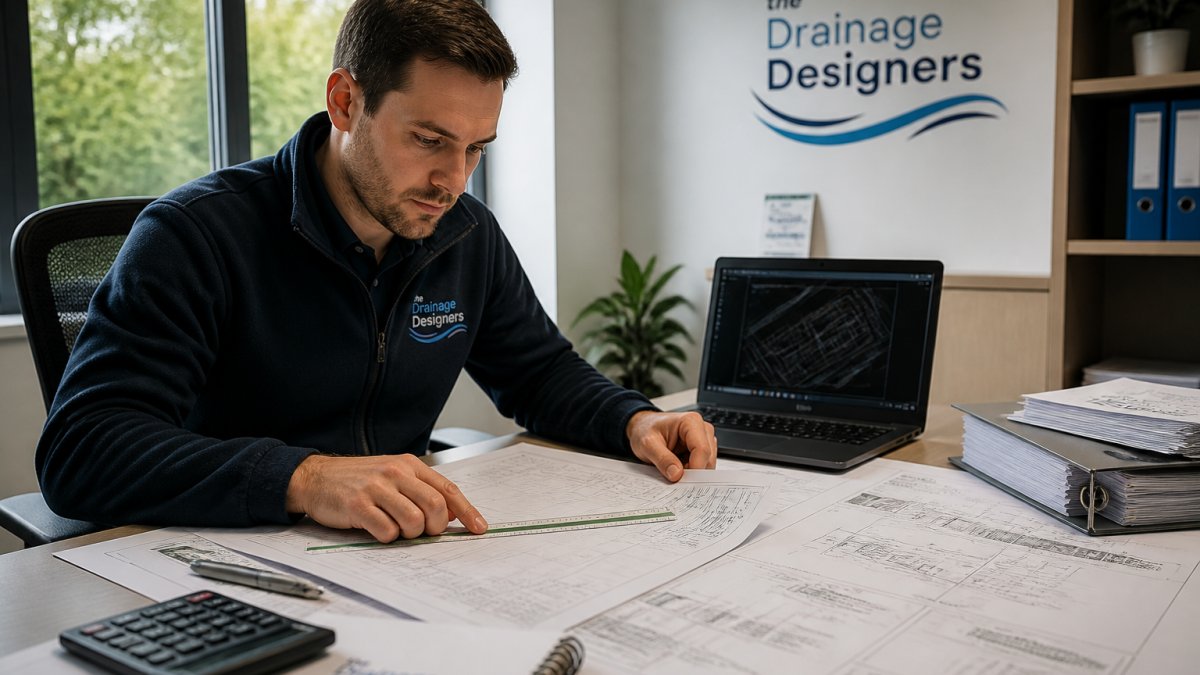
Organise drawings, calculations, and consultation responses into a clear submission package. Most local authorities have online portals for uploads. Common mistakes include submitting incomplete calculations, missing consultation responses, or providing drawings that don’t match the planning permission. Double-check every document against your condition wording before submission.
Your condition discharge application succeeds when every requirement in the condition wording is addressed with supporting technical evidence. Incomplete submissions get rejected and restart the clock.
Developing a Drainage Strategy for Planning Permission
Your drainage strategy must address surface water, foul drainage, and flood risk holistically. Surface water drainage typically requires sustainable drainage systems (SuDS) unless site conditions prevent them, including attenuation, infiltration, or controlled discharge to watercourses. Foul drainage connects either to public sewers or a treatment system like a septic tank, with water companies confirming connection feasibility.
Flood risk assessment sits at the heart of your strategy. The Environment Agency or Lead Local Flood Authority determines whether your site is at risk and what mitigation you need. Your strategy must also address maintenance and long-term operation, outlining who maintains the system and how often. Every site presents different challenges: ground permeability, nearby watercourses, neighbouring properties, and local authority preferences all shape the strategy.
Submitting Surface Water Drainage Details to Your Local Authority
Surface water drainage details are the most frequently scrutinised part of condition discharge applications. Your submission must include site plans, calculations proving your system handles the 1-in-100-year rainfall event (plus climate change allowance), infiltration testing details if applicable, maintenance schedules, and evidence that sustainable drainage systems (SuDS) principles have been applied.
Understanding the consultee review process
Your local planning authority will consult the Lead Local Flood Authority (LLFA), which reviews surface water management strategy, attenuation calculations, and maintenance arrangements. If discharging to a public sewer or watercourse, the water and sewerage company (or Environment Agency for main rivers) must approve your submission, checking that your discharge rate does not overload their network.
Infiltration testing and what consultees expect
Infiltration testing is often required and is one of the most common reasons for application delays. Trial pits must be dug to at least 1 metre depth, filled with water, and monitored to measure how quickly the water level drops.
Attenuation storage calculations
Attenuation calculations must model rainfall intensity, calculate site runoff, and size storage volume to contain the peak runoff from a 1-in-100-year storm event. You must provide a clear summary of assumptions, inputs, and results. Consultees often request clarification on rainfall intensity assumptions, runoff coefficients, climate change allowance, storage volume calculations, and discharge rates.
Responding to consultee comments
When consultees submit comments, you have typically 10-15 working days to provide revised drawings, calculations, or clarifications. Common comments request infiltration testing, revised attenuation calculations, discharge rate constraints, or maintenance schedules. Responding promptly and thoroughly is critical; vague or incomplete responses trigger further requests and extend timescales. If you cannot meet a consultee’s requirement, propose an alternative and resubmit for reconsultation.
Common reasons for rejection or delay
The most frequent issues that cause rejection or delay are infiltration testing not carried out, attenuation calculations missing or unjustified, no response to consultee comments, discharge rates not agreed, maintenance schedules missing, and SuDS principles not demonstrated. Submitting a complete, technically sound application with all consultee responses included first time significantly reduces delays.
Consultee comments are not rejections; they are requests for clarification or revision. Respond promptly with revised evidence, and most applications will be approved within 2-3 weeks of your response.
Understanding Planning Condition Approval Timescales
Local authorities have statutory timescales for determining condition discharge applications, but these are often misunderstood. The standard determination period is 8 weeks from a valid submission (all required documents present, application fee paid, application form complete). However, the clock does not start until the local authority has validated your submission.
Realistic end-to-end timescales
In practice, most drainage condition discharge applications take 12-16 weeks from initial submission to formal approval. Simple applications with straightforward drainage may be approved within 8-10 weeks. Complex applications involving multiple consultees, infiltration testing, or flood risk assessment can take 16-20 weeks or longer.
The local planning authority will request further information if calculations are incomplete, infiltration testing has not been carried out, consultee comments have not been addressed, drawings do not match the planning permission, maintenance arrangements are unclear, or the drainage strategy does not comply with local authority SuDS guidance.
Consultee review runs in parallel with the local authority’s determination, but consultees often take the full 8 weeks (or longer) to respond. If a consultee raises objections or requests changes, the local authority will ask you to respond, adding time beyond the initial 8 weeks. A realistic timeline is 14-15 weeks, not 8 weeks.
Some local authorities operate faster-track procedures for straightforward applications. If your drainage design is simple, uncontroversial, and all consultees approve without comment, you might see approval within 6-8 weeks. Straightforward applications typically involve connection to public sewer, low flood risk sites, and simple surface water management.
If the local authority has not issued a decision within 8 weeks of a valid submission, contact the planning department and ask for a progress update.
The most effective way to reduce timescales is to submit a complete, technically sound application first time: ensure all documents are included, carry out infiltration testing before submission if required, provide clear justified calculations, obtain pre-submission feedback from the Lead Local Flood Authority or water company, and address likely consultee concerns in your initial submission.
Contact your local planning authority before submitting to ask whether pre-submission consultation with the Lead Local Flood Authority or water company is available. This can identify issues early and prevent delays during formal determination.
What Happens If a Drainage Condition Is Not Discharged
Failing to discharge a pre-commencement drainage condition creates escalating problems. The immediate risk is enforcement action from your local planning authority.
If the authority discovers work has started before condition discharge, they can serve an enforcement notice. This requires you to cease work and remedy the breach. Ignoring an enforcement notice is a criminal offence that can result in fines or prosecution. Even if you eventually discharge the condition, the breach remains on record and affects future planning applications on the same site.
Your building control approval may also be questioned. Building control inspectors verify that work complies with building regulations, but they assume compliance with planning conditions. If a drainage condition wasn’t discharged before work started, building control may refuse final sign-off until the breach is formally resolved. This prevents you obtaining a completion certificate, which complicates future conveyancing and mortgage arrangements.
Insurance implications are serious. If your drainage fails after work has proceeded without condition discharge, your buildings insurance and liability insurance may refuse claims. Insurers treat breaches of planning conditions as evidence of negligence or deliberate non-compliance. You’re left bearing the full cost of drainage failure and any damage to neighbouring properties.
Selling the property becomes difficult. Conveyancing solicitors identify undischarged conditions during searches. Buyers’ lenders typically refuse to lend on properties with breached planning conditions. You may need to retrospectively discharge the condition (if the local authority agrees) before sale, which is slower and more expensive than discharging prospectively.
Neighbouring properties affected by failed drainage have legal recourse against you. If your drainage causes flooding or damage, you’re liable for remedial costs and compensation. Without formal condition discharge, you have no defence that your design was approved by the local authority.
The cost of discharging conditions properly upfront is negligible compared to enforcement action, insurance disputes, conveyancing delays, and liability for drainage failure. Never skip this step.
Conclusion
Learning how to discharge pre-commencement drainage conditions in the UK is a legal requirement that protects your project, your neighbours, and the local environment. The process involves submitting technical evidence that your drainage design meets building regulations, flood risk standards, and local authority requirements. Completing this before work starts prevents enforcement action, insurance disputes, and costly delays.
The Drainage Designers (Woodvale consulting Ltd) simplifies this process with professional drainage design, site assessments, and condition discharge applications. We handle consultations with water authorities and flood risk assessments, ensuring your submission is complete and technically sound. Get in touch to discuss your drainage condition discharge and keep your project on schedule.
Frequently Asked Questions
What is a pre-commencement planning condition?
A pre-commencement planning condition is a requirement imposed by the local planning authority that must be satisfied before you can legally begin any work on site. For drainage, this typically means submitting and obtaining formal written approval of your drainage strategy, surface water management plans, or foul drainage arrangements. The decision notice will specify which conditions must be discharged before commencement and which can be dealt with later. Failing to discharge these conditions before starting work constitutes a breach of planning control.
What documents do I need to submit with a planning condition discharge application?
Your submission should include the completed discharge application form, a copy of the relevant condition from your decision notice, and all supporting technical documents. For drainage conditions, this typically includes drainage layout drawings, calculations showing infiltration rates or attenuation volumes, details of sustainable drainage systems (SuDS) if required, flood risk assessment findings, and any correspondence with water authorities or Lead Local Flood Authorities. Some authorities request a covering letter explaining how each aspect of the condition has been addressed. Check your local planning authority’s website for their specific requirements, as these vary.
How long does it take to discharge a planning condition?
Most local planning authorities have a statutory 8-week timescale to determine a discharge application, though this clock only starts when the application is valid and complete. In practice, drainage conditions often take 4 to 12 weeks depending on complexity, whether consultees (such as the water company or Lead Local Flood Authority) need to review your proposals, and how quickly you can respond to any requests for further information. Starting your application early and submitting comprehensive, well-prepared documentation can significantly reduce delays.
Can I start work before a drainage condition is discharged?
No. Starting work before a pre-commencement condition is discharged is a breach of planning control. Even if work is minor or preparatory, commencing any development activity before formal written approval from the local planning authority puts you at risk of enforcement action, including a stop notice, restoration orders, or fines. Always obtain written confirmation that the condition has been discharged before any site work begins, including demolition, groundworks, or deliveries of materials.