Water Quality Treatment – The SuDS Treatment Train
Why Water Quality is Central to SuDS Design
When most people think about drainage, the focus tends to be on managing the volume of water and preventing flooding. However, the CIRIA SuDS Manual places equal importance on water quality. Rainwater runoff from developed areas is rarely clean. As it flows across roofs, roads, and paved surfaces, it collects a range of pollutants including sediments, oils, heavy metals, nutrients, and debris. If left untreated, these contaminants are discharged into rivers, lakes, and groundwater, contributing to environmental degradation and potentially breaching regulatory standards.
The SuDS approach recognises that drainage systems must do more than simply move water. They must also improve its quality before it leaves the site. This is particularly important as environmental regulation becomes stricter and there is greater emphasis on protecting water bodies under frameworks such as the Water Framework Directive. Designing for water quality is therefore not an optional enhancement but a fundamental requirement of modern drainage practice.
Understanding the Treatment Train Concept
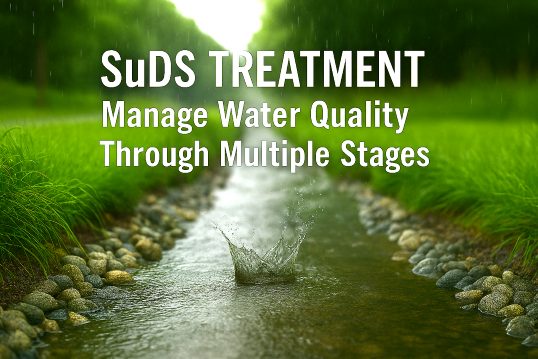
The CIRIA SuDS Manual introduces the concept of the treatment train as the primary method for managing water quality. Rather than relying on a single component to remove pollutants, the treatment train uses a sequence of stages, each providing incremental improvement. As water moves through the system, pollutants are gradually reduced through a combination of physical, chemical, and biological processes.
This approach mirrors natural systems, where water passing through soils, vegetation, and wetlands becomes progressively cleaner. In a SuDS scheme, each component in the train contributes in a different way. Early stages may remove coarse sediments and debris, while later stages target finer pollutants and dissolved contaminants. By spreading the treatment process across multiple features, the system becomes more effective and resilient.
An important advantage of this approach is that it reduces reliance on any single element. If one part of the system underperforms or requires maintenance, the remaining stages can still provide a level of treatment. This layered structure is particularly valuable in ensuring long-term performance.
Matching Treatment to Pollution Risk
Not all development sites generate the same type or level of pollution, and the SuDS Manual emphasises the importance of tailoring treatment accordingly. Land uses are typically categorised into different pollution hazard levels. For example, runoff from residential roofs is generally considered low risk, while runoff from busy roads or industrial sites may contain higher concentrations of contaminants such as hydrocarbons and metals.
The level of treatment required is determined by this risk profile. Lower-risk areas may only require one or two stages of treatment, whereas higher-risk sites will need a more comprehensive approach with multiple components working in sequence. This ensures that the system is neither over-designed nor underperforming, providing an efficient balance between cost and environmental protection.
Designers must therefore assess the characteristics of the site carefully, considering factors such as traffic levels, surface materials, and potential sources of contamination. This assessment informs the selection and arrangement of SuDS components within the treatment train.
Key Treatment Processes in SuDS
The effectiveness of the treatment train relies on a range of natural processes that occur within SuDS components. Sedimentation is one of the most important mechanisms, where particles settle out of the water as flow is slowed. This is particularly effective for removing coarse sediments and associated pollutants.
Filtration plays a significant role, especially in features such as permeable pavements, filter strips, and swales. As water passes through granular materials or vegetation, fine particles and pollutants are trapped and retained. Biological processes, including microbial activity and plant uptake, further improve water quality by breaking down or absorbing contaminants.
In systems that include permanent water bodies, such as attenuation ponds and wetlands, additional processes come into play. These include adsorption, where pollutants bind to sediments, and biological transformation, where harmful substances are converted into less harmful forms. The combination of these processes ensures a high level of treatment when systems are designed correctly.
The Role of Different SuDS Components in Treatment
Each SuDS component contributes differently to water quality improvement, and understanding these roles is key to designing an effective treatment train. Source control features such as green roofs and permeable paving provide initial treatment by reducing runoff volumes and filtering pollutants at the point of generation. These elements are particularly valuable because they prevent contamination from spreading through the system.
As water moves through the site, conveyance features such as swales and filter strips provide additional treatment. Their ability to slow flows and promote infiltration allows more time for pollutants to be removed. Storage features such as detention basins and attenuation ponds provide the final stages of treatment, where longer retention times enable finer particles to settle and biological processes to take effect.
By combining these elements, designers can create a system where each component builds on the performance of the previous one. This not only improves water quality but also enhances the overall efficiency of the drainage network.
Integrating Water Quality into Early Design
One of the key messages of the SuDS Manual is that water quality considerations should be integrated from the earliest stages of design. Too often, drainage strategies are developed late in the process with a primary focus on flow control, leaving limited opportunity to incorporate effective treatment measures.
By considering water quality early, designers can position SuDS components more strategically within the site layout. For example, placing permeable surfaces near pollution sources or routing runoff through vegetated areas before it reaches storage features can significantly improve performance. Early integration also makes it easier to align drainage with landscape design, creating systems that are both functional and visually appealing.
For architects and planners, this highlights the importance of collaboration with drainage engineers. Decisions about layout, levels, and land use can have a direct impact on the effectiveness of the treatment train, making early coordination essential.
Designing for Long-Term Performance
Water quality treatment is not a one-off consideration but an ongoing process that must be sustained over the life of the development. This means that SuDS systems must be designed with maintenance in mind. Sediments and pollutants will accumulate over time, and without regular maintenance, the effectiveness of the system can decline.
The treatment train approach supports long-term performance by distributing the load across multiple components. Early-stage features capture larger volumes of sediment, protecting downstream elements from excessive build-up. This makes maintenance more manageable and reduces the risk of system failure.
Clear maintenance plans, accessible design, and appropriate material selection all play a role in ensuring that systems continue to perform as intended. By addressing these factors during the design process, it is possible to create robust systems that deliver consistent water quality benefits over time.
Why the Treatment Train Matters
The treatment train is one of the most important concepts within the CIRIA SuDS Manual because it encapsulates the idea of integrated, multi-functional design. It ensures that water quality is addressed systematically rather than as an afterthought, and it provides a framework for combining different components into a cohesive system.
For designers, understanding this concept is essential to delivering compliant and effective drainage strategies. It also reinforces the broader SuDS philosophy of working with natural processes, using simple, distributed systems rather than relying on complex, centralised infrastructure.
Ultimately, the treatment train is what enables SuDS to protect water quality while also delivering benefits in terms of flood management, amenity, and biodiversity. It is a key part of what makes sustainable drainage both practical and environmentally responsible.