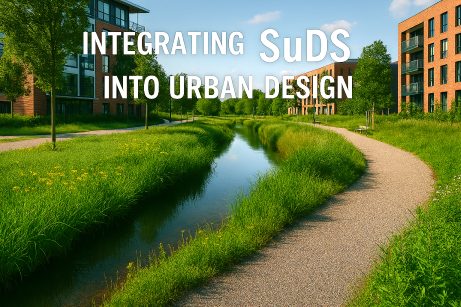
Integrating SuDS into Urban Design
Moving Beyond a Purely Engineering Approach
One of the most important messages within the CIRIA SuDS Manual is that drainage should not be treated as a separate engineering exercise that is added at the end of the design process. Instead, it should be considered a fundamental part of how a development is planned and experienced. Traditional approaches often resulted in drainage infrastructure being hidden underground or confined to leftover spaces, with little consideration for how it could contribute to the wider environment.
The SuDS approach challenges this mindset by encouraging designers to see water as an asset rather than a constraint. Surface water features can be visible, functional, and integral to the character of a place. This shift requires a move away from siloed working practices and towards a more collaborative design process, where drainage is considered alongside architecture, landscape design, and planning from the very beginning.
The Relationship Between SuDS and Placemaking
Placemaking is a key concept in modern development, focusing on creating environments that are attractive, functional, and meaningful for the people who use them. SuDS plays a significant role in this because it directly influences how space is shaped and used.
When integrated effectively, SuDS features such as swales, basins, ponds, and rain gardens can become defining elements of a development. Rather than being hidden, they can form part of green corridors, public open space, or streetscapes. This contributes to a more natural and visually appealing environment, helping developments feel less engineered and more connected to their surroundings.
In residential settings, for example, a detention basin can be designed as a park or recreational space that only fills during heavy rainfall. In urban environments, rain gardens can soften hard streets and introduce planting that improves both aesthetics and biodiversity. These features not only manage water but also enhance the quality of the built environment.
Designing Multi-Functional Spaces
A core principle of the SuDS Manual is that drainage features should deliver multiple benefits wherever possible. This is particularly important in urban areas, where space is often limited and every part of a site must work efficiently.
Multi-functional design means that SuDS features serve more than one purpose. A swale might convey water, provide habitat, and create a visual boundary within a development. A pond might attenuate runoff, support wildlife, and act as a focal point within a public space. Even permeable paving can contribute to both drainage and urban design by influencing surface character and detailing.
Achieving this requires careful consideration of layout, levels, and land use. It also requires an understanding of how people will interact with these spaces. Features must be designed so they are safe, accessible, and appropriate for their setting. When done well, multi-functional SuDS can add significant value without requiring additional land.
The Importance of Early Integration
One of the most common challenges in SuDS design is that it is often considered too late in the process. By the time drainage is addressed, the layout may already be fixed, leaving limited flexibility to incorporate effective surface-based solutions. This frequently results in a reliance on underground storage, which meets hydraulic requirements but fails to deliver wider benefits.
Early integration is therefore essential. At the concept stage, decisions about building positions, road layouts, and open space can be informed by how water will move through the site. This allows SuDS features to be incorporated naturally into the design rather than being forced into residual spaces.
For architects, this means engaging with drainage principles from the outset. Understanding where water will flow, where it can be stored, and how it can be used to enhance the design can lead to more coherent and efficient schemes. Early collaboration with engineers and landscape designers is key to achieving this.
Working Across Disciplines
Successful SuDS integration depends on collaboration between multiple disciplines. Engineers bring technical expertise in hydrology and drainage design, while architects and landscape designers contribute to spatial planning, aesthetics, and user experience. Planners provide the regulatory framework and ensure that developments meet policy requirements.
When these disciplines work together from the beginning, it becomes much easier to create solutions that satisfy all objectives. For example, an engineer might identify the need for a storage feature, while a landscape architect can design it as an attractive and usable space. Similarly, architects can adjust building layouts to accommodate drainage pathways, ensuring that water flows naturally through the site.
This collaborative approach not only improves design outcomes but also reduces the risk of late-stage changes and delays. It ensures that SuDS is fully integrated rather than treated as an afterthought.
Balancing Aesthetic and Technical Requirements
Integrating SuDS into urban design requires balancing technical performance with visual quality. Drainage features must meet specific criteria in terms of capacity, flow control, and water quality treatment, but they must also fit within the overall design vision of the development.
This balance can be challenging, particularly on constrained sites. However, it also presents opportunities for creative design. Subtle changes in levels, planting strategies, and material choices can transform functional features into attractive landscape elements. For example, a swale can be designed with varied planting to create visual interest, or a basin can include gentle slopes and seating areas to encourage use.
The key is to treat SuDS features as design opportunities rather than constraints. By doing so, they can enhance both the functionality and the character of a development.
Creating Legible and Understandable Landscapes
An often overlooked aspect of SuDS integration is the concept of legibility. This refers to how easily people can understand and interpret their environment. Visible water features can help make drainage systems more understandable, allowing users to see how water is managed across a site.
This visibility can also have educational and behavioural benefits. When people see how water flows and is stored, they are more likely to appreciate the importance of sustainable drainage and support its maintenance. Clear and well-designed SuDS features can therefore contribute to a greater awareness of environmental issues.
However, visibility must be balanced with safety and practicality. Features should be designed so they are clearly defined, easy to navigate, and do not create hazards, particularly during storm events.
Responding to Urban Constraints
Urban environments present unique challenges for SuDS integration. Space is often limited, ground conditions may be complex, and there may be existing infrastructure that restricts design options. Despite these challenges, the principles of SuDS can still be applied effectively with careful planning.
This might involve integrating SuDS into streets through features such as roadside swales or rain gardens, using permeable paving to manage runoff at source, or incorporating green roofs on buildings. In some cases, innovative solutions such as podium decks or blue roofs may be required to provide storage where ground-level space is unavailable.
The key is to remain flexible while adhering to the core principles of managing water at source and using surface-based solutions wherever possible.
Why Integration Matters
Integrating SuDS into urban design is about more than meeting technical requirements. It is about creating developments that are more resilient, sustainable, and enjoyable to live in. By combining drainage with landscape and architectural design, it is possible to deliver schemes that perform well both functionally and visually.
From a planning perspective, well-integrated SuDS can strengthen applications by demonstrating a commitment to sustainability and good design. From a user perspective, it creates better environments that offer both practical and aesthetic benefits.
Ultimately, the integration of SuDS represents a shift towards a more holistic approach to development, where water management is embedded within the fabric of the built environment rather than hidden beneath it.