Maintenance and Long-Term Performance of SuDS
Why Maintenance is Critical to SuDS Success
One of the most important, yet often underestimated, aspects of Sustainable Drainage Systems is maintenance. While design and construction tend to receive the most attention during a project lifecycle, the long-term performance of SuDS depends heavily on how well they are maintained once they are in operation. A system that is designed perfectly can still fail if it is neglected, whereas a well-maintained system can continue to perform effectively for decades.
The CIRIA SuDS Manual emphasises that maintenance should not be treated as an afterthought. Instead, it must be considered from the earliest stages of design. This ensures that systems are not only functional at completion but remain effective, safe, and efficient throughout their lifespan. Maintenance is therefore not simply an operational issue, it is a fundamental design consideration.
Designing with Maintenance in Mind
The design of SuDS should actively facilitate ongoing maintenance rather than create challenges. This means ensuring that components are accessible, easy to inspect, and simple to manage using standard practices. Unlike traditional buried drainage systems, many SuDS features are visible and at surface level, which makes them more straightforward to monitor but also requires careful planning to avoid conflicts with their use as public or landscaped spaces.
For example, access routes must be provided so that maintenance teams can remove sediment or manage vegetation without disrupting the wider site. Inlets and outlets should be positioned where they can be easily inspected and cleared if necessary. Similarly, features such as permeable paving must be designed to allow for periodic cleaning to prevent clogging.
Designers should always consider how each component will be maintained in practice, not just how it performs hydraulically. A well-designed system is one that balances performance with practicality, ensuring that maintenance requirements can be met without excessive cost or complexity.
Typical Maintenance Activities in SuDS
Maintenance requirements vary depending on the type of SuDS component, but they generally fall into a few key categories. Sediment management is one of the most important activities, as many SuDS features rely on capturing and retaining sediments to improve water quality. Over time, this sediment must be removed to prevent a reduction in storage capacity or flow performance.
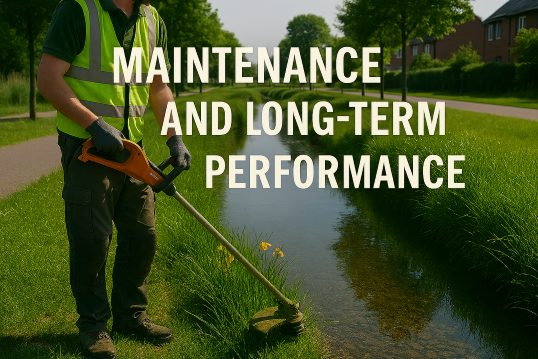
Vegetation management is another critical task, particularly for features such as swales, basins, and ponds. Regular cutting, replanting, and removal of invasive species help maintain both hydraulic performance and visual quality. In some cases, vegetation plays a direct role in water treatment, making its management essential to system effectiveness.
Inspection and maintenance of inlets, outlets, and control structures are also vital. Blockages or damage can significantly impact system performance, particularly during storm events. Routine inspections help identify issues early and prevent more serious problems from developing.
These activities are generally straightforward and can often be carried out using standard landscaping techniques, which is one of the advantages of SuDS compared to conventional drainage systems.
Assigning Responsibility for Maintenance
A key consideration in SuDS design is identifying who will be responsible for maintenance over the long term. This can vary depending on the type of development and the local regulatory framework. In some cases, systems may be adopted by a local authority or water company, while in others, responsibility may fall to a private management company or landowner.
Clear agreements must be established to ensure that maintenance responsibilities are understood and properly managed. Without this clarity, there is a risk that systems will be neglected, leading to reduced performance and potential failure. Maintenance plans should therefore be prepared as part of the overall drainage strategy, outlining the tasks required, the frequency of maintenance, and the party responsible.
For developers and designers, this highlights the importance of considering adoption requirements early in the process. Different adopting bodies may have specific standards and preferences, which can influence design decisions and long-term management arrangements.
Lifecycle Costs and Long-Term Value
While maintenance involves ongoing costs, it is important to consider the broader lifecycle economics of SuDS. In many cases, well-designed systems can offer cost savings over time compared to traditional drainage infrastructure. This is because they rely on natural processes and simple maintenance activities rather than complex mechanical systems.
Investing in good design and clear maintenance planning can reduce the risk of costly repairs or system replacements in the future. It can also enhance the overall value of a development by maintaining attractive and functional spaces that contribute to its appeal.
From a client perspective, understanding these lifecycle benefits is essential. Maintenance should not be seen purely as a cost but as an investment in the long-term performance and sustainability of a development.
Maintaining Performance Over Time
The performance of SuDS systems can change over time due to factors such as sediment accumulation, vegetation growth, and changes in land use. Regular monitoring is therefore essential to ensure that systems continue to operate as intended.
The SuDS Manual encourages a proactive approach to maintenance, where issues are identified and addressed before they impact performance. This includes routine inspections as well as periodic reviews to assess whether systems are meeting their design objectives.
A key principle is that maintenance should be predictable and manageable. By distributing treatment and storage across multiple components, as encouraged by the management train approach, SuDS systems can be more resilient to individual component issues. This reduces the likelihood of sudden failure and supports consistent long-term operation.
Balancing Maintenance with Design and Use
In many developments, SuDS features are designed to serve multiple purposes, such as providing recreational space or enhancing visual amenity. This introduces an additional layer of complexity, as maintenance must be carried out in a way that does not compromise these functions.
For example, a detention basin that doubles as a public open space must be maintained so that it remains both functional and usable. This requires careful coordination between drainage maintenance and landscape management. Similarly, features such as ponds must be designed to balance ecological value with safety and accessibility.
Achieving this balance requires a clear understanding of how spaces will be used and how maintenance activities will interact with those uses. This reinforces the importance of integrating SuDS into the overall design rather than treating it as a separate system.
Common Maintenance Challenges
Despite the guidance provided in the SuDS Manual, several common challenges can arise in practice. These include unclear ownership, inadequate maintenance planning, and a lack of understanding of how SuDS systems function. In some cases, systems may be altered or damaged over time due to changes in land use or poor management practices.
These challenges can often be traced back to decisions made during the design stage. Ensuring that maintenance is fully considered from the outset, with clear documentation and defined responsibilities, can significantly reduce the risk of issues arising later.
Education and awareness also play an important role. Those responsible for maintenance must understand how the system works and why it is designed in a particular way. Providing clear guidance and training can help ensure that maintenance is carried out effectively.
Why Maintenance is a Design Issue
A key takeaway from the CIRIA SuDS Manual is that maintenance is not simply an operational concern but a core aspect of design. Decisions about layout, component selection, and detailing all influence how easy it will be to maintain a system over time.
For architects and designers, this means considering maintenance as part of the overall design process. Features should be positioned and detailed in a way that supports long-term management while also contributing to the character and usability of the development.
By doing so, it is possible to create SuDS systems that are not only effective at managing water but also sustainable in the truest sense, performing reliably over the long term with manageable maintenance requirements.
Ensuring Long-Term Success
Ultimately, the success of a SuDS scheme is measured not just by its initial performance but by how well it continues to function over time. Maintenance is the key factor that determines this outcome.
By designing with maintenance in mind, clearly defining responsibilities, and adopting a proactive approach to management, it is possible to ensure that SuDS systems deliver lasting benefits. This includes not only effective drainage but also enhanced environments, improved biodiversity, and long-term value for both developers and occupants.