Choosing the Right Drainage Consultant: A 2026 Guide
Table of Contents
- Why Hire a Professional Drainage Consultant
- Understanding Flood Risk Assessment for Planning Permission
- Key Factors to Consider When Choosing a Drainage Consultant
- Drainage Strategy Report Requirements
- Hiring a Drainage Consultant Checklist
- Questions to Ask Before Hiring
- Sustainable Drainage Systems and Modern Compliance
- Frequently Asked Questions
Last Updated: September 29, 2026
Why Hire a Professional Drainage Consultant
A drainage consultant brings expertise that most in-house teams lack, understanding building regulations, flood risk assessments, and local authority requirements in ways that save you time and money.
Drainage is a core part of your planning application. Local authorities scrutinise designs to ensure surface water is managed properly, foul drainage connects correctly, and your site won’t contribute to flooding downstream. Get this wrong, and your application gets rejected.
A dedicated drainage consultant focuses entirely on getting your design right the first time, rather than juggling multiple consultants or relying on staff who handle drainage alongside other tasks.
A common mistake is treating drainage as a minor detail to sort out after planning permission is granted. In reality, drainage design often determines whether your application succeeds. Start the conversation with a drainage consultant early, ideally before you submit your plans.
Understanding Flood Risk Assessment for Planning Permission
A flood risk assessment demonstrates whether your site is at risk of flooding and what measures you’ll implement to manage that risk. Most residential developments now require one, particularly if your site exceeds 1 hectare or is in a flood risk area.
The assessment examines historical flood data, ground conditions, and rainfall patterns to recommend drainage strategies that protect your building and avoid increasing flood risk elsewhere. Without one, your planning application will almost certainly be rejected.
Local authorities and Lead Local Flood Authorities require detailed analysis of surface water management, evidence of Sustainable Drainage Systems consideration, and proof of regulatory compliance. A professional drainage consultant knows what each authority expects because they work with them regularly.
A thorough assessment protects you legally. If flooding occurs and you lacked a proper assessment, you could face liability claims. Commissioning one upfront removes that risk.
Key Factors to Consider When Choosing a Drainage Consultant
Select a drainage consultant who understands your specific site, your local authority’s preferences, and your project’s technical challenges.
Qualifications and Professional Certifications
Your drainage consultant should hold relevant qualifications in civil engineering or environmental engineering and memberships in professional bodies like the Institution of Civil Engineers or the Chartered Institution of Water and Environmental Management. These require ongoing professional development and adherence to ethical standards.
Digital Surveying and Modelling Capability
Advanced surveying and modelling technology separates experienced drainage consultants from those treating drainage as a secondary service.
A competent drainage consultant should use:
-
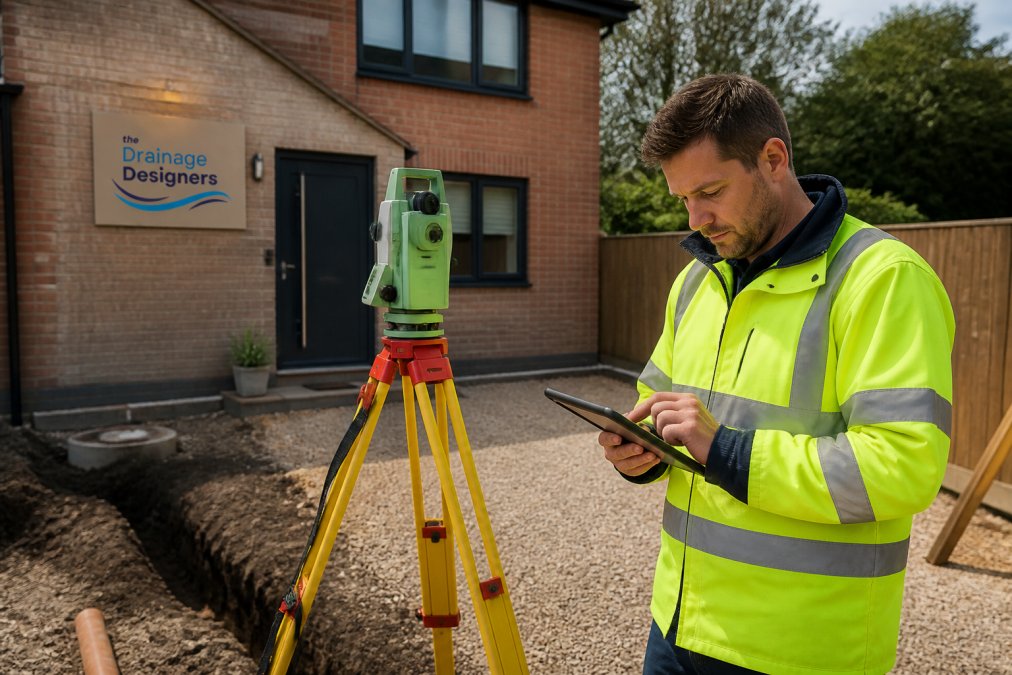
Topographical surveys: Detailed laser or GPS-based surveys mapping ground levels to millimetre accuracy, essential for understanding water flow and informing drainage strategy. Ask whether they conduct these in-house or commission them from a specialist surveyor.
-
CCTV drainage surveys: Closed-circuit television inspection reveals blockages, structural defects, and capacity issues before designing new connections. This is essential when connecting to existing public sewers or private drains.
-
Ground investigation data: Soil permeability, groundwater levels, and ground stability directly affect drainage design. Professional consultants commission boreholes or use existing ground reports to understand subsurface conditions before designing SuDS systems.
-
3D digital models: Modern drainage design uses CAD or specialist software to create three-dimensional models showing how water moves, identifying problems before construction. Ask whether they provide these models as deliverables.
-
Hydraulic modelling software: For complex sites or where surface water discharge is constrained, hydraulic modelling calculates how your drainage system will perform during rainfall events. This software predicts water levels, flow rates, and storage requirements. It’s the difference between a design that meets regulations on paper and one that actually works in practice.
Insurance and Professional Indemnity Cover
Professional indemnity insurance protects you if the design fails and causes damage. This is non-negotiable.
Local Authority Knowledge and Track Record
Every local authority has its own preferences for drainage design and specific requirements about surface water discharge rates or foul drainage connections. A consultant who works regularly with your local authority understands these nuances.
The best drainage consultant for your project is one with proven success in your area, relevant professional credentials, current professional indemnity insurance, and demonstrable capability in digital surveying and modelling. Local knowledge combined with technical depth saves time and increases the likelihood of first-time approval.
Drainage Strategy Report Requirements
A drainage strategy report is the core deliverable, setting out how surface water and foul drainage will be managed. It must satisfy your local authority and Lead Local Flood Authority whilst remaining clear enough for builders to implement.
The report typically includes:
- Site location plan showing existing and proposed drainage
- Topographical survey data and ground conditions analysis
- Rainfall data and surface water calculations
- Details of proposed Sustainable Drainage Systems
- Connection points to public sewers or alternative discharge routes
- Maintenance and management plan for drainage features
- Compliance statement confirming adherence to building regulations
Hiring a Drainage Consultant Checklist
Before hiring, work through this checklist:
- Confirm they hold relevant professional qualifications and memberships
- Request proof of current professional indemnity insurance
- Ask for references from similar recent projects
- Check their experience with your local authority
- Clarify their fee structure and what’s included in the scope
- Confirm they can meet your project timeline
- Ask whether they’ll handle building control submissions
- Verify they understand Sustainable Drainage Systems requirements
- Check they can provide digital models and technical drawings
- Confirm communication process and project management approach
Questions to Ask Before Hiring
Ask these specific questions when evaluating a drainage consultant:
What’s your experience with projects like mine? They should describe similar work, challenges faced, and solutions implemented.
Sustainable Drainage Systems and Modern Compliance
Sustainable Drainage Systems (SuDS) manage surface water by mimicking natural processes, allowing water to soak into the ground, filter through soil, or be stored temporarily before gradual release. They reduce flooding, improve water quality, and provide environmental benefits.
Design That Accounts for Long-Term Maintenance
The critical gap in most SuDS discussions is maintenance. A poorly maintained SuDS feature becomes ineffective and creates liability problems, with property owners inheriting unexpected ongoing costs and responsibilities.
When evaluating a drainage consultant’s SuDS approach, ask:
-
Who is responsible for maintenance after completion? Your consultant should clearly identify whether maintenance falls to you, a management company, or the local authority, documented in the drainage strategy report.
-
What does the maintenance plan specify? A professional plan details inspection frequency, specific tasks (sediment removal, vegetation cutting, blockage clearance), responsibility, and costs. Ask for a sample schedule.
-
Has the design been tested for real-world performance? Some SuDS designs look good on paper but fail in practice because they weren’t designed with maintenance reality in mind. For example, a rain garden that becomes waterlogged and kills vegetation, or a permeable surface that clogs with algae. Ask whether the consultant has experience with how their proposed systems perform over 5, 10, and 20 years.
-
What happens if the system fails to perform? If your SuDS system doesn’t infiltrate water as designed, or if surface water floods your property during heavy rainfall, who is liable? Your consultant’s professional indemnity insurance should cover design failures, but only if the design was appropriate for the site conditions. This is why proper ground investigation and hydraulic modelling matter.
Regulatory Compliance and Adoption
Many local authorities now require SuDS to be “adoptable” – meaning the council will take ownership and maintain them long-term. This removes your maintenance burden but requires the design to meet strict standards. Other authorities require property owners to maintain SuDS in perpetuity.
Indemnity and Liability for SuDS Performance
Because SuDS are relatively new and performance varies widely, liability questions often arise. If a SuDS system fails and causes flooding or property damage, who pays?
- Design defects that cause the system to fail
- Inadequate site investigation that led to inappropriate SuDS selection
- Failure to comply with building regulations or local authority requirements
SuDS are not a “set and forget” solution. They require ongoing maintenance and clear assignment of responsibility. Before your consultant finalises the design, ensure you understand exactly what maintenance is required, who will do it, and what it will cost over the lifetime of your property. This protects you from unexpected liabilities and ensures the system actually works.
Frequently Asked Questions
What qualifications should a professional drainage consultant hold?
A qualified drainage consultant should hold relevant civil engineering qualifications such as a degree in civil engineering or a related discipline. Look for membership of professional bodies such as the Institution of Civil Engineers (ICE) or the Chartered Institution of Water and Environmental Management (CIWEM). They should also demonstrate specific expertise in drainage design, flood risk assessment, and compliance with Building Regulations and environmental standards. Ask for evidence of professional indemnity insurance and any additional certifications in sustainable drainage systems (SuDS) design.
Why is a drainage strategy report required for planning permission?
A drainage strategy report is essential because planning authorities and Lead Local Flood Authorities need to assess how surface water and foul drainage will be managed on your site. The report demonstrates that your project complies with Building Regulations, considers ground conditions and soil permeability, and incorporates appropriate flood risk mitigation. It shows the local authority that your drainage design is feasible, sustainable, and won’t increase flood risk elsewhere. Without a compliant report, your application is likely to be rejected or subject to costly conditions.
How early in the design process should I appoint a drainage consultant?
Appoint a drainage consultant as early as possible, ideally during the initial site assessment and concept design phase. Early involvement allows them to evaluate ground conditions, topographical surveys, and site complexity before your architectural design is finalised. This prevents costly redesigns later and ensures your drainage strategy integrates seamlessly with the overall project plan. For projects requiring planning permission, having a consultant involved from the start significantly improves the likelihood of first-time approval and keeps your project timeline on track.
What is the difference between a drainage consultant and a groundworks contractor?
A drainage consultant designs the drainage system, produces technical specifications, and ensures compliance with regulations and building standards. They assess site conditions, create hydraulic models, and prepare documentation for planning permission. A groundworks contractor implements the design, excavating and installing the physical drainage infrastructure on site. You need both: the consultant for design and compliance, the contractor for construction. Some projects benefit from the consultant overseeing the contractor’s work to ensure the installation matches the approved design.