
How to Design a Rain Garden for Roof Runoff
Table of Contents
- Rain Garden Size for Roof Runoff: Calculating What Your Roof Delivers
- Choosing the Right Location and Managing Downspout Connections
- Rain Garden Soil and Drainage: Testing Infiltration Before You Dig
- Excavation, Shallow Depression Depth and Overflow Design
- Rain Garden Plants: Selecting Species for Roof Runoff Conditions
- Rain Garden Maintenance: Seasonal Tasks and Troubleshooting
- Frequently Asked Questions
Last Updated: October 8, 2026
Rain Garden Size for Roof Runoff: Calculating What Your Roof Delivers
A rain garden for roof runoff is a shallow, planted depression that captures rainwater from your roof and lets it soak into the ground instead of overwhelming drains. Get the size wrong and it either floods or does nothing useful. This guide walks through how to design a rain garden for roof runoff, from measuring your roof to choosing plants that survive both drought and downpour.
The core rule most guides skip: size the garden to the water your roof actually delivers, not to the space you happen to have spare. That means working with three numbers: the roof area draining to the garden, the rainfall depth you want to capture, and the infiltration rate of your soil.
Measuring Your Roof Area and Impervious Surface
Start with the footprint, not the full roof surface. For sizing, you need the area of roof that drains to your chosen downspout, measured in square metres. A simple rectangular roof section is length multiplied by width. If only one downspout serves that area, that is your contributing roof area.
Add any other hard surfaces feeding the same spot. A driveway or patio that slopes toward the garden counts as impervious surface too, and it adds to the volume you must handle. Sketch the flow path on paper before you dig anything.
A Worked Sizing Example Using Rainfall Depth and Soil Infiltration
Most guides stop at a percentage rule of thumb.
Step 1: Calculate the runoff volume.
Use a design rainfall depth that represents a heavy but common storm. In many parts of the UK, a 1 in 10 year storm of 30 minutes duration delivers roughly 20 to 25 millimetres of rain.
For a roof area of 40 square metres and a rainfall depth of 20 millimetres (0.02 metres), the volume is:
40 m² × 0.02 m = 0.8 cubic metres (800 litres).
Step 2: Estimate how long the garden needs to empty.
A rain garden should drain within 24 to 48 hours to avoid becoming a pond. If your soil infiltration rate is 25 millimetres per hour (a typical loam), a garden with a surface area of 6 square metres can infiltrate:
6 m² × 0.025 m/hour = 0.15 cubic metres per hour.
To soak away 0.8 cubic metres, it would need about 5.3 hours, which is well within the 24 hour target.
Step 3: Check the storage depth.
The garden must hold the runoff volume until it infiltrates. If the garden is 6 square metres and 0.15 metres deep (15 centimetres), the storage volume is:
6 m² × 0.15 m = 0.9 cubic metres.
That is slightly more than the 0.8 cubic metres delivered, so the garden would not overflow in this design storm.
| Roof Area Draining In | Design Rainfall | Runoff Volume | Soil Infiltration | Minimum Garden Area (at 15 cm deep) |
|---|---|---|---|---|
| 20 m² | 20 mm | 0.4 m³ | 25 mm/hr | 3 m² |
| 40 m² | 20 mm | 0.8 m³ | 25 mm/hr | 6 m² |
| 60 m² | 20 mm | 1.2 m³ | 25 mm/hr | 9 m² |
| 80 m² | 20 mm | 1.6 m³ | 25 mm/hr | 12 m² |
| 40 m² | 20 mm | 0.8 m³ | 5 mm/hr | 12 m² |
Treat these figures as a starting point. A proper site analysis and infiltration test will refine them.
Sizing by rainfall volume and infiltration rate gives you a garden that works in real storms, not just average ones. The percentage rule is a quick check, but the calculation above is what separates a rain garden that functions from one that floods.
Choosing the Right Location and Managing Downspout Connections
The best location is a low, level spot at least 2 to 3 metres from your foundations, downhill of the house where possible. Water should flow in by gravity, never pool against the walls. Avoid the spot directly over your drains or a soakaway, and stay clear of where you know the ground already stays wet.
Safe Distances from Foundations and Property Boundaries
Keep a minimum of 2 metres from any building, and further if your soil is clay. Clay holds water and can swell, which puts pressure on foundations. Check your boundary line too: a rain garden that sends water onto a neighbour’s land is a dispute waiting to happen.
Routing Roof Water to the Garden
Getting water from the downspout to the garden without erosion or blockage is where most DIY installations fail. You have three main options, and the right one depends on the distance and the fall available.
1. Buried pipe with a gentle fall
This is the cleanest option for distances over 3 metres. Use a rigid or flexible drainage pipe of at least 100 millimetres diameter.
2. Surface swale or channel
If the garden is close to the house and the ground slopes gently, a shallow vegetated swale can carry water across the lawn. Line it with gravel or plant it with moisture-tolerant grasses. This slows the flow and filters debris.
3. Downspout diverter
A diverter fits into the downspout and sends the first flush of rain to the garden while allowing the rest to continue to the drains.
Fit a leaf guard or gutter mesh before you connect anything. Roof runoff carries leaves and grit that clog the inlet pipe within a season, and clearing a buried pipe is far harder than clearing a gutter.
Preventing Erosion at the Inlet
Water arriving from a roof can be fast and concentrated. Protect the inlet with a splash block, a small pile of cobbles, or a planted buffer strip. If you see a channel forming, add more stone or redirect the flow with a gentle bend in the pipe. Never let the water hit bare soil directly, as it will carve a gully in one season.
Skip the overflow and a single cloudburst can back water up against your walls. Plan the spill route before you backfill, because adding it later means digging the garden out again.
Rain Garden Soil and Drainage: Testing Infiltration Before You Dig
Infiltration is how fast water soaks into your soil, and it decides whether your garden works at all. Test it before you commit to a location. If the ground cannot drain, a rain garden just becomes a pond.
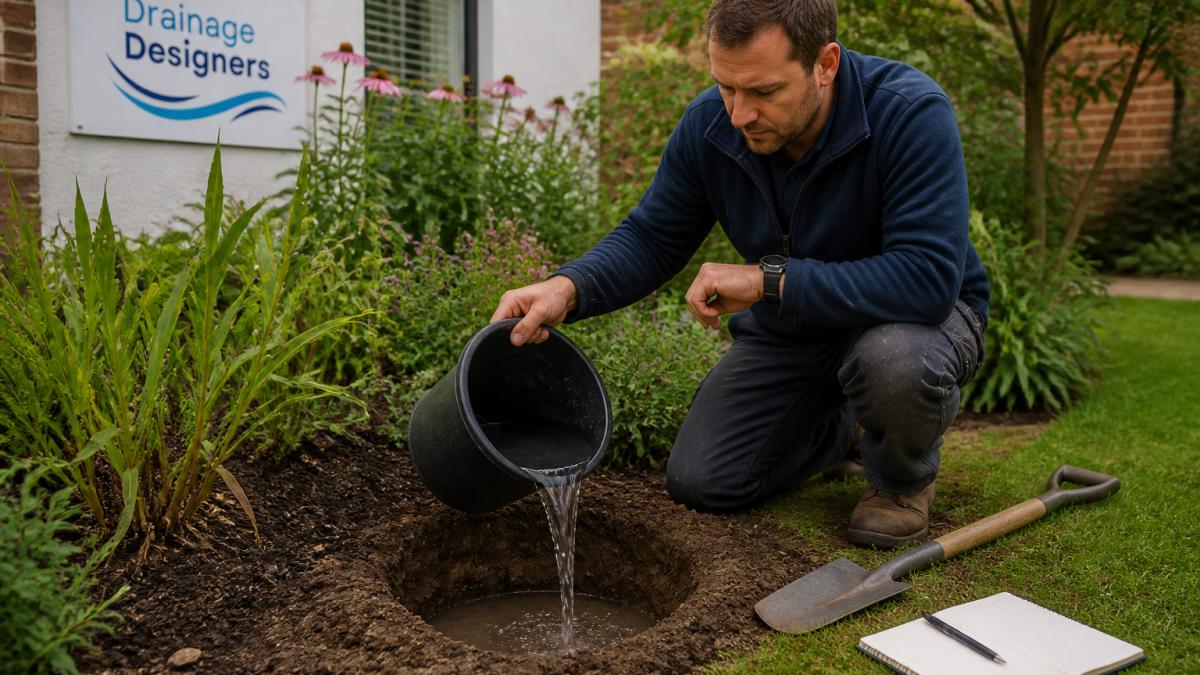
How to Run a Simple Infiltration Test with Pass or Fail Results
Dig a hole about 30 centimetres deep and 30 centimetres wide. Fill it with water and let it drain completely. Then refill it and time how long the second fill takes to drop.
- If the water drops 2.5 centimetres or more in an hour, the soil passes. Build here.
- If it drops 1 to 2.5 centimetres in an hour, the soil is marginal. Enlarge the garden or amend the soil.
- If it drops less than 1 centimetre in an hour, the soil fails. Choose another spot or build a raised bed.
The first fill saturates the soil. The second fill is the one that tells you the truth.
Excavation, Shallow Depression Depth and Overflow Design
A rain garden is a shallow depression, not a deep pit. Aim for a bowl-shaped garden about 15 to 20 centimetres deep at the centre, with gently sloping sides. That depth holds a useful volume of rainwater without turning into a swimming pool.
Excavate to the shape you want, then level the base so water spreads evenly. The sides should slope so the garden blends into the lawn. Keep the base flat, not sloped, so the whole bed soaks in together.
Overflow design is the part most people forget. When a heavy storm dumps more rain than the garden can hold, the water needs somewhere safe to go.
Skip the overflow and a single cloudburst can back water up against your walls. Plan the spill route before you backfill, because adding it later means digging the garden out again.
Rain Garden Plants: Selecting Species for Roof Runoff Conditions
Roof runoff swings between soaking wet and bone dry, so plant selection matters more than most guides admit. You need plants that shrug off both. Native and moisture-tolerant species handle the cycle best.
Choose a mix:
- Moisture-tolerant plants for the centre, where water sits longest
- Medium water needs plants for the slopes
- Grasses and structural plants for the edges and overflow lip
Match plants to your sunlight. A garden in full shade needs different species from one in full sun. Group them by water need, not by colour, and the bed will look after itself. Mulch around the plants to hold moisture and stop erosion while roots establish.
Rain Garden Maintenance: Seasonal Tasks and Troubleshooting
Maintenance is light if you build it right, but it is not zero. Check the inlet and overflow after every big storm for the first year. Clear leaves and sediment before they block the flow.
Season by season:
- Spring: cut back dead growth, check plants have survived, top up mulch
- Summer: water new plants in dry spells, watch for the bed drying too fast
- Autumn: clear fallen leaves from the inlet and gutter, the biggest clog risk
- Winter: check overflow works, remove silt build-up at the inlet
If the garden stays wet for days after rain, the soil is draining too slowly. If it dries out within hours, it may be too small or the soil too sandy. Both are fixable with soil amendments or resizing.
When a project needs a compliant drainage design signed off by your local authority, this is where professional input saves time. We handle site visits, flood risk assessments, and the documentation that keeps your plans moving through council approval. Our nationwide team supports homeowners, architects, and developers from first sketch to final sign-off.
Frequently Asked Questions
How do you size a rain garden for roof runoff?
Measure the roof area draining to the downspout, then aim for a rain garden roughly 10 to 20 percent of that footprint, depending on your soil. Heavy clay needs a larger garden; sandy loam needs less. A 50 square metre roof section typically needs a garden of 5 to 10 square metres. Depth matters too: most rain gardens sit 100 to 200 millimetres below the surrounding ground level, with a flat base so water spreads evenly rather than pooling in one corner.
What soil is best for a rain garden?
You want a mix that drains freely but still holds enough moisture for plants. A common blend is roughly 50 to 60 percent sand, 20 to 30 percent topsoil, and 20 percent organic compost. Avoid pure clay, which infiltrates too slowly, and pure sand, which dries out and starves plants. Before committing, dig a test hole 300 millimetres deep, fill it with water, and check that it empties within 24 to 48 hours. If it does not, improve the soil or choose a different spot.
Which plants are suitable for a rain garden?
Choose native or moisture-tolerant species that cope with both flooding and dry spells. Good options include purple loosestrife, marsh marigold, soft rush, and Siberian iris for the wetter centre. Around the edges, where water sits less, try hardy geranium, astilbe, or fern. Match plants to sunlight: most rain garden species prefer full sun to partial shade. Group thirsty plants in the middle of the bowl and tougher, drought-tolerant types near the rim so the garden looks good year-round.
How deep should a rain garden be?
Most residential rain gardens are 100 to 200 millimetres deep at the centre, with gently sloping sides. Deeper than 300 millimetres and you risk standing water, mosquito breeding, and safety issues. The base should be level so water spreads across the whole surface rather than collecting in one low spot. If your soil drains slowly, keep the garden shallower and wider instead of deeper. Always confirm the finished depth sits below the level of the downspout outlet so water flows in by gravity.
Designing a rain garden for roof runoff is straightforward once you size it to your roof, test your soil, and plan the overflow. The tricky part is meeting local drainage and planning requirements, which vary from one authority to the next. The Drainage Designers take the guesswork out of that process with site visits, compliant SuDS design, and support through Local Authority and Lead Local Flood Authority approval. Get in touch to move your project forward on schedule.