Knowledge Centre
Beyond the Basics: Advanced SuDS Features for Challenging Sites
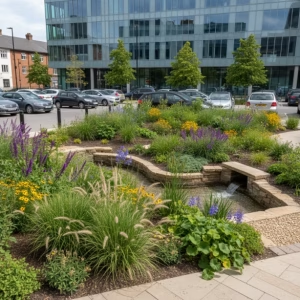
When it comes to sustainable drainage systems, not every site presents a straightforward solution. Whilst basic SuDS features like permeable paving and simple swales work brilliantly on standard developments, challenging sites demand a more sophisticated approach. After four decades in drainage design, I’ve encountered every conceivable site constraint, and I can tell you that advanced…
Read MoreWhen Soakaways Fail: Alternative Attenuation Methods for Clay Soils
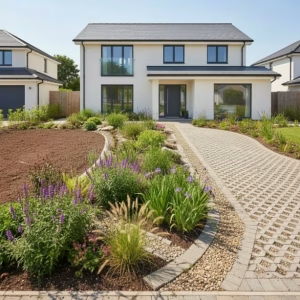
We should be aware now that soakaways are often the go-to solution for surface water drainage, but they have one critical weakness: they simply don’t work in clay soils. If you’re a homeowner, architect, or developer facing this challenge, you’re not alone. Clay’s low permeability means water has nowhere to go, leaving you with a…
Read MoreIs Rainwater Harvesting Worth the Investment for UK Property Developers?
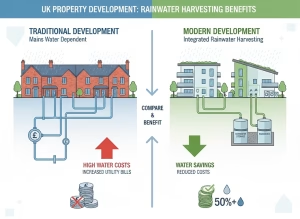
As the UK faces a projected water deficit of 5 billion litres per day by 2050, property developers are increasingly looking at rainwater harvesting systems not just as an environmental consideration, but as a strategic business decision. The question is no longer whether to implement water reuse solutions, but rather how quickly you can integrate…
Read MoreHow Rainwater Harvesting Can Slash Your Water Bills by 50%: A Complete Guide for UK Homeowners

With water bills rising across the UK and environmental concerns at the forefront of homeowners’ minds, rainwater harvesting has emerged as a practical solution that delivers both financial savings and sustainability benefits. If you’re looking to reduce your water costs whilst contributing to water conservation, this guide will show you exactly how rainwater harvesting can…
Read MoreThe Hidden Benefits of Greywater Recycling: What Housing Developers Need to Know
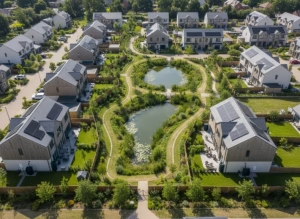
As a housing developer, you’re constantly balancing construction costs, planning requirements, and market appeal. Greywater recycling systems might seem like an additional expense, but they offer strategic advantages that can significantly impact your project’s viability, profitability, and marketability. Beyond the obvious water conservation benefits, greywater systems can reduce infrastructure costs, strengthen planning applications, and create…
Read MoreActive Attenuation Technology: A Practical Guide for Developers
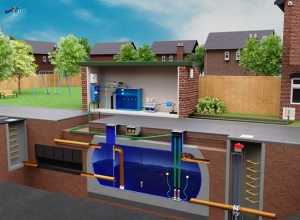
Active attenuation represents a different approach to managing surface water on development sites. Unlike passive systems that rely solely on storage volume, active systems use mechanical controls to regulate discharge rates. What Is Active Attenuation? Active attenuation systems incorporate flow control devices, typically vortex valves or electronically controlled outlets, to manage the rate at which…
Read MoreGreywater Recycling: Understanding Its Role in UK Water Management

Greywater recycling systems are increasingly being considered for UK buildings as part of water management strategies. Understanding what these systems can and cannot do helps architects, developers, and building owners make informed decisions. What Is Greywater? Greywater is wastewater from baths, showers, hand basins, and washing machines. It excludes water from toilets (blackwater) and kitchen…
Read MoreRainwater Harvesting for Architects: Practical Considerations and Design Guidance
Rainwater harvesting is increasingly being considered in UK building projects as part of a sustainable water management strategy. For architects, understanding the fundamentals of rainwater harvesting can help with meeting planning requirements, achieving water efficiency targets, and supporting broader sustainability goals. What Is Rainwater Harvesting? Rainwater harvesting involves collecting rainwater from roofs or other hard…
Read MoreUpsizing Pipes vs. Adding Attenuation: Which Solution Saves Money?
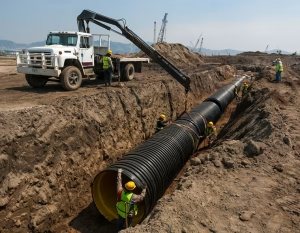
When it comes to effective drainage design, two of the most common solutions for managing excess water are upsizing pipes or adding attenuation. Both approaches aim to prevent flooding, comply with local regulations, and ensure long-term performance, but they come with different costs and benefits. So, which option is more cost-effective for your project? Understanding…
Read MoreBeyond the Basics: Advanced SuDS Features for Challenging Sites
Sustainable Drainage Systems (SuDS) are now essential for securing planning permission throughout the UK. While standard SuDS approaches work well for many developments, some sites bring unique challenges such as limited space, difficult ground conditions, or strict environmental requirements. In these situations, moving beyond the basics is crucial. Here is a deeper look at advanced…
Read MoreClimate Change Allowances in 2025: How They’re Reshaping UK Drainage Design
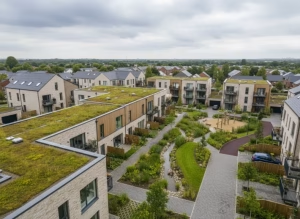
Climate change is now a central concern for the UK drainage sector. In 2025, new climate change allowances are fundamentally changing the way drainage systems are designed, approved, and maintained across the country. These changes reflect updated government guidance and an urgent need to future-proof infrastructure against increasingly frequent extreme weather events and unpredictable rainfall…
Read MoreUnderstanding the National SuDS Standards
Sustainable Drainage Systems (SuDS) are now a central part of planning and development in the UK. The National SuDS Standards set out clear requirements for managing surface water in new developments, ensuring both environmental protection and regulatory compliance. This article explains the general requirements set out in paragraphs 2.3 to 2.7, highlighting what architects, developers,…
Read MoreUnderstanding Permeable Pavement Compliance for Surface Water Drainage
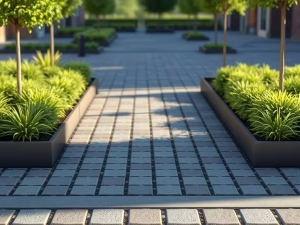
Permeable pavements are increasingly used in sustainable drainage systems (SuDS) to manage rainwater, reduce surface runoff, and meet planning and environmental regulations. Knowing when a permeable pavement design is compliant is essential for successful project delivery. Here is a detailed explanation of the main compliance rules, including practical scenarios and design tips. Permeable Surfaces Without…
Read MoreStandard Four of the National SuDS Standards: The Water Treatment Trend for Architects and Housing Developers
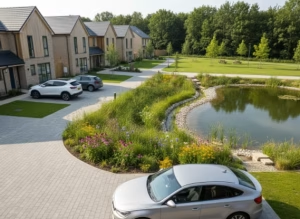
For architects and housing developers, understanding Standard Four of the National SuDS Standards is essential for delivering compliant, sustainable, and marketable projects. This standard is all about water quality and ensuring that runoff from your developments is treated effectively before leaving the site. Why Water Treatment Matters for Your Projects Modern developments face increasing scrutiny…
Read MoreBeyond the Basics: Advanced SuDS Features for Challenging Sites
When it comes to sustainable drainage systems (SuDS), many sites present unique challenges that demand more than standard solutions. While the basics such as permeable paving, soakaways, and swales are essential for managing runoff and improving water quality, complex sites often require a more advanced approach. Here, we explore some cutting-edge SuDS features that can…
Read MoreMaintenance Planning for your drainage assets: Ensuring Long-Term Performance
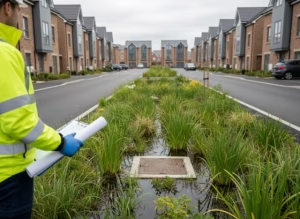
Maintenance is no longer the “nice to have” part of drainage and SuDS design. Under newer expectations and standards, long term performance is treated as a core design outcome, not an afterthought. If you are an architect, developer, or homeowner planning a project, the message is simple: if you cannot show how the system will…
Read MoreCombining Attenuation with Rainwater Harvesting: A Smart Approach to Flood Prevention and Water Reuse
If the past couple of weeks have shown anything, it is that the South of England can swing quickly from worrying about surface water and flooding to worrying about water shortages. In Kent and Sussex alone, a major incident was declared as tens of thousands of properties were left without a proper water supply for…
Read MoreIntegrating Green Roofs Into Your Surface Water Strategy
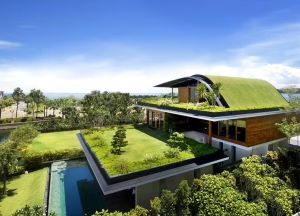
Green roofs, sometimes called living roofs, are more than a nice architectural feature. Done properly, they can become a practical part of your surface water strategy. They help slow down runoff, reduce pressure on drains, and support planning approval where SuDS is expected. This article explains what green roofs do, where they fit in a…
Read MoreCombining Multiple SuDS Features: A Systems Approach to Surface Water
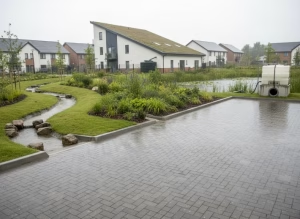
We know that architects and housing developers are under pressure to deliver sites that work on paper and on the ground. Planning conditions are tighter, rainfall patterns are less predictable, and space is always at a premium. A systems approach to SuDS avoids that. Instead of relying on one feature to do everything, you combine…
Read MoreNational SuDS Standards in Plain English (What They Mean for Your Next Planning Submission)
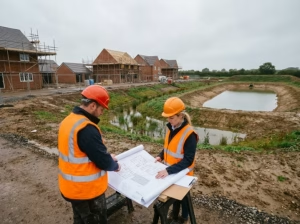
f you are an architect or housing developer, you do not need another policy document to read. You need to know what the National SuDS Standards mean in practice, what planners will ask for, and how to avoid the slow, expensive back and forth that can derail a programme. In simple terms, the National SuDS…
Read MoreThe One Thing That Delays SuDS Approvals Most (And How to Avoid It)
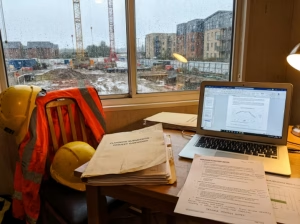
Most delays are not caused by complex hydraulics. They are caused by uncertainty. The planner or drainage officer cannot clearly see that the design is appropriate for the site, so they ask questions. Each question creates another round of drawings, notes, and approvals. The most common root cause is a drainage strategy that does not…
Read MoreThe Runoff Destination Hierarchy Explained (And How to Justify Your Choice)
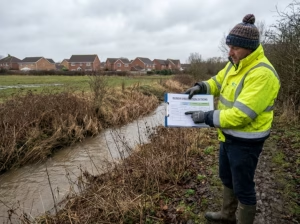
The National SuDS Standards promote a clear order of preference for where surface water should go. This is often called the runoff destination hierarchy. It matters because it forces the design team to consider better outcomes first, rather than defaulting to the easiest connection. Option one is to use the water on site, for example…
Read MoreInfiltration in SuDS (When It Works, When It Fails, And What Evidence You Need)
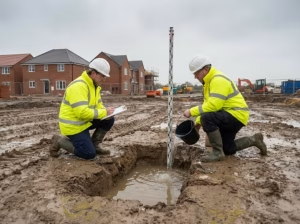
Infiltration is often treated as the default answer, but it is only a good answer when the ground conditions support it. When it is forced onto a site without evidence, it becomes a planning risk and a construction risk. Infiltration works well when soils can accept water at a reliable rate, groundwater levels are suitable,…
Read More