Beyond the Basics: Advanced SuDS Features for Challenging Sites
Sustainable Drainage Systems (SuDS) are now essential for securing planning permission throughout the UK. While standard SuDS approaches work well for many developments, some sites bring unique challenges such as limited space, difficult ground conditions, or strict environmental requirements. In these situations, moving beyond the basics is crucial. Here is a deeper look at advanced SuDS features and how they can transform even the most complex sites.
Understanding Site-Specific Challenges
Some projects are located on urban infill plots with minimal external land, while others face high groundwater levels or heritage restrictions. These constraints can make it impossible to install traditional soakaways, ponds, or detention basins. Furthermore, developments in water-stressed areas or near sensitive ecosystems must meet additional regulatory and environmental targets. Advanced SuDS features are designed to address these obstacles with innovative, site-specific solutions.
Green Roofs and Blue Roofs: Maximising Roof Surfaces
Green roofs are constructed using layers of vegetation, engineered soil, and drainage membranes. They absorb rainwater, delay runoff, and provide insulation as well as biodiversity benefits. This makes them ideal for projects where ground space is at a premium, such as city centre buildings or developments with large roof areas. Blue roofs are a different approach, designed to temporarily store water on flat roofs. These systems release water gradually through controlled outlets, helping to prevent local flooding and reduce pressure on below-ground drainage. Both options can be combined with solar panels or recreational spaces for added value.
Rainwater Harvesting: Meeting Non-Potable Demand
Rainwater harvesting systems collect and store rainfall for uses such as irrigation, cleaning, or toilet flushing. This can be particularly valuable on sites in water-stressed regions or where planning authorities require sustainable water management. Storage tanks, filters, and pumps are sized according to the building’s needs and local rainfall patterns. By using water on-site, these systems reduce both mains water consumption and the volume discharged to drains, supporting compliance with the SuDS hierarchy.
Permeable Paving: Managing Runoff at Source
Permeable paving is a versatile option for car parks, driveways, and walkways. These systems allow rainwater to pass through the surface into a stone sub-base, where it is either stored temporarily or allowed to infiltrate into the ground. Permeable paving can be combined with geotextile layers and underdrainage to manage runoff even on clay soils or sites with high water tables. This approach not only reduces surface water flooding but also filters out pollutants before water enters the wider drainage network.
Swales, Rain Gardens, and Filter Strips: Enhancing Landscape and Function
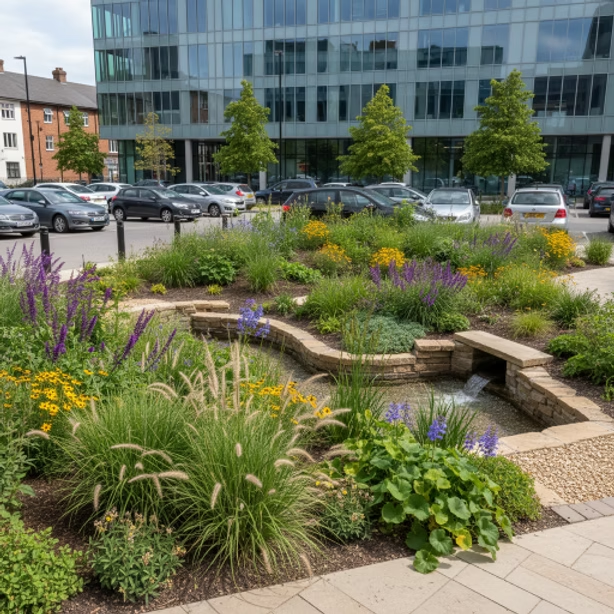
Where space permits, swales and rain gardens offer attractive and functional ways to manage surface water. Swales are shallow, vegetated channels that slow down runoff, encourage infiltration, and improve water quality through natural filtration. Rain gardens are planted depressions that capture and treat runoff from roofs or hardstanding. Filter strips are bands of grass or planting along the edge of paved areas, intercepting and cleaning runoff before it reaches drains. These landscape features can be integrated into public spaces, verges, or private gardens, adding ecological value and visual appeal.
Smart Controls and Attenuation: Precision Water Management
Modern developments benefit from smart flow controls that monitor rainfall and adjust discharge rates in real time. Attenuation tanks or modular crates can be installed underground to store excess water during storms, releasing it slowly to prevent downstream flooding. These systems are especially important on sites with limited discharge options or where local authorities set strict runoff limits. Smart sensors and remote monitoring allow for proactive maintenance and rapid response to changing weather conditions.
The Value of Expert Design
Every challenging site requires a bespoke approach. Advanced SuDS features must be carefully selected and integrated to meet planning, environmental, and client requirements. Experienced drainage designers bring technical expertise, regulatory knowledge, and creative problem-solving to ensure that each project achieves both compliance and long-term value. At The Drainage Designers, we work closely with clients, architects, and authorities to deliver tailored solutions for even the most complex sites.