
Is Rainwater Harvesting Worth the Investment for UK Property Developers?
As the UK faces a projected water deficit of 5 billion litres per day by 2050, property developers are increasingly looking at rainwater harvesting systems not just as an environmental consideration, but as a strategic business decision. The question is no longer whether to implement water reuse solutions, but rather how quickly you can integrate them into your developments to unlock competitive advantages.
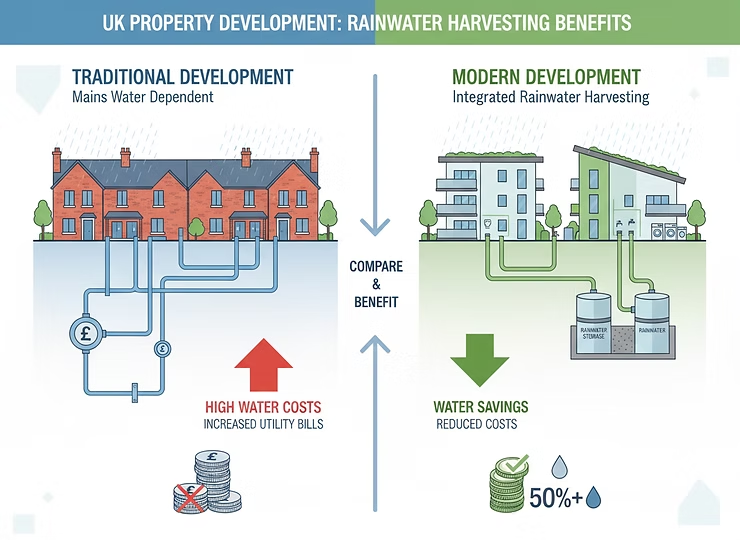
The Financial Case: Incentives That Improve Your Bottom Line
One of the most compelling reasons to invest in rainwater harvesting is the financial incentives available from UK water utility companies through the Environmental Incentives Common Framework introduced by Ofwat. These are not minor rebates; they are substantial contributions that can significantly offset installation costs.
Affinity Water provides verified incentives of £2,163 for developments achieving 85 litres per person per day or below, and an impressive £2,880 for projects that achieve water neutrality. United Utilities offers £400 for water reuse systems on new connections, increasing to £664 for water neutrality projects. Anglian Water provides £500 for developments achieving 90 litres per person per day or below.
Several other regional water companies including Thames Water, Severn Trent Water, Bristol Water, and South West Water also offer environmental incentives for water-efficient developments and rainwater harvesting systems. The specific amounts and qualifying criteria vary by region, so developers should contact their local water company to understand the full range of incentives available for their projects.
These incentives multiply across housing developments, transforming from individual rebates into substantial project savings that directly improve your bottom line.
Unlocking Development Potential in Water-Stressed Regions
If your business operates in water-scarce areas (particularly in London, the South East, or other high-demand regions) rainwater harvesting is not just beneficial, it is becoming essential. According to the UK Water Reuse Association, if every new commercial and residential property included reuse systems by 2050, we would unlock enough water capacity for 1.9 million homes. That represents 20.5% of the UK’s national water deficit.
For developers, this translates into a competitive advantage. Properties with integrated water reuse systems can proceed more smoothly through planning approval in water-stressed areas, where new developments might otherwise face restrictions or delays due to water capacity constraints.
Quantifiable Water Savings and Operational Benefits
The water savings from properly designed rainwater harvesting systems are substantial. According to Stormsaver, a leading UK manufacturer with over two decades of experience, commercial and non-household properties can reduce water usage by up to 75% when systems are correctly sized by experts. For residential developments, the reduction averages 30 litres per person daily.
These are not theoretical numbers; they are based on real-world performance from over 2,500 installations across the UK. The systems collect rainwater from roof areas, filter it, store it, and reuse it for non-potable applications including toilet flushing, washing machines, irrigation, and vehicle washing. In the UK’s climate, with abundant rainfall, roofs provide an excellent collection surface that would otherwise direct water straight into drainage systems.
The ROI Equation: Initial Investment vs Long-Term Returns
When evaluating ROI, developers must consider multiple financial factors beyond the initial installation cost. First, the water utility incentives mentioned earlier provide immediate cost recovery. Second, properties with rainwater harvesting systems command premium positioning in an increasingly sustainability-conscious market.
Third, there are the ongoing operational savings. Reduced mains water consumption means lower utility bills for occupants, which is a selling point for both residential buyers and commercial tenants. For housing developments, this can be a significant differentiator in marketing materials and can justify premium pricing.
It is worth noting that retrofitting rainwater harvesting systems costs up to 50% more than installing them during new construction, according to independent research by Ricardo. This makes the business case even stronger for developers who integrate these systems from the design phase rather than attempting to add them later.
Combining Rainwater Harvesting with Required Attenuation
Most new developments already require attenuation systems to prevent local drainage systems from being overwhelmed during heavy rainfall. Smart developers are combining necessary attenuation with rainwater harvesting, effectively serving two purposes with one integrated system.
Combined rainwater harvesting and attenuation systems can reduce surface water runoff by up to 95%, helping prevent flooding whilst simultaneously providing a sustainable water source. This dual functionality means you are not adding an entirely separate system; you are enhancing infrastructure you would need to install anyway. The UK Government recognises this value, naming non-potable water reuse as “priority one” in the new National Standard for Sustainable Urban Drainage.
Regulatory Momentum and Future-Proofing
The regulatory landscape is shifting decisively towards mandatory water reuse. The UK Water Reuse Association has published a roadmap towards mandatory water reuse, and water companies are increasingly incentivising (and in some cases requiring) water efficiency measures for new connections through the Environmental Incentives Common Framework.
Developers who implement rainwater harvesting now are future-proofing their projects against inevitable tightening of water efficiency regulations. Properties built today with integrated water reuse systems will not require costly retrofitting when regulations change, protecting asset values and avoiding disruption to occupants.
Addressing Common Concerns
Is it safe? Modern rainwater harvesting systems include multiple safeguards. They maintain complete separation between harvested rainwater and mains water through Type AA air gaps and other industry best practices. Systems include automatic mains water flush-through features to prevent stagnant water, and optional temperature monitoring sensors can integrate with Building Management Systems to alert users of any conditions that might promote bacterial growth.
What about maintenance? Like any mechanical system, rainwater harvesting requires regular maintenance. However, established manufacturers like Stormsaver offer comprehensive lifecycle support, from initial design through installation, commissioning, and ongoing maintenance. Annual servicing ensures system reliability and maximum efficiency, protecting your investment and ensuring consistent performance.
Does it work in the UK climate? Absolutely. The UK’s abundant rainfall makes it ideal for rainwater harvesting. The challenge is not lack of water; it is capturing and storing it effectively. With proper system sizing based on roof area, local rainfall data, and building water demand, UK properties can achieve significant mains water displacement.
The Competitive Advantage
In today’s property market, sustainability credentials matter. Buyers and tenants increasingly prioritise environmental performance, and planning authorities favour developments that demonstrate genuine commitment to resource efficiency. Rainwater harvesting provides tangible, measurable sustainability benefits that can be prominently featured in marketing materials and planning applications.
For developers working on multiple projects, the expertise gained from implementing rainwater harvesting becomes a repeatable competitive advantage. Understanding how to specify, install, and maintain these systems efficiently across your portfolio creates operational efficiencies and strengthens your reputation as a forward-thinking developer.
Making the Decision
The financial case for rainwater harvesting in UK housing developments is increasingly compelling. Water utility company incentives offset installation costs, significant water savings reduce operational expenses, regulatory momentum supports implementation, and market demand for sustainable properties continues to grow.
The question for UK property developers is not whether rainwater harvesting offers value (the evidence clearly demonstrates it does). The real question is whether you can afford not to implement it, particularly in water-stressed regions where it may soon become a requirement rather than an option.
Developers who act now benefit from current incentives, gain experience with systems that will likely become standard, and position their properties as leaders in sustainability. Those who wait may find themselves retrofitting at significantly higher cost or facing regulatory barriers to development in water-constrained areas.
The investment in rainwater harvesting is not just about water; it is about building developments that are financially sound, environmentally responsible, and positioned for long-term success in an increasingly water-conscious United Kingdom.