Maintenance Planning for your drainage assets: Ensuring Long-Term Performance
Maintenance is no longer the “nice to have” part of drainage and SuDS design. Under newer expectations and standards, long term performance is treated as a core design outcome, not an afterthought. If you are an architect, developer, or homeowner planning a project, the message is simple: if you cannot show how the system will be looked after, you may struggle to secure approval, funding, or sign off.
This article explains what maintenance planning should include, why it matters more than ever, and how to make it practical for the people who will actually run the site.
Why maintenance planning is now a design requirement
Drainage systems and SuDS features are built to manage risk over decades. The problem is that many failures are not caused by “bad design” in the hydraulic sense. They are caused by blocked inlets, silted basins, compacted soils, damaged controls, or simple neglect.
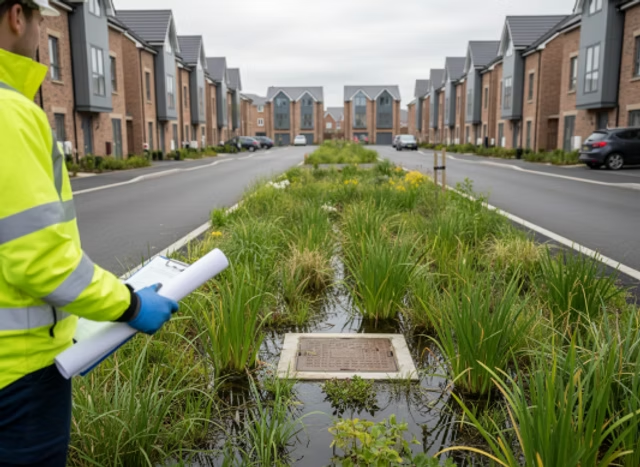
Standards and guidance increasingly focus on outcomes like flood resilience, water quality, biodiversity, and climate adaptation. Those outcomes depend on routine inspection and timely intervention. A rain garden that is not maintained can become a pond. A permeable pavement with clogged joints stops infiltrating. A flow control that is not checked can cause upstream flooding.
In other words, maintenance is what turns a compliant design into a reliable asset.
What “good” looks like in a maintenance plan
A strong maintenance plan should be clear, specific, and usable. It should not read like a generic template. It should help a site manager, facilities team, or homeowner understand what to do, when to do it, and what “normal” looks like.
At minimum, a good plan should include:
- Asset list and locations: A schedule of every maintainable component, with references to drawings so nothing is missed.
- Access and safety: How each feature is accessed, what restrictions apply, and any safety requirements.
- Inspection frequency: Monthly, quarterly, and annual checks, plus event based inspections after heavy rainfall.
- Maintenance activities: What tasks are required, what tools are needed, and what competence level is assumed.
- Performance indicators: Simple signs that something is not working, such as standing water after 48 hours, visible erosion, odours, silt build up, or damaged vegetation.
- Responsibility and ownership: Who maintains what, and how that responsibility transfers if the site is sold or handed over.
- Record keeping: A basic log format so inspections and actions are documented.
The goal is not to create paperwork. The goal is to create confidence that the system will keep working.
Designing for maintainability (not just compliance)
The easiest maintenance plan to follow is the one that is supported by the design itself. Maintenance planning should start early, not at the end of the project.
Here are practical design choices that make long term performance more likely:
- Provide safe access to inlets, outlets, flow controls, and inspection chambers.
- Avoid hidden complexity where possible. If a component cannot be inspected, it cannot be managed.
- Use robust details that tolerate real world conditions like silt, leaves, and occasional misuse.
- Plan for sediment management with silt traps, forebays, or easily cleaned sumps.
- Make responsibilities obvious by clearly separating private and adoptable elements.
A system that is hard to access or unclear to operate will not be maintained well, even with the best intentions.
Common maintenance risks that get missed
Maintenance plans often fail because they ignore how sites actually operate. A few recurring issues we see:
- No allowance for silt and debris: Many features need early life maintenance, especially in the first year after construction.
- Unclear handover: The plan exists, but no one knows who owns it or where it lives.
- Landscaping conflicts: Planting schemes change, storage areas get used for materials, or access routes are blocked.
- Over reliance on specialist knowledge: If the plan requires a specialist for basic checks, it will not happen.
- No trigger points: Without clear “if this, then do that” guidance, small issues become expensive failures.
A good maintenance plan anticipates these realities and keeps instructions simple.
A simple maintenance schedule you can build on
Every site is different, but most projects benefit from a clear baseline schedule:
- Monthly: Visual checks of inlets and outlets, remove litter and leaves, check for standing water, check for obvious damage.
- Quarterly: Check silt build up, inspect flow controls and chambers, confirm vegetation health where applicable, clear minor blockages.
- Annually: Full system inspection, deeper clean where needed, review performance after seasonal extremes, update the plan if the site use has changed.
- After heavy rainfall: Walk the system, check for erosion, overtopping, debris accumulation, and any signs of flooding.
This approach is easy to explain to clients and easy to implement on site.
How to present maintenance planning for approvals
When maintenance planning is done well, it supports the wider planning narrative. It shows that the design is not only compliant on paper, but also resilient in practice.
To strengthen submissions:
- Reference maintenance responsibilities in the drainage strategy report.
- Include an asset schedule and clear drawing references.
- Explain how the design supports safe access and routine inspection.
- Provide a realistic frequency schedule and record keeping approach.
This is especially important where SuDS features contribute to water quality and biodiversity outcomes, because those benefits depend on ongoing care.
Final thoughts
Maintenance planning under newer standards is about protecting long term performance. It reduces risk, supports approvals, and helps clients avoid avoidable failures.
If you want your drainage and SuDS design to perform for decades, treat maintenance as part of the design, not a document you add at the end.
If you would like support producing a maintenance plan that aligns with your drainage strategy and is practical for real sites, we can help you build it into the project from day one.