What is the CIRIA SuDS Manual and Why It Matters
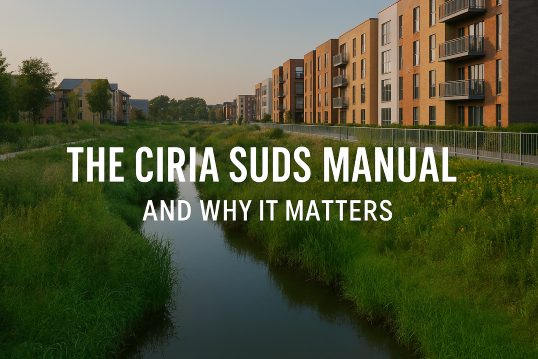
Understanding the Purpose of the SuDS Manual
The CIRIA SuDS Manual, known as C753, is widely recognised as the leading guidance document for sustainable drainage design in the United Kingdom. It sets out best practice principles for managing surface water in a way that moves beyond traditional drainage approaches, which historically focused on conveying water away from sites as quickly as possible.
The official guidance is published by CIRIA and can be accessed here:
👉 CIRIA SuDS Manual (C753)
As SuDS becomes increasingly central to development, understanding the foundations is essential. If you are new to this topic, this article serves as a starting point before exploring how these principles are applied in practice, such as in our guide to
👉 The SuDS Design Philosophy – Managing Rain Where It Falls
A Shift Away from Traditional Drainage Thinking
Traditional drainage systems were designed with one primary goal, which was to remove water from a site quickly and efficiently. While effective in the short term, this approach often increased flood risk downstream and contributed to pollution in natural watercourses.
The SuDS Manual introduces a different way of thinking. Instead of treating water as a problem, it encourages designers to manage it as part of the landscape by slowing it down, storing it, and improving its quality before discharge. This approach aligns closely with national planning guidance on flood risk and drainage:
👉 https://www.gov.uk/guidance/flood-risk-and-coastal-change
The Four Pillars of SuDS Design
At the heart of the SuDS Manual are four interdependent objectives that define sustainable drainage design: water quantity, water quality, amenity, and biodiversity.
Water quantity focuses on controlling the rate and volume of runoff to reduce flood risk. This aligns with national planning policy set out in the
👉 https://www.gov.uk/government/publications/national-planning-policy-framework–2
Water quality addresses the need to treat runoff and remove pollutants before discharge. This aligns with environmental protection guidance such as the
👉https://www.gov.uk/guidance/water-framework-directive-assessment-estuarine-and-coastal-waters
Amenity relates to the creation of visually appealing and usable spaces, while biodiversity focuses on supporting natural habitats. These align with wider environmental policy, including
👉 https://www.gov.uk/government/collections/biodiversity-net-gain
Alignment with Planning Policy and Regulation
Although the SuDS Manual itself is not legislation, it is closely aligned with UK planning policy and is widely used by Lead Local Flood Authorities when assessing drainage proposals.
Planning guidance makes clear that SuDS should be used in major developments unless there is clear evidence that they are not appropriate:
👉 https://www.gov.uk/guidance/flood-risk-and-coastal-change
Designs are expected to demonstrate that they can control runoff, manage water quality, and remain effective over time. Without clear alignment to these principles, schemes are more likely to face delays or require revision.
Why the SuDS Manual Matters in Practice
The importance of the CIRIA SuDS Manual continues to grow as environmental pressures increase. Climate change is leading to more intense rainfall, while urban development is placing greater strain on existing drainage systems.
Government guidance highlights the increasing importance of managing flood risk and building resilience into development:
👉 https://www.gov.uk/guidance/flood-risk-and-coastal-change
As a result, SuDS is no longer a specialist consideration but a core part of how developments are designed. It influences everything from layout and levels to landscape strategy and long-term management.
For architects and designers, understanding the manual is not just about compliance. It is about recognising how early design decisions shape drainage outcomes. When considered from the outset, SuDS can support better layouts, improve placemaking, and reduce the risk of redesign later in the process.
Where to Go Next
This article provides a foundation for understanding what the SuDS Manual is and why it matters. However, its real value comes from how its principles are applied across the design process.
To build on this, you can explore:
If you are working on a project and want to avoid delays, reduce redesign risk, and integrate SuDS effectively from the outset, we can help. At The Drainage Designers, we work closely with architects and developers to deliver compliant, practical, and well-integrated drainage strategies that support both design and planning approval. Whether you are at concept stage or progressing a live scheme, we would be happy to discuss how we can add value to your project.
Martin Young
📞 01256 807116
📧 martin.young@thedrainagedesigners.co.uk
🌐 https://www.thedrainagedesigners.co.uk/