
Sustainable Drainage Systems for Home Renovations: A Guide
Table of Contents
- What Are Sustainable Drainage Systems (SuDS)?
- The Three Pillars of SuDS: Quantity, Quality, and Amenity
- SuDS Planning Permission Requirements for Home Renovations
- Types of SuDS Features: From Permeable Paving for Driveways to Rain Gardens
- How SuDS Mimic Natural Water Cycles and Reduce Flood Risk
- DIY vs. Professional Installation: What Homeowners Need to Know
- Cost-Benefit Analysis: Why Sustainable Drainage Systems Pay Off
- Maintenance and Long-Term Care of Your Drainage System
Last Updated: August 5, 2026
What Are Sustainable Drainage Systems (SuDS)?
Sustainable drainage systems for home renovations represent a fundamental shift in how residential properties manage water. Rather than channelling surface water runoff directly into overwhelmed sewer networks, SuDS work with natural processes to infiltrate, filter, and gradually release rainwater where it falls. This approach mimics how water moves through natural landscapes, slowly and with multiple opportunities for filtration and groundwater recharge.
At The Drainage Designers (Woodvale consulting Ltd), we’ve observed that homeowners often assume traditional drainage is the only option. It isn’t. SuDS encompasses a family of techniques, from permeable paving for driveways to rain gardens and soakaways, each designed to reduce both the volume and velocity of surface water leaving your property. A properly designed SuDS strategy doesn’t just manage water; it improves biodiversity, enhances landscape amenity, and reduces the risk of surface water flooding that increasingly affects UK properties.
The Three Pillars of SuDS: Quantity, Quality, and Amenity
SuDS success depends on balancing three interconnected objectives, each equally important to local authorities and environmental regulators.
Quantity addresses the volume of water your property generates during rainfall. Traditional hard surfaces like concrete driveways and tarmac create impermeable surfaces that shed water rapidly, overwhelming drainage capacity. SuDS reduce peak flows by allowing infiltration and attenuation, the temporary storage of water in rain gardens, detention basins, or permeable layers. This slower release prevents the sudden surges that trigger flooding downstream.
Quality focuses on what happens to that water before it reaches groundwater or watercourses. As surface water runoff travels across your driveway or roof, it picks up contaminants: oils from vehicles, sediment, nutrients from fertiliser. SuDS filter these pollutants through soil layers and vegetation before water infiltrates. A properly installed rain garden or swale acts as a natural treatment system, protecting water quality in local catchments.
Amenity is the element most homeowners appreciate immediately. A rain garden with native planting adds visual interest and biodiversity to your garden. Permeable paving maintains the functionality of a driveway whilst allowing grass and low planting to flourish between pavers. This triple benefit, managing water, protecting the environment, and improving your garden’s appearance, is why planning authorities increasingly expect SuDS in renovation projects.
SuDS Planning Permission Requirements for Home Renovations
Planning permission rules for sustainable drainage systems vary by local authority, but the underlying principle is consistent: new developments and major renovations must demonstrate how they’ll manage surface water without increasing flood risk.
For most residential extensions or new driveways, Building Regulations Part H requires you to show that surface water drainage is adequate. Many local authorities now require a Drainage Strategy or Flood Risk Assessment that specifically addresses SuDS. The Lead Local Flood Authority (LLFA) in your area, typically the county council or unitary authority, sets the local standard.
Before submitting plans, check your local authority’s SuDS policy. You’ll need to establish whether your site can accommodate infiltration-based SuDS (soakaways, permeable paving) by conducting a simple percolation test on your soil. If infiltration isn’t viable due to poor drainage or contaminated ground, you’ll specify attenuation features (rain gardens, detention basins) or other control measures.
The Drainage Designers (Woodvale consulting Ltd) routinely handles this assessment for homeowners and architects. The key is submitting evidence early, ideally at pre-application stage, so your local authority can confirm that your proposed SuDS strategy meets their requirements before detailed design begins. Rejections at the formal planning stage are far more costly than addressing concerns during pre-application consultation.
Types of SuDS Features: From Permeable Paving for Driveways to Rain Gardens
Permeable Paving for Driveways
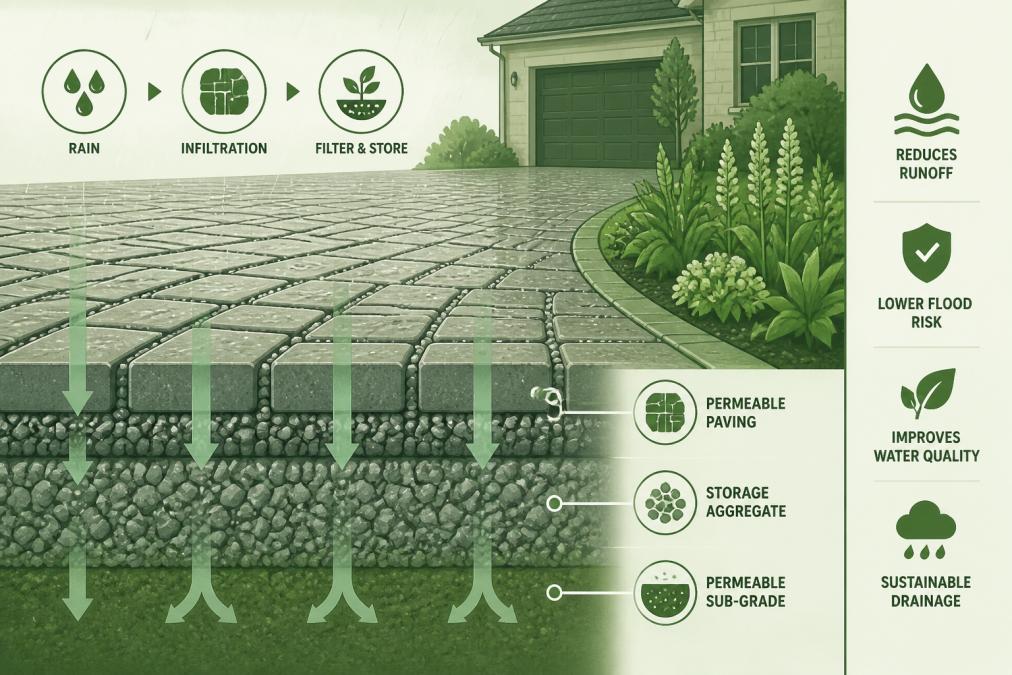
Permeable paving for driveways is one of the most practical SuDS solutions for residential properties. Rather than replacing a traditional impermeable surface with another, permeable alternatives allow water to drain through the surface into a stone reservoir beneath, where it infiltrates into the ground or is gradually released into the drainage system.
The most common options are permeable concrete blocks, resin-bound gravel, or permeable asphalt. Water passes through the surface, through a sand or fine gravel layer, into larger stone (typically 150mm depth), and then into subsoil. This design reduces surface water runoff by up to 100% depending on rainfall intensity and soil permeability. Installation requires proper specification of the stone base and subsoil preparation. Many local authorities now require permeable paving on new driveways as a condition of planning approval, making it a cost-effective compliance measure.
Rain Gardens and Swales
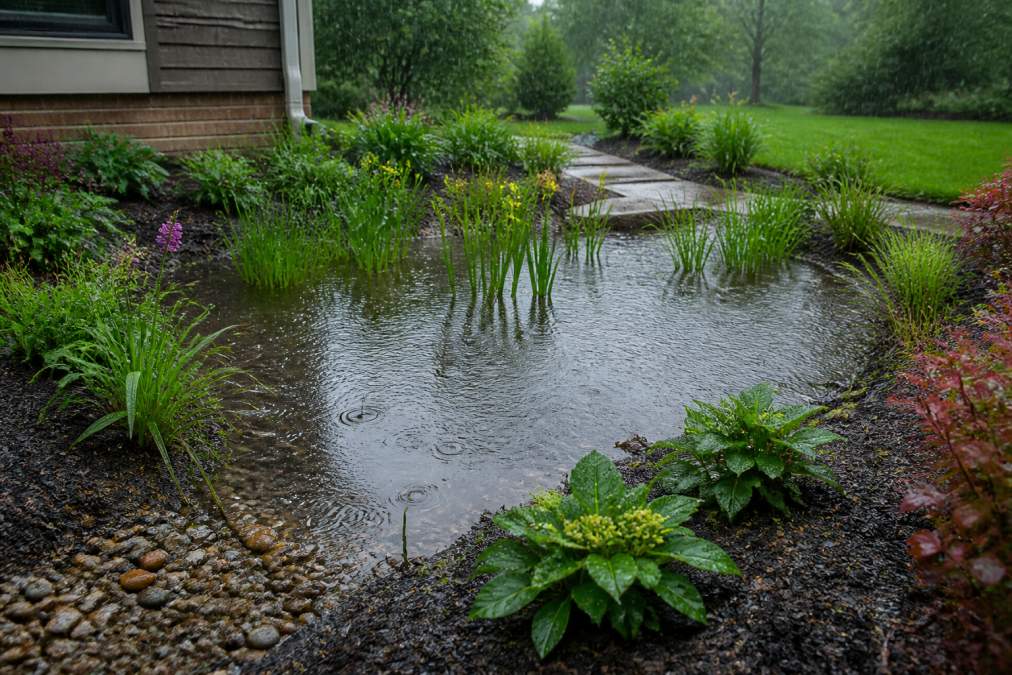
Rain gardens are shallow planted depressions designed to capture and infiltrate surface water runoff from roofs, driveways, and hard landscaping. A typical rain garden is 150-300mm deep, planted with native species tolerant of both wet and dry conditions, and lined with a permeable membrane that allows water to soak through whilst preventing soil erosion.
During rainfall, water collects in the depression, infiltrates through the soil and planting, and recharges groundwater. Between rainfall events, the garden drains completely, functioning as ordinary garden space. This dual-purpose design, combining water management with landscape amenity, is why rain gardens have become standard in residential SuDS strategies.
Swales are linear versions of the same principle: gently sloped channels, typically 300-600mm deep, that guide surface water runoff whilst allowing infiltration. A swale along the edge of a driveway or between properties can manage significant volumes of water whilst creating a planted feature. Both require careful design to ensure they drain within 24-48 hours of rainfall, preventing stagnation. Native species adapted to UK climate variations are more resilient than ornamental imports.
Soakaway Installation Guide
A soakaway is a subsurface infiltration feature: a pit filled with stone or gravel that receives surface water runoff and allows it to percolate into surrounding soil. Soakaways are ideal where space is limited or where above-ground features like rain gardens aren’t practical.
A typical residential soakaway is 1-2 metres deep and 1-1.5 metres in diameter, constructed in a pit lined with geotextile membrane and filled with clean stone (typically 20-40mm diameter). Rainwater from gutters or surface water from permeable paving drains into the soakaway, where it infiltrates slowly into the surrounding soil.
The critical step is establishing that your soil will actually accept the water. A percolation test, digging a test pit, saturating it, and measuring how quickly water drains, determines whether infiltration-based SuDS are viable. If your soil drains at less than 1 metre per day, infiltration-based soakaways won’t work; you’ll need attenuation features instead. Sizing is straightforward: for a typical residential property, a single 1-metre-diameter soakaway handles runoff from a small roof or driveway. Local Building Control and your LLFA can confirm the specification needed for your site.
How SuDS Mimic Natural Water Cycles and Reduce Flood Risk
Natural landscapes manage rainfall through interception, infiltration, and slow release. Trees and vegetation intercept some rainfall; soil absorbs the rest; groundwater slowly feeds streams and rivers. This distributed, gradual process prevents the sudden surges that cause flooding.
Urban and suburban development replaces this natural system with impermeable surfaces. Tarmac, concrete, and traditional roofing shed water rapidly into underground pipes designed for a smaller, slower flow. When intense rainfall exceeds pipe capacity, increasingly common with climate change, water backs up and floods properties and roads.
SuDS restore elements of the natural cycle. Permeable surfaces allow infiltration. Rain gardens and swales temporarily store water, extending the time it takes to reach watercourses. This attenuation reduces peak flows, keeping volumes within the capacity of downstream drainage systems. Vegetation and soil layers filter water, improving quality before it reaches groundwater or surface watercourses.
(/516/drainage-strategy-report-for-planning-a-step-by-step-guide/)]
For homeowners, this translates to tangible benefits. A property with SuDS is at lower risk of surface water flooding, increasingly important as climate change intensifies rainfall events. You’re also reducing your contribution to downstream flooding that affects neighbours and communities. From a planning perspective, demonstrating that your renovation includes SuDS significantly improves the likelihood of approval, particularly in areas designated as Flood Zones 2 or 3.
DIY vs. Professional Installation: What Homeowners Need to Know
Simple features like rain gardens can often be installed by a competent homeowner, provided you understand soil conditions, drainage design, and planting requirements. You’ll need to conduct a percolation test, calculate the required volume based on your roof or driveway area, and select plants that tolerate both waterlogging and drought.
Soakaways and permeable paving require more precision. A soakaway must be correctly sized and positioned to avoid undermining foundations or creating localised flooding. Permeable paving requires proper base preparation, correct stone gradations, and drainage layer specification. Poor installation leads to surface water pooling, pavement failure, or subsurface water causing structural problems.
Planning approval and Building Control inspection add another layer. Most local authorities require sign-off from a drainage engineer or qualified surveyor before you can proceed. For complex sites, poor drainage conditions, or tight timelines, professional installation is the pragmatic choice.
Many homeowners underestimate the cost of getting approval wrong. A rejected drainage design can delay your entire project by months. Investing in [professional design upfront](/467/professional-drainage-design-services-uk-complete-guide/) saves far more than you’ll spend on the service.
Cost-Benefit Analysis: Why Sustainable Drainage Systems Pay Off
The financial case for SuDS depends on what you’re comparing them to. If the alternative is a traditional soakaway or connection to the public sewer, SuDS often cost more to design and install. But the comparison narrows when you factor in broader benefits. A property with SuDS is less likely to experience surface water flooding, a growing risk that can cause tens of thousands of pounds in damage. Some insurers offer better rates for properties with demonstrable flood mitigation measures.
Permeable paving doubles as a landscape feature, adding visual appeal and potentially increasing property value. Rain gardens support biodiversity and can reduce garden maintenance costs over time. Groundwater recharge benefits the wider environment, reducing pressure on water companies. For developers and architects, planning approval is faster and more certain when you include SuDS from the outset, avoiding costly rejections and redesigns.
Maintenance and Long-Term Care of Your Drainage System
SuDS require more active maintenance than traditional drainage, but it’s straightforward and inexpensive if you understand what’s needed.
Rain gardens and swales need weeding and occasional replanting as vegetation dies back. They should be inspected after heavy rainfall to ensure they drain within 24-48 hours; if water persists, the drainage layer may be blocked or the design may need adjustment. Sediment accumulation over years can reduce infiltration capacity, so the top soil layer may need replacement every 10-15 years.
Permeable paving requires regular sweeping or pressure washing to keep the surface clear of sediment and moss. Blocked pores reduce infiltration, so maintenance is essential. Soakaways rarely need maintenance if properly designed, but they should be inspected during site visits. If water isn’t infiltrating, the surrounding soil may have become compacted or the stone may be clogged with sediment.
The key is establishing a maintenance schedule and sticking to it. A simple annual inspection, checking that features drain properly, removing debris, and addressing any signs of ponding, keeps your system functioning as designed.
The difference between a renovation that manages water responsibly and one that creates problems downstream often comes down to early planning and professional guidance. Sustainable drainage systems for home renovations aren’t optional extras; they’re increasingly a requirement for planning approval and a practical investment in flood resilience.
Get in touch with The Drainage Designers (Woodvale consulting Ltd) for a site assessment and drainage strategy tailored to your property. Our team handles everything from initial percolation testing and design through to securing local authority approval, ensuring your renovation meets current standards and future-proofs your property against changing climate patterns.
| Feature Type | Best For | Maintenance | Infiltration Potential |
|---|---|---|---|
| Permeable paving | Driveways, patios | Regular sweeping, annual inspection | High (if properly installed) |
| Rain gardens | General surface water management | Seasonal weeding, replanting every 10-15 years | High (if soil drains well) |
| Swales | Linear water management along boundaries | Annual inspection, sediment removal | Medium to high |
| Soakaways | Space-limited properties | Minimal (occasional inspection) | Depends on soil type |
According to guidance from the Environment Agency’s sustainable drainage standards, SuDS should be designed to manage at least the 1-in-100-year rainfall event whilst maintaining water quality. Research from the UK Building Research Establishment on SuDS performance demonstrates that properly installed permeable surfaces reduce surface water runoff by 80-100% compared to traditional impermeable alternatives. The British Standards Institution’s guide to sustainable drainage design provides detailed specifications for all SuDS feature types and is the reference standard used by local authorities across the UK.
Frequently Asked Questions
Do I need planning permission for sustainable drainage systems in my home renovation?
Planning permission requirements for sustainable drainage systems depend on your project scope and location. Most residential extensions and renovations involving new impermeable surfaces or changes to surface water drainage require approval under Building Regulations. Some SuDS features like permeable paving on driveways may fall under Permitted Development rights, but this varies by local authority. Contact your Local Authority or Lead Local Flood Authority before starting work to confirm what approvals your specific project needs.
What are the main benefits of SuDS for residential properties?
Sustainable drainage systems offer three key benefits for homeowners. First, they reduce surface water runoff, lowering flood risk during heavy rainfall and protecting your property and surrounding areas. Second, they improve water quality by filtering pollutants through soil and vegetation before water reaches watercourses. Third, they enhance amenity value by creating attractive green spaces like rain gardens and swales that increase biodiversity and property appeal. Over time, these systems also help with groundwater recharge, supporting natural water cycles.
Can I install permeable paving myself, or do I need a professional?
Permeable paving installation requires proper understanding of soil permeability, drainage design, and building regulations compliance. While some homeowners with construction experience may tackle smaller projects, professional installation ensures correct infiltration rates, adequate base layers, and compliance with local planning and building regulations. A professional designer can also assess your site's hydrogeology and catchment characteristics to confirm the paving will perform as intended. For renovation projects requiring council approval, professional installation strengthens your application.
How do soakaways work and what makes them suitable for UK homes?
A soakaway is an underground pit filled with gravel or permeable material that collects surface water and allows it to infiltrate slowly into the ground. This mimics natural drainage and reduces the burden on public sewer networks. Soakaways work well in UK homes where soil permeability is adequate, though site conditions vary significantly by region. Before installing a soakaway, you need a percolation test to measure your soil's infiltration rate. Professional assessment ensures your soakaway is sized correctly for your catchment area and positioned to avoid flooding basements or affecting neighbouring properties.
This article was written using GrandRanker