Scaling Architectural Firms Through Design Outsourcing
Table of Contents
- Why Architectural Firms Turn to Design Outsourcing
- Benefits of Outsourcing Drainage Design
- Outsourcing vs In-House Architectural Drafting
- UK Building Regulations Compliance for Outsourced Designs
- Building a Hybrid Model: Transitioning from In-House to Outsourced Teams
- Quality Control and Communication Protocols
- Getting Started with Design Outsourcing
Last Updated: August 19, 2026
Why Architectural Firms Turn to Design Outsourcing
Architectural practices face a persistent challenge: how to scale capacity without proportional increases in overhead. When a project pipeline swells, firms either hire permanent staff (locking in fixed costs) or turn away work. Design outsourcing offers a third path, accessing skilled resources on demand without the burden of recruitment, training, and idle capacity during quiet periods.
The pressure is real. Small to medium architectural practices often operate with lean teams. A single large project can stretch resources thin. A downturn can leave expensive staff underutilised. Outsourcing drainage design and construction documentation shifts this dynamic. Instead of maintaining a full-time drainage engineer for inconsistent workload, firms engage specialists precisely when needed.
At The Drainage Designers, we work with architectural practices across the UK who’ve discovered that outsourcing isn’t about cutting corners, it’s about accessing expertise they can’t afford to maintain in-house. Whether you’re handling a complex residential extension requiring detailed site surveys or a commercial development needing Sustainable Drainage Systems assessments, outsourced design partners handle the technical documentation while your core team focuses on client relationships and strategic decisions.
This approach addresses a fundamental hiring challenge in architecture. Drainage design expertise is specialised. Finding, vetting, and retaining qualified technicians is costly and time-consuming. Outsourcing transfers that burden to specialists who live and breathe this work.
Benefits of Outsourcing Drainage Design
Outsourcing drainage design delivers tangible advantages that go beyond cost reduction. The primary benefit is scalability without commitment. When workload fluctuates, outsourced resources scale with it. You pay for capacity used, not for permanent headcount sitting idle during slower periods.
Operational efficiency improves measurably. Your team stops managing administrative overhead for additional staff, no recruitment, no onboarding, no compliance training cycles. Instead, you hand off technical documentation to specialists already equipped with current knowledge of Building Regulations, Local Authority requirements, and Lead Local Flood Authority expectations.
Time-to-market accelerates. Drainage design is often a bottleneck in planning submissions. When your internal team is stretched across multiple projects, drawings get delayed, approvals stall, and project timelines slip. Outsourced designers work in parallel with your other disciplines, compressing the overall delivery schedule. Site surveys can be scheduled immediately. Detailed designs follow within days, not weeks.
Quality and compliance become more predictable. Specialists who focus exclusively on drainage design maintain current knowledge of regulatory changes. They understand which councils are strict about SuDS implementation, where flood risk assessments must include climate projections, and how to structure drawings to maximise approval odds on first submission. This reduces rework and rejection risk.
Cost predictability is another advantage. Rather than absorbing salary, benefits, and overhead for permanent staff, you negotiate fixed fees per project phase. Budget clarity improves. There are no surprise salary reviews, pension contributions, or redundancy costs when workload drops.
Access to specialist equipment and software is included. Drainage design requires BIM modelling, hydrological analysis tools, and CAD platforms. Outsourced providers maintain these systems. You don’t invest capital in software licences or training staff on tools used intermittently.
Outsourcing vs In-House Architectural Drafting
The choice between in-house and outsourced architectural drafting depends on your project mix, team size, and strategic goals. Understanding the trade-offs is essential.
In-house teams offer direct control and immediate availability. Your staff understand your practice’s standards, client preferences, and workflow. Communication is instant. There’s no handoff delay or coordination overhead. For firms with consistently high workload, permanent staff may be more cost-effective than outsourcing every project.
However, in-house capacity creates fixed costs. A full-time drainage engineer costs roughly the same whether you’re executing one project or five. During slow periods, that becomes expensive overhead. Recruitment and retention are also friction points. Finding qualified drainage technicians in competitive markets takes months. Training them on your systems takes additional time. If they leave, you’re back to square one.
Outsourced teams excel at flexibility. You engage specialists for specific project phases, site survey and assessment, detailed design, drawing revisions, council submission support. Once the phase concludes, the engagement ends. No permanent payroll. No bench strength sitting unused.
The trade-off is reduced direct control. Outsourced partners must understand your standards and client expectations. Communication happens asynchronously across emails and file sharing. Revisions take longer than a quick chat with your in-house draughtsperson. Time zone differences (if outsourcing internationally) can further slow turnaround, though UK-based providers eliminate this friction.
Quality variance is a risk with outsourcing. Not all drainage design firms maintain the same standards. Vetting partners carefully is essential. The Drainage Designers mitigates this by maintaining a transparent customer charter, delivering consistent quality across all projects, and ensuring every design aligns with your practice’s specifications.
Many architectural practices adopt a hybrid model. Core team handles routine projects and client management. Outsourced specialists handle peaks and specialised work (SuDS, complex flood risk assessments, CAD documentation). This balances flexibility with control, reducing permanent overhead while maintaining capacity for growth.
UK Building Regulations Compliance for Outsourced Designs
Outsourced drainage design must comply with UK Building Regulations and Local Authority requirements. Non-compliance creates liability, delays approvals, and damages client relationships. This is where specialist knowledge becomes critical.
Building Regulations Part H (Drainage and Waste Disposal) sets mandatory standards for foul and surface water drainage. Designs must demonstrate adequate capacity, proper gradients, and appropriate materials. Part L (Conservation of Fuel and Power) increasingly includes water efficiency requirements. Outsourced designers must stay current on all applicable parts.
Local Authority Building Control enforces these standards. Each council interprets regulations slightly differently. Some are strict about SuDS implementation; others prioritise conventional drainage if site conditions permit. Experienced outsourced partners understand local authority preferences because they work with them repeatedly. This knowledge accelerates approvals.
Lead Local Flood Authority (LLFA) approval is mandatory for developments in flood-risk areas or those affecting flood risk. Designs must include flood risk assessment, demonstrate that the development doesn’t increase flooding elsewhere, and incorporate appropriate mitigation. This is complex technical work requiring specialist expertise. Outsourced providers typically handle LLFA coordination, reducing burden on your practice.
Building Regulations approval requires detailed technical documentation: cross-sections showing gradients, material specifications, calculations demonstrating adequate capacity, and maintenance access provisions. Drawings must be clear enough for inspectors to verify compliance on site. Outsourced designers produce documentation that passes first-time review, avoiding costly revisions.
The Drainage Designers ensures every design complies with current Building Regulations, Local Authority standards, and LLFA requirements. Our team maintains relationships with councils across the UK, understanding their specific expectations. This translates to faster approvals and fewer conditions on discharge.
Building a Hybrid Model: Transitioning from In-House to Outsourced Teams
Many architectural practices don’t move entirely to outsourcing. Instead, they build a hybrid model, retaining some in-house capability while outsourcing overflow and specialised work. This approach balances control, cost, and flexibility.
The transition requires careful planning. Start by identifying which work should remain in-house. Routine projects, client-facing design, and strategic decisions typically stay internal. Outsource technical documentation, detailed CAD work, and compliance-heavy tasks. This preserves your team’s core skills while reducing their workload on repetitive tasks.
Next, establish clear handoff protocols. Define what information you’ll provide to outsourced partners, what deliverables you expect, and what timeline applies. Document your standards, drawing conventions, specification formats, approval processes. The clearer your brief, the fewer revisions you’ll need.
Communication is critical during transition. Your team will initially feel they’re losing control. Involve them in selecting outsourced partners. Let them review early deliverables and provide feedback. Build trust gradually. After a few projects, your team will understand how outsourced partners work and what quality to expect.
Start with a pilot project. Outsource a complete drainage design for a straightforward residential extension. Use this to test workflows, identify gaps in your brief, and assess the outsourced partner’s quality and responsiveness. If successful, expand to more complex projects.
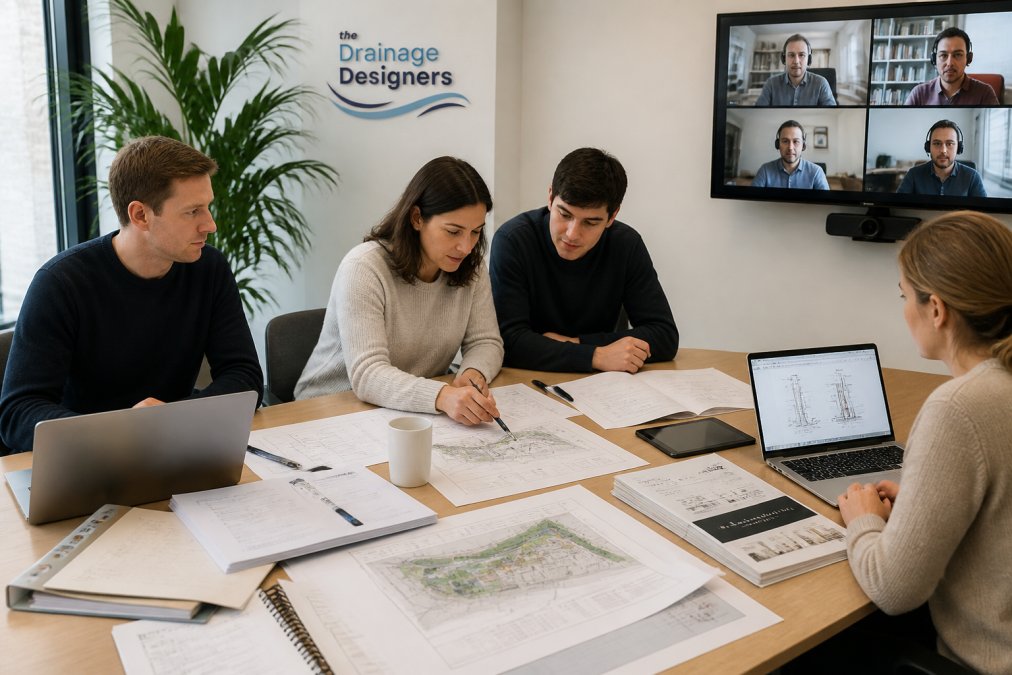
Track metrics during transition. Measure project turnaround times, approval rates, revision cycles, and cost per deliverable. Compare in-house versus outsourced performance objectively. This data guides future decisions about which work to outsource.
Resource allocation improves as the hybrid model matures. Your in-house team focuses on high-value work, client relationships, design innovation, strategic planning. Outsourced partners handle documentation and compliance work. This often increases job satisfaction for your permanent staff, as they spend less time on repetitive drafting and more on creative problem-solving.
Quality Control and Communication Protocols
Outsourcing introduces coordination complexity. Without clear protocols, quality suffers and communication breaks down. Establishing strong processes from the start prevents problems.
Quality control begins with a detailed brief. Before outsourcing any work, document the project scope, regulatory requirements, client specifications, and your practice’s standards. Include site survey data, existing plans, and any constraints. The more comprehensive your brief, the fewer misunderstandings occur.
Regular review cycles are essential. Don’t wait until final deliverables to assess quality. Schedule checkpoint reviews at 25%, 50%, and 75% completion. This allows early correction of errors or misalignments before they cascade through the design.
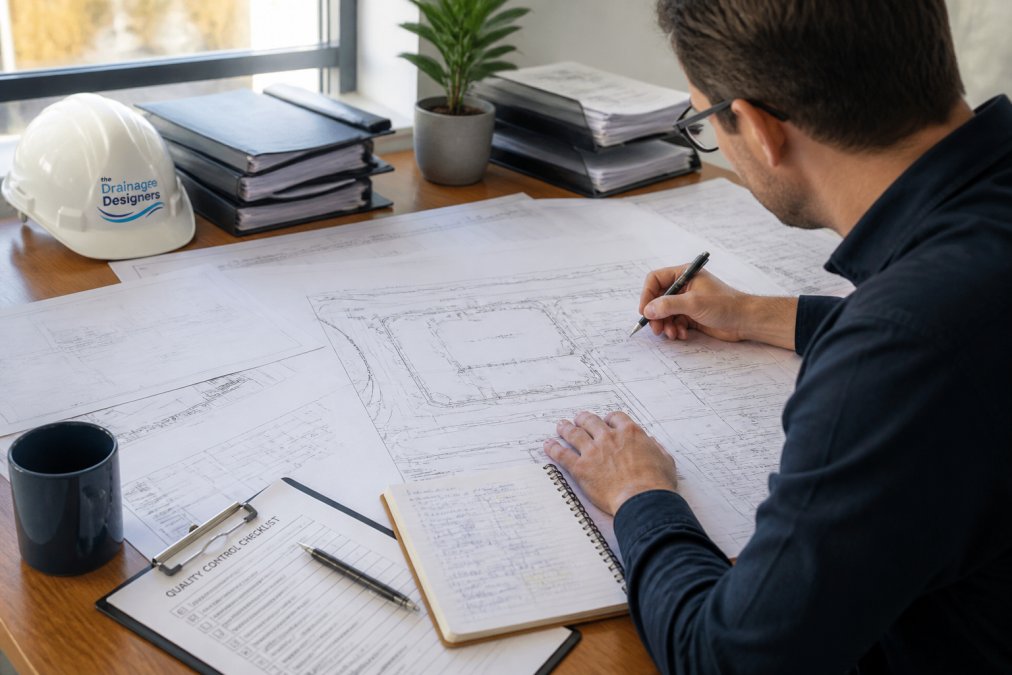
Communication protocols prevent delays. Define who communicates with the outsourced partner, how frequently, and through what channels. Weekly progress calls work well for complex projects. Email is appropriate for status updates and document exchange. Avoid informal communication that creates confusion about decisions or requirements.
Version control is critical when multiple parties edit documents. Use clear naming conventions: include date, revision number, and drafter initials. Store all versions centrally so no one works from outdated files. This prevents costly rework when conflicting versions circulate.
Approval workflows must be explicit. Who reviews outsourced deliverables? What criteria determine approval? What happens if revisions are needed? Document this before engagement begins. Ambiguity creates friction and delays.
The Drainage Designers operates to a transparent customer charter covering communication frequency, revision processes, and approval timelines. We understand that outsourcing only works when both parties operate from aligned expectations. Clear protocols ensure projects flow smoothly and clients remain confident in the process.
Getting Started with Design Outsourcing
Selecting an outsourced partner is the critical first step. The wrong choice creates more problems than outsourcing solves. The right partner becomes an extension of your team.
Start by defining your needs precisely. What work will you outsource? How frequently? What complexity level? Are you seeking ongoing partnership or project-by-project engagement? This clarity helps you find a suitable partner rather than settling for whoever responds first.
Evaluate potential partners rigorously. Request examples of similar projects. Review their quality, compliance, and documentation standards. Ask for references from other architectural practices. Understand their process, turnaround times, and communication style. Don’t choose based solely on cost, the cheapest option often delivers poor quality, creating expensive rework.
Verify their expertise in your specific domain. If you need SuDS designs, confirm they’ve delivered successful SuDS projects. If you work primarily on residential extensions, ensure they understand the planning and Building Regulations requirements for this sector. Specialist knowledge matters enormously.
Check their compliance credentials. Are they familiar with Local Authority requirements across the regions where you operate? Do they maintain current knowledge of Building Regulations updates? Have they worked successfully with the councils you submit to? This background prevents approval delays caused by non-compliance.
Start with a trial engagement. Outsource a single project or project phase. Use this to assess quality, communication, and responsiveness. If successful, expand the relationship. If problems emerge, it’s better to discover them on a small project than on a critical client delivery.
Establish clear terms before beginning. Document scope, deliverables, timeline, revision limits, and cost. Include communication protocols and approval processes. Ambiguity creates conflict; clarity enables smooth collaboration.
According to the Royal Institute of British Architects guidance on outsourcing, successful partnerships require aligned values and transparent communication. This is as true for drainage design as for any professional service.
The Drainage Designers works with architectural practices throughout the UK who’ve made the decision to outsource drainage design. We handle everything from initial site survey through final council submission. Our team understands UK Building Regulations, Local Authority expectations, and the specific requirements of LLFA approval. We deliver compliant designs that secure approvals on schedule, allowing your practice to focus on what you do best, designing buildings that clients love.
Outsourcing isn’t about reducing quality. It’s about accessing specialist expertise efficiently, scaling capacity without permanent overhead, and freeing your team to focus on strategic work. When executed thoughtfully, design outsourcing accelerates project delivery, improves compliance, and strengthens your practice’s competitive position.
Scaling your architectural practice requires more than good design, it requires reliable, compliant technical documentation delivered on schedule. The Drainage Designers provides exactly that. Our nationwide service covers site surveys, flood risk assessments, SuDS design, Building Regulations compliance, and Local Authority coordination. We simplify the complex planning process so your practice can focus on growth. Get in touch to discuss how outsourced drainage design can strengthen your next project.
Frequently Asked Questions
What are the main benefits of outsourcing drainage design for architectural practices?
Outsourcing drainage design allows firms to manage workload fluctuations without maintaining permanent staff, reduce overhead costs, and access specialist expertise in complex areas like Sustainable Drainage Systems (SuDS) and flood risk assessments. Practices can focus resources on core design competencies whilst outsourced partners handle technical documentation and compliance work, improving overall operational efficiency and time-to-market for projects.
How does outsourcing ensure compliance with UK building regulations?
Specialist outsourced providers stay current with Building Regulations, Local Authority requirements, and Lead Local Flood Authority guidelines across different regions. They conduct thorough site assessments, produce compliant technical documentation, and manage the approval process with councils. This reduces the risk of rejections and rework, as outsourced teams have dedicated expertise in navigating regional variations in building control requirements.
Is outsourcing drainage design more cost-effective than hiring in-house staff?
For most small-to-medium practices, outsourcing offers better cost-benefit outcomes. You avoid recruitment costs, training, employee benefits, and idle capacity during quiet periods. Outsourced services typically operate on a per-project or retainer basis, allowing predictable pricing and flexibility. Firms pay only for the capacity they need when they need it, making it particularly valuable for managing peak workloads without long-term staffing commitments.
Can we outsource part of a project and handle the rest in-house?
Yes. Many practices use a hybrid model, outsourcing specific tasks like CAD drafting, BIM modeling, or drainage design whilst retaining design leadership and client management in-house. This approach lets you scale capacity for specific bottlenecks without restructuring your entire team. Clear communication protocols and defined handover points between in-house and outsourced teams are essential to maintain design integrity and workflow continuity.
This article was written using GrandRanker