
SuDS Planning Conditions: A Developer’s Guide
Table of Contents
- What Are SuDS Planning Conditions?
- Understanding Lead Local Flood Authority SuDS Requirements
- When SuDS Planning Conditions Apply to Your Development
- Creating Your SuDS Drainage Strategy Template
- The SuDS Approval Process Timeline
- Developing Your SuDS Maintenance and Management Plan
- Common Reasons for SuDS Planning Condition Rejection
- Conclusion
What Are SuDS Planning Conditions?
SuDS planning conditions are requirements imposed by local planning authorities to ensure that new developments incorporate sustainable drainage systems that manage surface water runoff effectively. These conditions form part of planning permission and must be discharged before construction can proceed or be fully completed.
Unlike traditional piped drainage systems that concentrate water and increase flood risk downstream, SuDS planning conditions require developers to implement a hierarchy of drainage approaches. This means managing water where it falls, reducing peak runoff rates, and improving water quality before discharge. The conditions typically specify technical standards, maintenance responsibilities, and approval processes that must be followed throughout the project lifecycle.
At The Drainage Designers (Woodvale consulting Ltd), we’ve guided developers through understanding and meeting these conditions. The complexity often lies not in the concept itself, but in translating regulatory requirements into practical site-specific solutions that satisfy both the local planning authority and the Lead Local Flood Authority.
SuDS planning conditions exist because traditional drainage systems have failed to prevent flooding. By requiring sustainable approaches, authorities shift responsibility for managing surface water from centralised infrastructure to individual developments. This distributed approach reduces strain on public sewers and protects downstream communities from flood risk.
Understanding Lead Local Flood Authority SuDS Requirements
The Lead Local Flood Authority (LLFA) is the statutory body responsible for managing flood risk from surface water, groundwater, and ordinary watercourses in your area. When a development triggers SuDS planning conditions, the LLFA’s technical requirements become part of your planning obligation.
LLFAs typically require evidence that your SuDS design follows the drainage hierarchy. This means demonstrating that infiltration has been considered first, then attenuation and conveyance, and only as a last resort discharge to a watercourse or sewer. Each stage must be justified with site assessment data showing soil permeability, groundwater levels, and site topography.
The LLFA will expect your SuDS approval process to include detailed hydraulic modelling showing how your design handles the 1-in-100-year rainfall event plus climate change allowances. These aren’t optional calculations, they’re statutory requirements that determine whether your planning conditions can be discharged.
Many developers underestimate how detailed LLFA scrutiny can be. Your LLFA will demand evidence of site assessment, soil testing, and professional design before they’ll sign off on discharge of conditions.
When SuDS Planning Conditions Apply to Your Development
SuDS planning conditions apply to most developments that increase impermeable surface area, though the threshold varies by local planning authority. Residential extensions, new houses, commercial buildings, and major renovations typically trigger these requirements if they exceed the authority’s specified threshold, often around 100 square metres of new hardstanding.
Critical drainage areas, zones where the local authority has identified higher flood risk, have lower thresholds or stricter SuDS requirements. If your site falls within a critical drainage area, you should expect more rigorous technical scrutiny and potentially more expensive SuDS solutions.
Critical Drainage Areas and Site Assessment
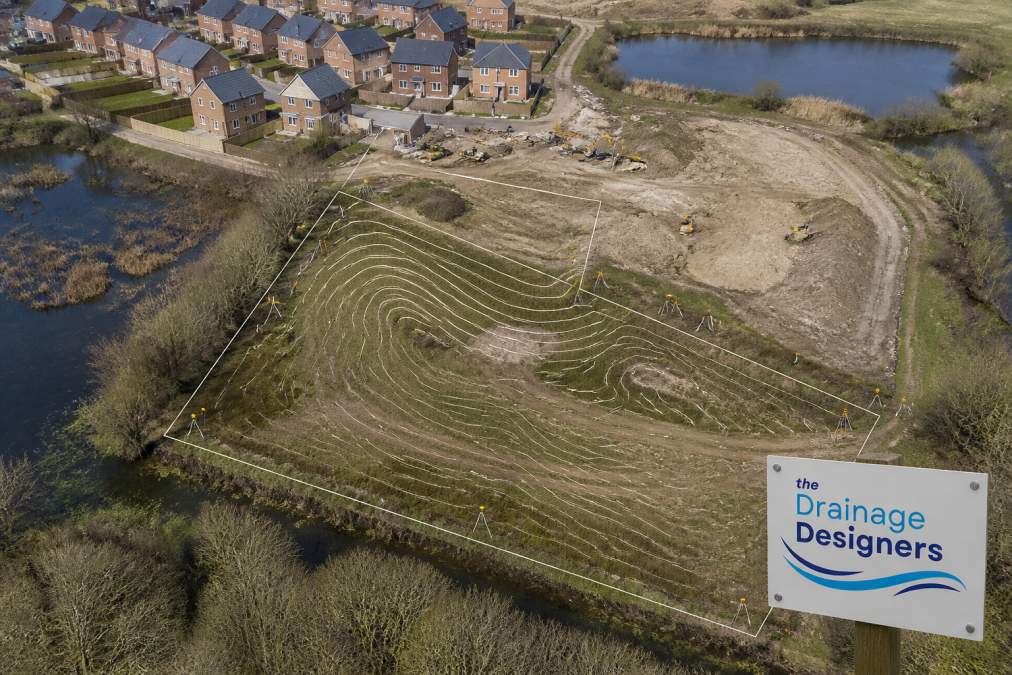
A critical drainage area is a designated zone where surface water flooding poses a significant risk to properties and infrastructure. Your local planning authority or LLFA will have mapped these areas. If your development site falls within one, you’ll face stricter SuDS planning conditions and higher standards of runoff control.
Before any SuDS design can proceed, a proper site assessment is essential. This involves a site visit to evaluate soil permeability, groundwater depth, site topography, and existing drainage patterns. Soil testing, typically a simple infiltration test, determines whether infiltration-based SuDS are feasible or whether you’ll need attenuation ponds or permeable paving instead.
The site assessment also identifies constraints: underground utilities, contaminated land, protected species habitats, and proximity to watercourses. These constraints shape what SuDS options are actually viable for your specific location. A solution that works on one site may be impossible on another, which is why generic SuDS templates often fail planning scrutiny.
Flood Risk Assessment Requirements
A flood risk assessment is a statutory requirement for developments in flood zones or where the development is likely to increase surface water runoff (gov.uk). Even if your site isn’t in a designated flood zone, the LLFA often requires one as part of SuDS planning condition discharge.
The assessment must demonstrate that your development will not increase flood risk to surrounding properties. This means calculating existing runoff rates, designing SuDS to match or reduce those rates, and showing that attenuation storage is adequate for extreme rainfall events. The calculations must account for climate change, typically a 40% increase in rainfall intensity for the design life of the development (gov.uk).
Many planning condition rejections happen because flood risk assessments are underestimated. Developers sometimes assume a simple calculation will suffice, but LLFAs now demand detailed hydraulic modelling using professional software. This is where working with specialists becomes essential.
Creating Your SuDS Drainage Strategy Template
A SuDS drainage strategy is the core technical document that discharges your planning conditions. It sets out which SuDS features you’ll use, where they’ll be located, how they’ll be maintained, and how they’ll perform under design rainfall events.
The strategy must address the drainage hierarchy systematically. Start by showing whether infiltration is possible on your site, this is the preferred option. If infiltration testing shows poor permeability, move to the next tier: attenuation storage combined with controlled discharge. The strategy must justify why each tier was or wasn’t chosen, backed by site assessment data.
Hydraulic Control and Runoff Calculations
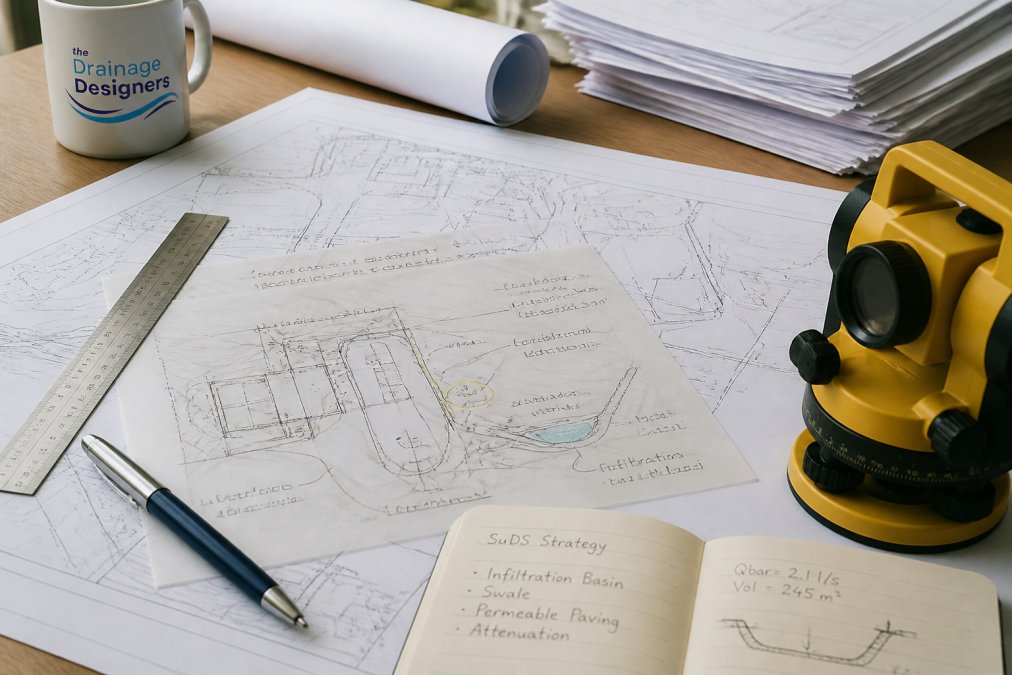
Hydraulic control means managing the rate at which water leaves your development. Instead of allowing all surface water to drain immediately, you slow it down through attenuation storage, ponds, swales, or underground tanks that temporarily hold water and release it gradually.
Runoff calculations determine how much water your site will generate during a design rainfall event. For a residential development, this typically means calculating the 1-in-100-year rainfall intensity (a rainfall event expected to occur once every 100 years on average) plus a climate change allowance. The calculation uses the site’s impermeable area, rainfall intensity, and runoff coefficient to determine peak flow rate in litres per second.
Your SuDS strategy must show that post-development runoff rates don’t exceed pre-development rates. This is the core principle behind SuDS planning conditions. If your site currently drains naturally at 5 litres per second, your SuDS design must ensure that after development, runoff doesn’t exceed that rate during the design event.
The calculations require professional hydraulic modelling software. Excel spreadsheets and simple formulas won’t satisfy modern LLFA requirements. The model must show how water moves through your site, how attenuation features store and release water, and whether your design performs adequately under extreme rainfall.
Water Quality and Biodiversity Net Gain
SuDS planning conditions increasingly require demonstration of water quality improvements. This means showing that pollutants are removed before water leaves your site or discharges to a watercourse. Permeable paving, bioswales, and reed beds all provide water quality treatment by filtering sediment and removing contaminants.
Biodiversity net gain has become a statutory requirement for most developments. Your SuDS strategy should explain how your design delivers habitat benefits. A well-designed attenuation pond with marginal planting provides breeding habitat for amphibians and birds. Permeable paving reduces habitat loss compared to traditional hardstanding. Swales and bioretention features support plant and invertebrate communities.
The strategy doesn’t need to be elaborate, but it must show that you’ve considered ecological benefits alongside drainage function. Planning authorities now expect integrated design that delivers multiple benefits: flood risk reduction, water quality improvement, and habitat creation.
The SuDS Approval Process Timeline
The SuDS approval process typically involves multiple stages and can take 8-16 weeks from initial submission to discharge of conditions (gov.uk). Understanding this timeline helps you plan project delivery and avoid delays caused by incomplete submissions or LLFA requests for further information.
The process begins with submission of your SuDS drainage strategy to the LLFA. They’ll review it against their technical standards, request site visit evidence if needed, and either approve it, request modifications, or reject it. A well-prepared strategy with comprehensive site assessment data and professional hydraulic modelling is more likely to be approved first time.
Discharge of Conditions and SAB Approval
Discharge of conditions is the formal process of satisfying planning conditions before construction begins. For SuDS, this means submitting your approved drainage strategy to the local planning authority and LLFA, who then formally confirm that the condition has been discharged.
Some local authorities require SuDS Approval Body (SAB) sign-off before discharge. The SAB is typically the LLFA or a designated council officer with technical expertise. They’ll check that your design complies with the technical standards, that site assessment evidence is adequate, and that maintenance arrangements are clearly defined.
The timeline for SAB approval varies significantly by authority. If your application is incomplete or raises technical questions, the clock resets when you submit additional information. This is why many developers experience delays, they submit preliminary designs expecting quick approval, then face multiple rounds of revisions.
Working with specialists who understand your specific LLFA’s expectations can significantly accelerate this process. Different authorities prioritise different aspects: some focus heavily on hydraulic modelling, others on maintenance arrangements. Knowing what your LLFA values helps you prepare a submission that addresses their concerns upfront.
Developing Your SuDS Maintenance and Management Plan
A SuDS maintenance and management plan is a statutory requirement that often determines whether your planning condition will be discharged. This document sets out who will maintain your SuDS features, what maintenance activities are required, how often they occur, and what happens if maintenance is neglected.
The plan must be realistic and enforceable. If you propose that a private householder will maintain an attenuation pond in perpetuity, the LLFA will likely reject this. Instead, the plan should identify a responsible body: a management company, the local authority, or a residents’ association with formal legal obligations.
Adoption by the local authority is often the preferred option, but authorities increasingly resist adopting SuDS. This is pushing developers toward private management companies or residents’ associations, which must be set up with legal agreements that ensure maintenance actually happens.
The maintenance plan must specify what happens if features fail. If an attenuation pond becomes overgrown and loses storage capacity, who’s responsible for clearing it? What if a permeable paving surface becomes blocked? These scenarios must be anticipated and addressed in the plan, otherwise your condition discharge will be refused.
Common Reasons for SuDS Planning Condition Rejection
Understanding why applications fail helps you avoid the same mistakes. The most common rejections result from incomplete site assessment, inadequate hydraulic modelling, or unrealistic maintenance plans.
Inadequate site investigation is the leading cause of rejection. Many developers submit SuDS strategies based on assumptions about soil permeability without actually testing the site. When the LLFA requests infiltration test results and none are provided, the application fails. Site assessment must be thorough: soil testing at multiple locations, groundwater level monitoring, and assessment of site topography.
Poor hydraulic modelling is another frequent issue. Developers use simplified calculations that underestimate runoff or don’t account for climate change allowances. The LLFA now expects detailed modelling using professional software that shows how water moves through the site during design rainfall events. If your model shows inadequate attenuation storage or excessive discharge rates, the condition won’t be discharged.
Vague maintenance arrangements cause rejections because authorities can’t enforce them. A statement that "maintenance will be arranged" is insufficient. The plan must name the responsible body, specify maintenance activities and frequency, include cost estimates, and establish legal mechanisms to ensure maintenance actually occurs.
Failure to address water quality requirements is increasingly common. Many developers focus solely on runoff control and ignore water quality. Modern SuDS planning conditions require evidence that pollutants are removed. If your strategy doesn’t address water quality treatment, expect a request for further information or rejection.
Inadequate biodiversity consideration now causes rejections in many authorities. If your SuDS design is purely functional with no ecological benefit, you may be asked to redesign to incorporate habitat features. This doesn’t mean elaborate ecological design, simply considering planting, marginal zones, and habitat creation as part of the SuDS layout.
SuDS planning conditions represent a significant shift in how developments manage surface water. Rather than piping water away quickly, you’re now responsible for managing it on-site, treating it, and delivering environmental benefits. This requires proper site assessment, professional technical design, and realistic long-term maintenance arrangements.
The Drainage Designers (Woodvale consulting Ltd) helps developers navigate this process from initial site assessment through discharge of conditions. Our approach focuses on understanding your specific site constraints and your LLFA’s technical expectations, then designing solutions that satisfy both. We handle the technical documentation, liaise with planning authorities, and ensure your conditions are discharged efficiently. Get in touch to discuss how we can help your project succeed.
Frequently Asked Questions
What are the mandatory SuDS requirements for new developments?
New developments must incorporate sustainable drainage systems that manage surface water runoff on-site where feasible. Requirements include a site assessment to determine soil permeability and infiltration potential, a flood risk assessment, and a drainage strategy that demonstrates how runoff will be managed. The hierarchy requires source control first (permeable paving, green roofs), then conveyance and storage, with discharge to watercourses only when infiltration is not viable. Your local planning authority and Lead Local Flood Authority will specify conditions based on site topography and critical drainage area designation.
Do SuDS need planning permission for small-scale residential extensions?
Most residential extensions require SuDS planning conditions if they increase impermeable surface area. Even modest extensions must demonstrate how surface water will be managed and not increase flood risk. The threshold varies by local authority, but any development affecting drainage or increasing runoff rates typically needs a SuDS drainage strategy template submitted with your planning application. Extensions in critical drainage areas face stricter scrutiny. Check your local planning authority's guidance on what triggers SuDS requirements for your specific project.
How long does the SuDS approval process timeline typically take?
The SuDS approval process timeline depends on several factors. Initial site assessment and drainage strategy preparation usually takes 2-4 weeks. Local planning authority review of your SuDS submission can take 4-8 weeks, depending on complexity and whether they request revisions. Discharge of conditions (final approval of detailed design) typically takes another 2-4 weeks once submitted. If Lead Local Flood Authority consultation is required, add 2-3 weeks. Total time from initial submission to discharge of conditions is typically 8-16 weeks, but can extend if revisions are needed.
What happens if my SuDS design doesn't meet local planning authority standards?
If your SuDS planning conditions submission is rejected or comes back with significant conditions, the local planning authority will specify what needs to change. Common issues include insufficient hydraulic control, inadequate water quality measures, or failure to demonstrate compliance with the drainage hierarchy. You'll need to revise your SuDS drainage strategy template and resubmit for discharge of conditions. This can delay your project. Working with experienced drainage consultants from the outset significantly reduces rejection risk by ensuring your design meets Lead Local Flood Authority requirements and local standards before formal submission.
This article was written using GrandRanker