
SuDS Maintenance: A Landowner’s Guide
Table of Contents
- Who is Responsible for SuDS Maintenance?
- How to Maintain SuDS on Private Land: Key Principles
- A SuDS Maintenance Schedule Template for Busy Landowners
- Permeable Paving Maintenance Best Practices
- DIY vs. Professional Maintenance: What to Tackle Yourself
- Troubleshooting Common SuDS Failures
- The Cost-Benefit Analysis of Regular Maintenance
- How Maintenance Impacts LLFA SuDS Planning Applications
- Frequently Asked Questions
Last Updated: September 5, 2026
Who is Responsible for SuDS Maintenance?
Sustainable Drainage Systems (SuDS) are designed to manage surface water runoff close to where it falls, reducing flood risk and improving water quality. SuDS maintenance is the ongoing process of inspecting, cleaning, and repairing these drainage assets to ensure they continue to perform as designed. When a SuDS scheme is built on private land, the legal responsibility for its upkeep typically falls on the landowner, not the local council.
Your Legal Duties and Liabilities
Under UK environmental regulations, the owner of a property with a SuDS feature holds the liability for its performance (gov.uk). This duty usually begins at the point of adoption or handover, where the system’s maintenance manual becomes a binding document for future owners.
If you fail to maintain the system, you could face several consequences. A blocked or silted drainage feature can cause localised flooding on your property, and it may also affect neighbouring land. In more serious cases, non-compliance with regulatory standards can lead to enforcement action from your Lead Local Flood Authority (LLFA) or the Environment Agency. The guidance on sustainable drainage systems confirms that proper upkeep is essential for the system to function and remain compliant.
How to Maintain SuDS on Private Land: Key Principles
Effective maintenance of SuDS on private land is not a single task but a cycle of observation and response. The core principle is to act before a problem becomes severe, protecting both the drainage capacity and the structural integrity of the system.
A common approach is to group tasks into three categories: routine, remedial, and occasional. Routine tasks, such as litter picking and visual checks, happen frequently. Remedial tasks, like removing silt from a gully, occur less often. Occasional tasks, such as repairing structural damage, are rare but essential. Many owners find that a simple logbook of these activities helps track what has been done and when.
The most effective maintenance strategy is a consistent one. A system that receives small, regular attention will outperform one that is left untouched for years and then requires costly repairs.
A SuDS Maintenance Schedule Template for Busy Landowners
A generic schedule is of little use if it does not reflect the specific assets on your land. The most effective template is one you tailor to each feature, listing the exact location, the task, the frequency, and the safety precautions required. Below is a more granular starting point that covers the typical assets found on private residential or small commercial sites.
Detailed Asset Schedule
| Asset Type | Task | Frequency | Safety / Notes |
|---|---|---|---|
| Permeable paving | Remove leaves and debris; sweep surface | Monthly, plus after storms | Use a stiff brush, not a pressure washer on high setting |
| Permeable paving | Check for ponding or silting in joints | Quarterly | If water stands for >24 hours, investigate |
| Swales | Mow banks and base (if dry); remove cuttings | Monthly during growing season | Check for nesting birds before cutting |
| Swales | Inspect inlet/outlet structures for scour or blockage | Quarterly | Look for erosion around headwalls |
| Soakaway / infiltration trench | Inspect inspection pipe for standing water | After heavy rainfall (within 24 hours) | Water should drain within 48 hours |
| Soakaway / infiltration trench | Clear debris from surface inlet | Monthly | Do not jet or rod a soakaway yourself |
| Gully pots / catchpits | Remove silt and debris | Annually (or more often if sediment is visible) | Wear gloves; dispose of silt as waste, not in compost |
| Retention pond | Inspect banks for erosion, animal burrows, or litter | Monthly | Keep a safe distance from water edges |
| Retention pond | Cut aquatic vegetation at edges | Annually (late summer) | Check for protected species first |
| Filter drains | Inspect outlet pipe for blockage | Quarterly | Look for signs of water backing up |
| Green roof | Weed and inspect membrane | Twice a year | Use a professional if the roof is steep or fragile |
Building Your Own Logbook
A logbook is your evidence of compliance. For each asset, record the date of inspection, the task performed, any issues found, and the action taken. A simple spreadsheet or a printed table in a folder works well. The key is consistency. If you ever need to demonstrate due diligence to your Lead Local Flood Authority or an insurer, this logbook is your first line of defence.
Seasonal Triggers to Add to Your Calendar
Do not rely solely on fixed dates. Add weather-based triggers to your schedule:
- After leaf fall: Clear all inlets and surfaces within 48 hours.
- After a 1-in-1-year rainfall event (approx 20mm in a day): Inspect all assets for standing water or overflow.
- Before the first frost: Ensure any above-ground pipework is clear to prevent freeze damage.
- After a prolonged dry spell: Check for cracks in permeable surfaces or pond liners that may have dried out.
Never enter a confined space such as a large chamber or culvert without proper training and rescue equipment. Most private landowners should stop at visual inspections from ground level.
Permeable Paving Maintenance Best Practices
Permeable paving is one of the most common SuDS features on private driveways, yet it is often the most misunderstood. The key to its function is the open surface that allows water to drain through into the sub-base below. SuDS maintenance for this surface must keep those gaps clear of fine sediment and organic matter.
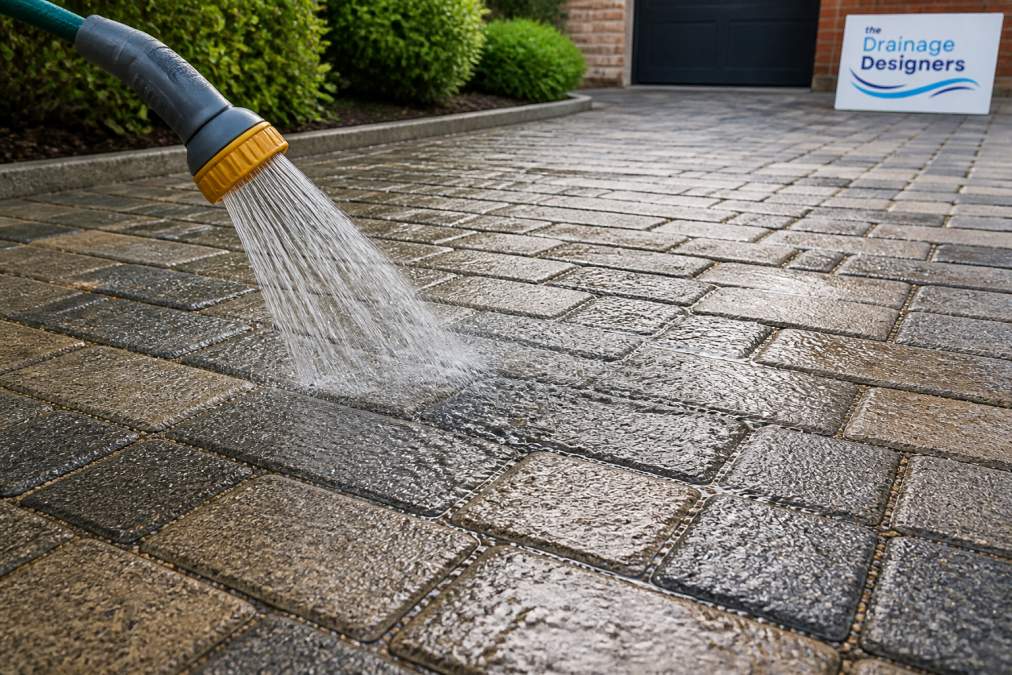
The best practice is simple: sweep the surface regularly and use a hose to wash trapped material into the drainage layer where it can be broken down. A common mistake is sealing the paving or resurfacing it with tarmac, which destroys its permeability and causes surface water to pool (susdrain.org). Routine sweeping prevents clogging, which is the primary cause of premature failure in these systems.
DIY vs. Professional Maintenance: What to Tackle Yourself
Many SuDS maintenance tasks are well within the capabilities of a capable landowner. Litter picking, sweeping, grass cutting, and basic visual inspections are straightforward DIY jobs that require no specialist equipment. For these, a simple schedule and a few basic tools are all you need.
However, some tasks require professional input. If you notice persistent standing water, structural cracking, or a suspected blockage deep within a soakaway, attempting a DIY fix could cause more damage. Professional contractors have the equipment for sediment removal, jetting, and CCTV surveys to diagnose issues within the drainage infrastructure. The decision between DIY and professional help usually comes down to the complexity of the task and the potential cost of getting it wrong.
Troubleshooting Common SuDS Failures
Most SuDS failures do not happen overnight. They present warning signs that, if read correctly, point to a specific cause and a proportionate remedy. The table below maps common symptoms to likely causes and the first steps you should take. This is the diagnostic approach most professional drainage contractors use before recommending any work.
Symptom-to-Solution Table
| Symptom | Likely Cause | First Step | DIY or Professional? |
|---|---|---|---|
| Water pools on permeable paving for >24 hours | Surface clogged with fine silt or organic matter | Sweep thoroughly; check if joints are full of debris | DIY: Sweeping and light hosing |
| Water pools on permeable paving after sweeping | Sub-base is saturated or the geotextile layer is blocked | Check the inspection pipe for water level | Professional: May require jetting or replacement of top layer |
| Swale is waterlogged and grass is dying | Outlet is blocked or the base has compacted | Clear the outlet of debris; check for silt deposits | DIY: Debris removal; Professional: If compaction is suspected |
| Gully pot overflows during moderate rain | Gully is full of silt or the connecting pipe is blocked | Lift the grate and inspect the pot | DIY: If you can safely remove silt from the top; Professional: If blockage is in the pipe |
| Standing water in a soakaway inspection pipe | Infiltration field is clogged or groundwater is high | Record water level; check if it drops over 48 hours | Professional: Do not attempt to rod or jet a soakaway |
| Erosion at the outlet of a pipe or swale | Flow velocity is too high or the energy dissipater is missing | Inspect for scour holes | Professional: May need a flow control or rip-rap |
| Unpleasant smell near a pond or basin | Anaerobic conditions from stagnant water or excess silt | Check inlet and outlet for blockages | Professional: If silt removal is required |
| Cracks in a concrete channel or headwall | Structural movement or freeze-thaw damage | Monitor crack width; check for water leakage | Professional: Structural assessment needed |
A Diagnostic Approach for the Landowner
When you spot a problem, follow this sequence before calling anyone:
- Identify the asset type. Is it a surface, a swale, a basin, or an underground structure?
- Check the obvious first. Is the inlet or outlet blocked with leaves or litter? This solves most problems.
- Look at the water path. Trace where water should flow from the source to the discharge point. The blockage is often where the path changes direction or narrows.
- Wait and observe. Note whether the issue resolves after a dry spell. Some ponding is normal after heavy rain and should drain within 24 to 48 hours.
- Document what you see. Take photos and notes. This helps a professional diagnose remotely and provides a record for your maintenance log.
When a Symptom Points to a Bigger Problem
If you have cleared visible debris and the symptom persists, the issue is likely below ground. A common pattern is a collapsed pipe or a displaced joint that allows soil to enter the system. Do not attempt to dig down to investigate. Excavation near a drainage line can cause further collapse or damage to other services. In this situation, a CCTV survey from a specialist contractor is the standard diagnostic tool. It provides a visual record of the pipe condition and pinpoints the exact location of any defect, allowing for a targeted repair rather than a blanket excavation.
Keep a simple sketch of your drainage layout, showing where each pipe runs and where inspection chambers are located. This will save significant time and money if a professional ever needs to investigate a problem.
The Cost-Benefit Analysis of Regular Maintenance
Investing in regular SuDS maintenance is significantly less expensive than funding emergency repairs or system replacement. A small annual outlay for sweeping and inspections can prevent the need for major excavation work to replace a failed soakaway or re-lay permeable paving. The operational efficiency of a well-maintained system also means it handles rainfall as designed, reducing the risk of property damage.
The true benefit of a maintenance schedule is risk mitigation. By demonstrating proactive care, you protect your property value and maintain compliance with your legal duties. While the cost of professional maintenance varies, the cost of ignoring a problem is almost always higher. A reactive approach often involves emergency call-out fees and more extensive remedial work.
How Maintenance Impacts LLFA SuDS Planning Applications
Your ongoing maintenance records can directly influence future planning decisions. When you apply for a new development or an extension, the Lead Local Flood Authority will assess how surface water will be managed. If you have a history of neglecting your existing SuDS, the LLFA may question your ability to manage new drainage assets.
A documented SuDS maintenance schedule demonstrates to the LLFA that you understand your responsibilities and have the means to meet them. This evidence of proactive management can smooth the path for future LLFA SuDS planning applications, as it shows a commitment to long-term performance and compliance. At The Drainage Designers (Woodvale consulting Ltd), we help clients prepare the documentation needed to show their drainage systems will be managed effectively. Our expertise spans site visits, flood risk assessments, and securing local council approvals, ensuring your development meets all necessary requirements.
Maintaining SuDS on private land is a continuous duty, but it does not need to be a burden. By following a clear schedule, understanding when to call in professionals, and keeping accurate records, you protect your property and stay compliant. If you are planning a new project and need guidance on drainage design or compliance with Local Authority requirements, the team at The Drainage Designers (Woodvale consulting Ltd) is ready to help. Get in touch to discuss how we can support your project from concept to approval.
Frequently Asked Questions
Who is legally responsible for maintaining SuDS on private property?
The landowner or the body responsible for the site’s management is legally responsible for maintaining SuDS on private land. This duty is typically enshrined in a legal agreement or a SuDS management plan approved during the planning process. This plan will specify who must maintain each drainage asset. Failing to meet these obligations can lead to system failure, localised flooding, and potential enforcement action from the Lead Local Flood Authority or the council.
How often should private SuDS features be inspected?
As a general rule, you should conduct a basic visual inspection of your private SuDS features at least once every six months, and after any major storm event. A more detailed inspection, which checks the structural integrity of the system and clears any build-up of silt, should be carried out annually. Your specific SuDS maintenance schedule template, agreed during the planning application, may set out different frequencies depending on the type of drainage asset you have.
What happens if a private SuDS system fails?
If a private SuDS system fails, you may experience surface water flooding on your property, waterlogging, or damage to the drainage infrastructure itself. This can also impact neighbouring land. Because the landowner retains liability, you are responsible for the cost of repairs. Ignoring a failing system could lead to disputes with neighbours or enforcement action from the local authority, so it is best to address issues like clogged inlets or siltation as soon as they are spotted.
Is a soakaway a SuDS?
Yes, a soakaway is a type of sustainable drainage system (SuDS). It is an underground structure designed to collect surface water runoff and allow it to infiltrate naturally into the surrounding ground. Other common SuDS features include permeable paving, swales, and retention ponds. To function correctly, a soakaway requires regular maintenance to prevent silt and debris from clogging the infiltration surface, which would otherwise reduce its drainage capacity.