SuDS Management Plan: A Complete 2026 Guide
Table of Contents
- What Is a SuDS Management Plan?
- Purpose and Objectives of SuDS
- The SuDS Management Train: Components and How They Work
- SuDS Maintenance Requirements and Inspection Frequency
- Creating a SuDS Maintenance Plan Template
- Lead Local Flood Authority SuDS Requirements and Compliance
- Roles, Responsibilities and Long-Term Stewardship
- Conclusion
Last Updated: August 30, 2026
What Is a SuDS Management Plan?
A SuDS management plan is a comprehensive document that outlines how sustainable drainage systems will be installed, maintained, and managed throughout the lifespan of a development. Rather than relying solely on traditional underground pipes and concrete channels, a SuDS management plan integrates natural and engineered drainage solutions that mimic natural hydrological processes. This approach reduces flood risk, improves water quality, and enhances biodiversity on site.
For residential extensions, commercial developments, and new builds, this document becomes essential during the planning approval process. Your local planning authority and Lead Local Flood Authority will scrutinise the plan to ensure it meets current drainage standards and environmental regulations. Without a strong SuDS management plan, planning permission is unlikely to be granted, and you risk costly redesigns or project delays.
The Drainage Designers (Woodvale consulting Ltd) work with homeowners, architects, and developers to create compliant SuDS management plans that secure planning approval. The plan typically covers site drainage strategy, component specifications, maintenance schedules, and long-term stewardship arrangements.
Purpose and Objectives of SuDS
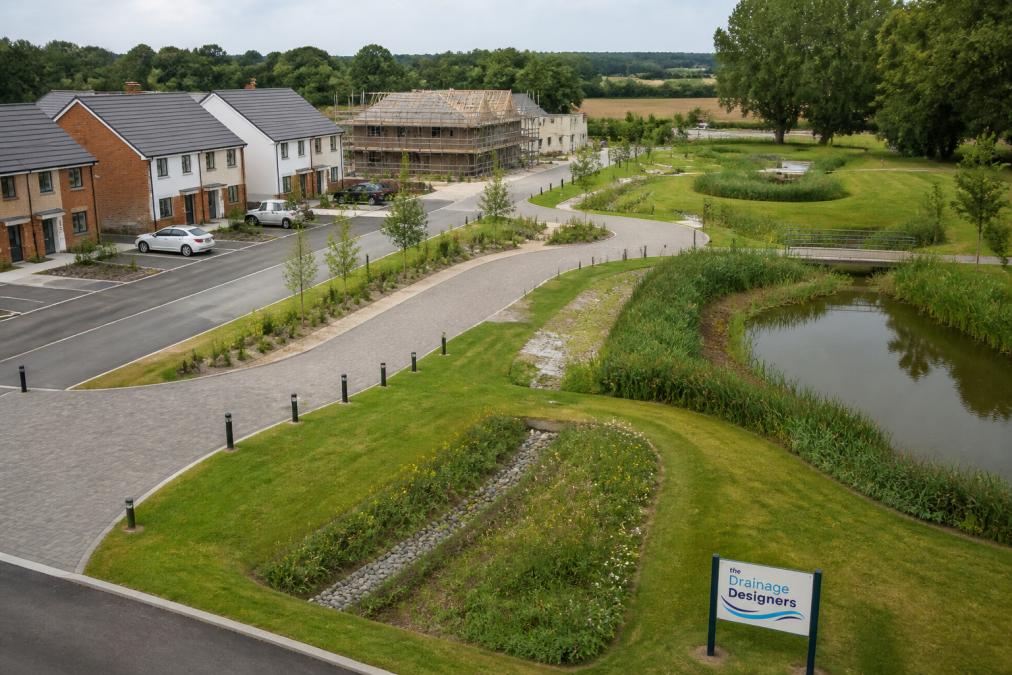
The primary purpose of a SuDS management plan is to manage surface water runoff sustainably whilst meeting regulatory requirements and delivering multiple co-benefits. Rather than simply moving water away as quickly as possible, sustainable drainage systems slow it down, filter it, and allow it to infiltrate or evaporate naturally.
Specific objectives include:
- Flood risk reduction: By attenuating peak discharge rates, SuDS systems reduce the volume of water entering watercourses during heavy rainfall events. This protects both your site and downstream properties.
- Water quality improvement: Permeable surfaces, vegetated systems, and sediment removal mechanisms filter pollutants before water reaches receiving watercourses.
- Biodiversity enhancement: Swales, detention basins, and other vegetated components create habitat for flora and fauna, contributing to local ecological networks.
- Amenity value: Well-designed SuDS features such as planted swales and retention ponds add visual interest and recreational value to developments.
- Regulatory compliance: The plan demonstrates adherence to planning policy, building regulations, and environmental legislation.
According to guidance from the Environment Agency and lead local flood authorities, sustainable drainage represents best practice for new development and major renovation projects. Your SuDS management plan must articulate how your specific site will achieve these objectives given its catchment characteristics, soil conditions, and local constraints.
The SuDS Management Train: Components and How They Work
The SuDS management train is a conceptual framework that sequences drainage components from source control through to final discharge. Think of it as a series of treatment stages, each contributing to runoff management and water quality improvement.
Source control is the first step. Permeable surfaces such as permeable paving, green roofs, and gravel driveways allow rainfall to infiltrate at the point of impact rather than creating runoff. For residential properties, this might mean replacing a concrete driveway with permeable block paving or installing a green roof on an extension.
Site drainage comes next. Swales are shallow, vegetated channels that collect and convey water whilst allowing infiltration and sediment settlement. Bioretention areas are planted depressions that filter runoff through soil layers. Both slow water movement and improve quality.
Attenuation and storage features such as detention basins, underground storage tanks, or oversized pipes temporarily hold water during peak rainfall events, releasing it gradually to receiving watercourses or infiltration systems. This prevents overwhelming downstream drainage infrastructure.
Discharge is the final stage. Water exits the site either through controlled discharge to a watercourse, connection to public sewers (where approved), or further infiltration if ground conditions permit.
Each component must be selected based on site-specific factors: soil permeability, groundwater levels, contamination risk, available space, and maintenance feasibility. A SuDS management plan details which components are used, where they are located, their design specifications, and how they interact as a system.
SuDS Maintenance Requirements and Inspection Frequency
SuDS systems are not maintenance-free. Permeable surfaces, vegetated components, and storage features require regular inspection and upkeep to function effectively. Neglect leads to clogging, reduced infiltration capacity, and eventual system failure.
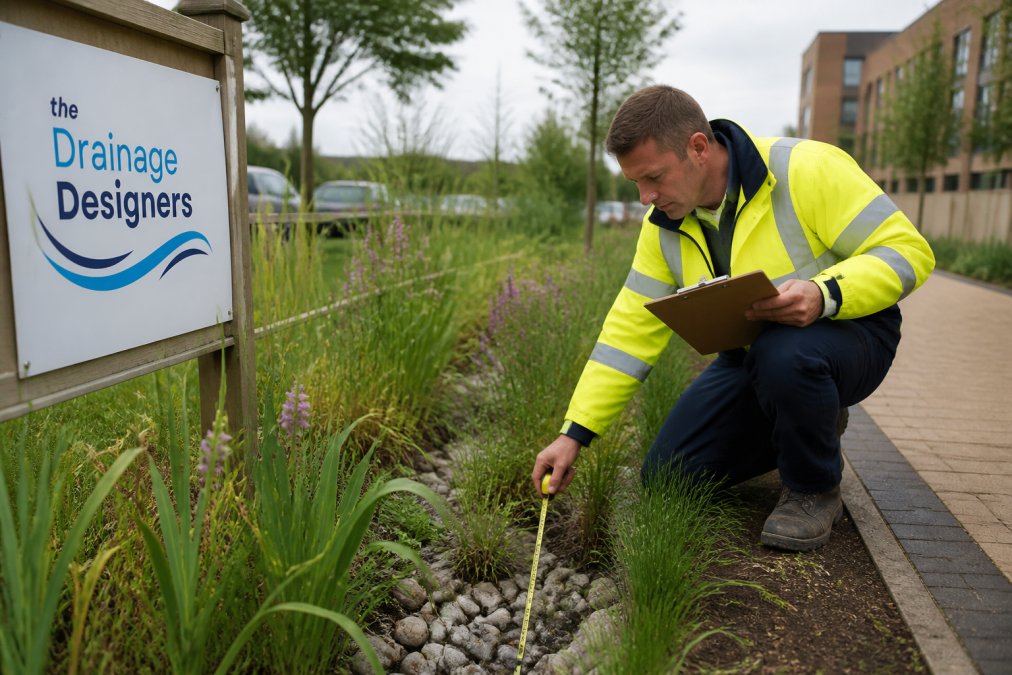
Inspection frequency depends on component type and site conditions. Permeable paving should be inspected quarterly and cleared of debris and sediment (gov.uk). Vegetated swales require inspection after heavy rainfall events to check for erosion or sediment accumulation, typically at least twice yearly. Detention basins should be inspected monthly during the growing season and after significant rainfall to ensure vegetation is healthy and sediment is not accumulating excessively.
Maintenance tasks include:
- Sediment removal from swales, basins, and filter trenches
- Vegetation management: cutting back overgrown plants, removing dead material, replanting where necessary
- Debris clearance from permeable surfaces and inlet structures
- Inspection of underground pipes and storage tanks for blockages
- Repair of damaged surfaces or eroded banks
- Monitoring of infiltration rates to detect clogging
The frequency and intensity of maintenance increases in areas with high sediment loads, such as car parks or roads with heavy traffic. Residential gardens with low-traffic permeable paving require less intensive management.
Your SuDS management plan must include a maintenance schedule that specifies who is responsible for each task, how often it should be performed, and what records should be kept. This contractual clarity prevents maintenance from being deferred or neglected after the initial development phase.
Creating a SuDS Maintenance Plan Template
A practical SuDS maintenance plan template should include the following sections:
1. Site overview and component inventory
List every SuDS component on the site: permeable paving areas (with dimensions and surface type), vegetated swales (length, width, depth, vegetation species), detention basins (volume, depth, outlet type), filter trenches, green roofs, and any underground storage. Include a site plan showing component locations.
2. Maintenance schedule table
Create a table with columns for component type, inspection frequency, maintenance tasks, responsible party, and estimated time or cost per visit. For example:
| Component | Inspection Frequency | Key Tasks | Responsible Party | Estimated Effort |
|---|---|---|---|---|
| Permeable paving | Quarterly | Debris clearance, power wash if needed | Facilities/grounds | 2-4 hours |
| Vegetated swale | Twice yearly | Sediment removal, vegetation trim, erosion check | Grounds maintenance | 4-6 hours |
| Detention basin | Monthly (growing season) | Sediment survey, vegetation management, outlet check | Grounds maintenance | 3-5 hours |
| Green roof | Annually | Vegetation health check, debris removal, drainage test | Specialist contractor | 1-2 days |
3. Record-keeping requirements
Specify what records must be kept: inspection checklists, photographs, maintenance logs, sediment removal quantities, and contractor invoices. Councils and flood authorities increasingly request these records to verify ongoing compliance.
4. Contingency and remediation
Outline what happens if components fail or perform poorly. For instance, if permeable paving loses infiltration capacity, what is the remediation process? Does it require specialist cleaning, surface replacement, or modification to underlying design?
5. Funding and responsibility transfer
Clarify who pays for maintenance: the property owner, a management company, a residents’ association, or the local authority. If ownership transfers (for example, when a new-build development is sold), the plan must specify how responsibility is transferred and how future occupants are informed of their obligations.
The Drainage Designers (Woodvale consulting Ltd) develops bespoke maintenance templates tailored to your specific components and site conditions, ensuring clarity and compliance with Local Authority requirements.
Lead Local Flood Authority SuDS Requirements and Compliance
Lead Local Flood Authorities (LLFAs) are responsible for managing surface water flooding and approving SuDS strategies for developments. Each LLFA has specific requirements and preferences, which vary by region. Understanding your local authority’s expectations is critical to securing approval.
Most LLFAs require that new developments achieve a greenfield runoff rate: the volume of water that would have left the site naturally before development (gov.uk). This is calculated using rainfall data and soil infiltration rates. Your SuDS management plan must demonstrate that your design meets or betters this greenfield standard.
LLFAs also require evidence that sustainable drainage has been considered in preference to traditional piped systems. If you propose connecting to public sewers, you must justify why SuDS alternatives are not viable. Justifications might include contaminated ground, high groundwater, or insufficient space.
Flood risk assessment is another key requirement. Your plan should reference a site-specific flood risk assessment that evaluates risk from surface water, groundwater, and watercourses. The SuDS design must mitigate identified risks proportionately.
Many LLFAs now require a long-term stewardship and maintenance plan to be agreed before planning permission is granted. This is where your maintenance template becomes essential: it demonstrates that components will be looked after and will continue to function as designed.
Regulatory compliance also extends to building regulations. Part H of the Building Regulations covers drainage and waste, and Part L addresses environmental performance. Your SuDS management plan must align with these standards and be coordinated with structural, electrical, and other engineering disciplines.
Roles, Responsibilities and Long-Term Stewardship
Clarity over roles and responsibilities is often where SuDS schemes fail. A beautifully designed system becomes ineffective if no one is accountable for maintenance, or if responsibility shifts between parties without formal agreement.
During design and construction: The architect or engineer (often working with specialists such as The Drainage Designers (Woodvale consulting Ltd)) designs the system, specifies components, and produces the management plan. The developer or contractor implements the design and ensures components are constructed to specification.
After completion: Responsibility typically passes to the property owner or occupier. For large commercial or residential developments, a management company may be appointed to coordinate maintenance on behalf of multiple property owners.
Long-term stewardship is the commitment to manage and maintain SuDS components indefinitely. This is not a one-off task; it is an ongoing obligation. Many planning authorities now require a formal stewardship agreement signed before planning permission is granted. This agreement specifies:
- Who is responsible for maintenance
- What maintenance must be performed and how often
- How funding for maintenance is secured (through service charges, council tax precepts, or other mechanisms)
- What happens if maintenance is neglected or components fail
- How responsibility transfers if the property is sold or ownership changes
For residential properties, the homeowner typically assumes stewardship responsibility. For larger developments, a management company or homeowners’ association manages the scheme on behalf of residents. In some cases, the local authority adopts SuDS components and assumes long-term responsibility, though this is less common and requires formal adoption agreements.
Asset registers are increasingly used to track SuDS components, their condition, and maintenance history. A digital asset register allows property managers to schedule maintenance, record work completed, and flag components requiring urgent attention. This creates an auditable record that satisfies planning authority and LLFA requirements.
Conclusion
A SuDS management plan is far more than a regulatory checkbox. It is a practical blueprint for managing water sustainably throughout a development’s lifespan, reducing flood risk, improving water quality, and creating amenity value. The plan bridges design intent and long-term reality by specifying components, maintenance protocols, responsibilities, and stewardship arrangements.
Getting the plan right from the outset prevents costly redesigns, secures planning approval, and ensures your drainage system functions reliably for decades. The Drainage Designers (Woodvale consulting Ltd) brings expertise in both technical design and regulatory navigation, helping you create a SuDS management plan that satisfies your local authority, meets environmental objectives, and sets your development up for long-term success. Get in touch with our team to discuss your site’s specific requirements and secure a compliant drainage solution delivered on schedule.
Many developments fail at the planning stage because their SuDS management plan lacks detail on long-term maintenance responsibility. Clarify who will maintain each component and secure formal agreement with your local authority before construction begins. This prevents disputes and ensures your system remains effective.
Frequently Asked Questions
What does SuDS stand for?
SuDS stands for Sustainable Drainage Systems. These are water management techniques designed to mimic natural drainage by allowing surface water runoff to infiltrate into the ground, reducing flood risk and improving water quality. SuDS form part of the broader hydrological cycle management approach required under planning policy across the UK.
Is a SuDS management plan a legal requirement for planning permission?
Yes, a SuDS management plan is typically required as part of planning applications for new developments and major extensions in most Local Authorities. The requirement is driven by planning policy and Lead Local Flood Authority guidance. Your Local Authority will specify what must be included; some may require detailed asset registers and maintenance schedules, whilst others have standard templates. Early consultation with your authority prevents delays.
What information must be included in a SuDS maintenance plan template?
A SuDS maintenance plan template should include: identification of all drainage components, inspection frequency for each element, specific maintenance tasks required, responsible parties, cost estimates, and contingency procedures. It must address sediment removal, vegetation management for swales and detention basins, and monitoring of infiltration rates. The template should align with your Local Authority's requirements and be proportionate to the complexity of your SuDS design.
Who is responsible for the long-term maintenance of SuDS?
Responsibility depends on site ownership and management arrangements. For residential developments, this may fall to the property owner, a management company, or the Local Authority. Your SuDS management plan must clearly assign roles and establish a maintenance schedule. Lead Local Flood Authority requirements often mandate that responsible parties are named and that adequate funding is secured before occupation. Clarity on liability and legal transfer is essential to avoid future disputes.
What are the main components of the SuDS management train?
The SuDS management train typically includes: source control (permeable surfaces, green roofs), site control (swales, infiltration trenches), and regional control (detention basins, attenuation ponds). Each component manages surface water runoff at different points, reducing peak discharge rates and improving water quality through filtration. The management train approach ensures multiple barriers to pollution and flood risk, creating resilience against climate change impacts.
How often should SuDS components be inspected?
Inspection frequency varies by component type. Permeable surfaces and vegetated systems typically require annual or bi-annual inspection, whilst sediment removal in basins may be needed every 1-3 years depending on catchment characteristics. Your SuDS maintenance requirements should specify inspection schedules for each drainage component. Lead Local Flood Authority guidance and your maintenance plan template will detail the frequency appropriate to your site's hydrological and environmental conditions.
What is the cost-benefit of maintaining SuDS properly?
Proper maintenance protects your investment by extending component lifespan, preventing costly repairs, and maintaining regulatory compliance. Well-maintained SuDS reduce flood risk, improve water quality, and enhance amenity value. The cost of a structured maintenance schedule is typically far lower than remediation of failed systems or liability claims from inadequate drainage. Long-term stewardship ensures your sustainable drainage systems deliver environmental and financial benefits throughout the asset's life.
Ready to create a compliant SuDS management plan for your project? The Drainage Designers (Woodvale consulting Ltd) provides site visits, flood risk assessments, and detailed drainage design that secures planning approval and ensures regulatory compliance. Contact us today for a consultation tailored to your site’s unique requirements.
This article was written using GrandRanker