
5 Best SuDS Solutions for Clay Soil Sites
Table of Contents
- Why Clay Soil Demands Specialist SuDS Solutions
- 1. Attenuation Tank Design for Clay: Storage-First Approach
- 2. Permeable Paving and Sub-Base Systems
- 3. French Drains with Perforated Pipe and Geotextile Membranes
- 4. Rain Gardens and Swales with Soil Improvement
- 5. Green and Blue Roofs for Precipitation Management
- SuDS Infiltration Testing Requirements and Site Assessment
- SuDS Planning Permission Compliance and Lead Local Flood Authority Requirements
Last Updated: August 24, 2026
Why Clay Soil Demands Specialist SuDS Solutions
Clay soil presents a fundamental challenge for drainage design. Unlike sandy or loamy soils that absorb water readily, clay has poor permeability and high water retention. When rainfall hits a clay-heavy site, water pools on the surface rather than infiltrating into the ground, creating surface flooding, waterlogging, and accelerated runoff that overwhelms conventional drainage infrastructure.
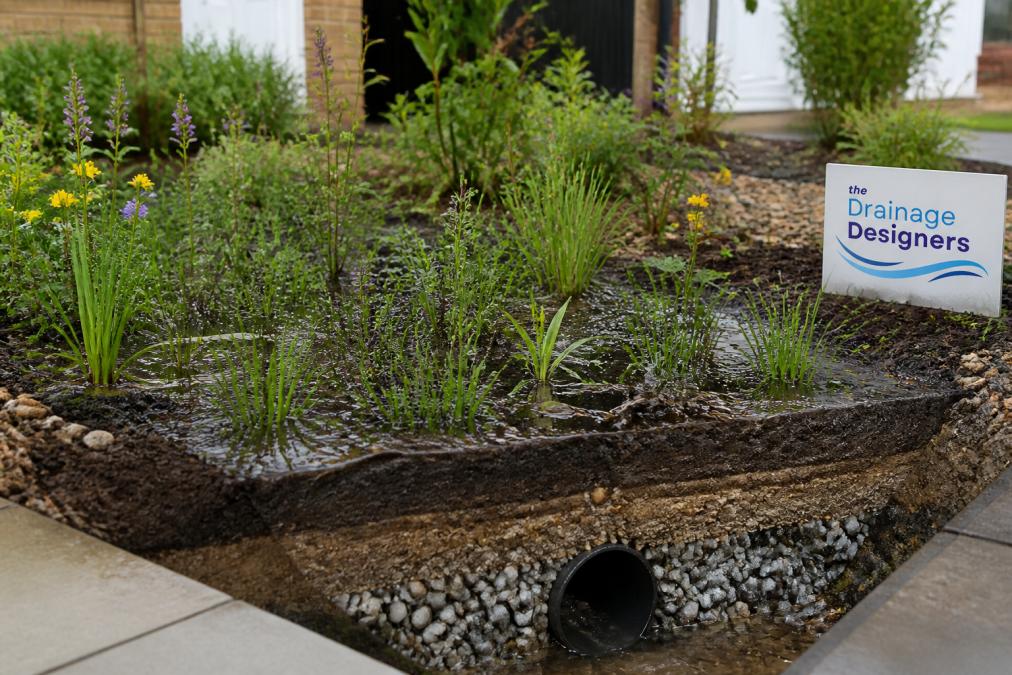
Standard soakaways fail on clay because they rely on soil infiltration. When the soil won’t absorb water, the soakaway becomes a lined pond that fills faster than it drains. Sustainable Drainage Systems (SuDS) work with the site’s hydrogeology rather than against it, using storage, attenuation, and surface management to handle water that clay won’t absorb.
At The Drainage Designers (Woodvale consulting Ltd), we design drainage systems for clay-heavy sites across the UK. The five solutions below represent effective approaches, each tested against real clay conditions and local flood authority standards.
1. Attenuation Tank Design for Clay: Storage-First Approach
Attenuation tanks are purpose-built storage vessels that capture surface water runoff and release it slowly through a controlled discharge point. On clay soil, this is often the most practical solution because it bypasses the infiltration problem entirely. Instead of relying on the ground to absorb water, the tank holds it temporarily, then metres it out at a rate the existing drainage system can handle.
How attenuation tanks work on clay-heavy sites
An attenuation tank sits below ground level, typically constructed from concrete, plastic, or modular block systems. Rainwater flows into the tank from roof gutters, permeable surfaces, or yard drainage. A controlled outlet, often a throttle valve or orifice plate, releases water at a predetermined rate, typically matching the site’s pre-development discharge rate or the local authority’s allowable discharge limit.
Tank capacity is calculated based on the catchment area, the design rainfall event (usually the 1-in-100-year storm), and the allowable discharge rate (gov.uk). On clay soil, this storage volume is often the critical factor because the soil provides zero infiltration capacity. Attenuation tanks are particularly effective where space allows underground installation, leaving gardens usable. They also work on sites with high water tables or contaminated ground where infiltration isn’t safe.
Pros and cons
Pros: Highly predictable performance with precise storage and discharge calculations. Compact footprint with most of the system below ground. Works on any soil type, including clay with zero permeability. Suitable for contaminated or high water table sites. Approved by most local authorities and well-understood by planning officers. Can be retrofitted to existing properties. Long operational lifespan with minimal maintenance if properly specified.
Cons: High upfront capital cost. Requires regular inspection and cleaning to prevent sediment accumulation. Discharge outlet can become blocked by debris. Doesn’t improve water quality through natural filtration or contribute to biodiversity. Requires structural design and may need building regulation approval. On very large catchment areas, tank size becomes impractical.
Attenuation tanks are a reliable solution for clay soil sites where space and budget allow. They shift the problem from infiltration to storage and controlled release, turning an impossible soil condition into a manageable design constraint.
2. Permeable Paving and Sub-Base Systems
Permeable paving allows water to drain through the surface layer into a storage sub-base below. On clay soil sites, the sub-base becomes critical because water won’t infiltrate into the clay beneath. Permeable paving surfaces include permeable block pavers, porous asphalt, or resin-bound gravel. Below the surface sits a geotextile membrane, followed by an aggregate sub-base layer, typically 150-300mm deep depending on the catchment area.
On clay soil, the sub-base must include a perforated pipe underdrain that collects water and routes it to either an attenuation tank or a controlled discharge point. Without this underdrain, water would accumulate in the sub-base and create waterlogging. The geotextile membrane prevents clay particles from being drawn up into the sub-base, which would reduce its storage capacity over time.
Permeable paving works well for driveways, parking areas, and low-traffic surfaces. For residential properties, permeable paving on driveways and patios can handle a significant portion of the site’s runoff, reducing the size and cost of other SuDS components.
Pros and cons
Pros: Maintains usable surface area as driveway, patio, or parking area. Improves water infiltration compared to impermeable surfaces. Reduces peak runoff rates, lowering flood risk. Lower cost than attenuation tanks for equivalent storage volume. Aesthetic appeal with various colours and finishes available. Can be installed incrementally or retrofitted to existing surfaces. Reduces urban heat island effect.
Cons: Surface can become clogged with silt and debris over time, reducing permeability. Requires regular maintenance (vacuum sweeping, jet washing) to maintain drainage performance. Uneven settlement of pavers can create ponding and reduce effectiveness. Sub-base design is critical; poor specification leads to waterlogging and structural failure. Not suitable for steep slopes. On clay soil, the perforated pipe underdrain is essential, adding cost and complexity.
On clay soil sites, specify a perforated pipe underdrain beneath the permeable paving sub-base. Without it, water accumulates in the sub-base and creates waterlogging. The pipe should be sloped towards an outfall or attenuation tank at a minimum gradient of 1:100.
3. French Drains with Perforated Pipe and Geotextile Membranes
A French drain is a shallow trench filled with gravel and a perforated pipe, designed to intercept and redirect surface water. On clay soil, French drains work by collecting water from the surface and channelling it away before it can saturate the clay. They’re particularly effective at managing runoff from roofs, driveways, and sloped ground surfaces.
The trench is typically 300-600mm deep and 300-500mm wide, depending on the expected water volume. A perforated pipe (usually 100mm diameter) sits at the base, surrounded by gravel. A geotextile membrane wraps the gravel to prevent fine clay particles from entering and clogging the system. Water seeps through the gravel, enters the perforated pipe, and flows to a discharge point or attenuation tank.
French drains are cost-effective because they require minimal excavation and no expensive tanks or complex structures. On clay soil, they’re particularly valuable because they prevent water from sitting on the surface and creating waterlogging. However, they’re not suitable for sites with very high water tables or where infiltration capacity is near zero.
Pros and cons
Pros: Low cost compared to attenuation tanks or complex SuDS systems. Simple to install with standard trenching and pipe work. Minimal surface disruption; can be buried beneath gardens or landscaping. Effective at intercepting and redirecting surface water. No moving parts or mechanical components; very low maintenance. Works on any soil type, including clay. Can be combined with other SuDS solutions. Suitable for retrofit to existing properties.
Cons: Requires accurate grading and slope; water must flow downhill to the discharge point. Not effective on flat sites without gravity-fed drainage. Geotextile membrane can become clogged with silt over time. Perforated pipe can become blocked by sediment or roots. Requires regular inspection and occasional jetting to maintain flow. Limited storage capacity; designed for conveyance, not attenuation.
4. Rain Gardens and Swales with Soil Improvement
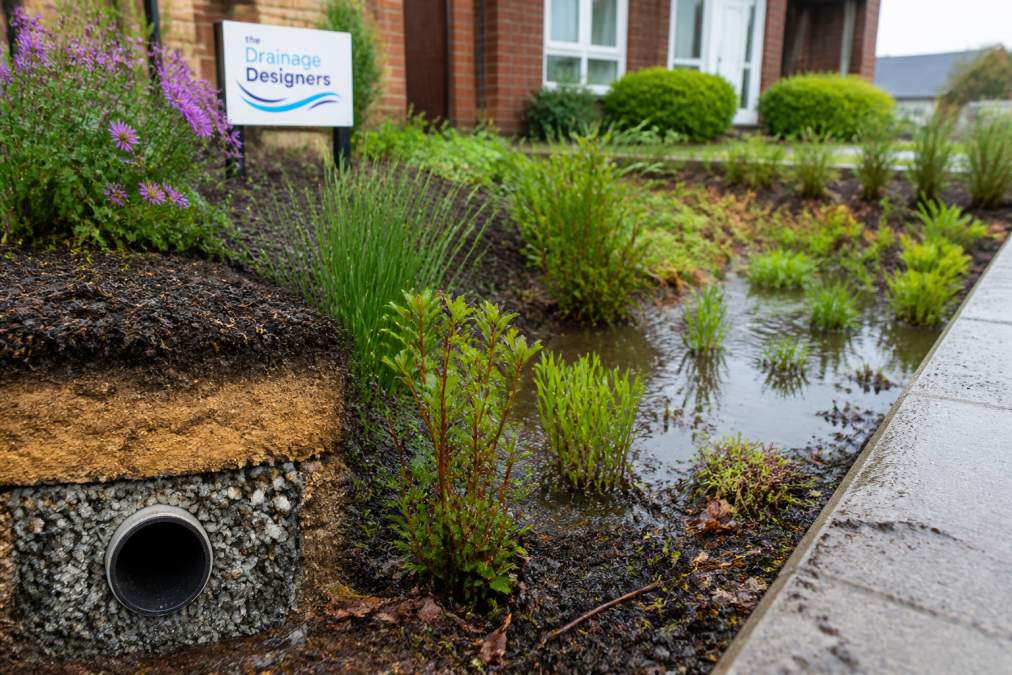
Rain gardens are shallow planted depressions designed to capture and filter runoff. A swale is a similar concept but typically longer and narrower, following contours across a slope. Both work by slowing water movement, allowing infiltration, and filtering water through soil and vegetation.
On clay soil, rain gardens and swales are most effective when the native clay is improved through soil amendment. Adding compost, sand, and organic matter increases permeability and creates a more hospitable environment for plants. A typical rain garden on clay soil is 150-300mm deep, with a 200-300mm layer of amended soil (typically a mix of topsoil, compost, and sand in a 60:20:20 ratio) (peer-reviewed research). Native plants with deep root systems help break up the soil and improve infiltration over time. A perforated pipe underdrain beneath the amended soil layer collects water that doesn’t infiltrate and routes it to an attenuation tank or discharge point.
Rain gardens work best for smaller catchment areas (typically under 500m2) and on sites with moderate slopes. They’re particularly valuable on residential properties because they provide amenity value, support biodiversity, and manage water visibly.
Pros and cons
Pros: Improves water quality through filtration and biological uptake. Provides habitat for plants, insects, and birds; enhances biodiversity. Adds aesthetic and amenity value to the property. Relatively low cost compared to attenuation tanks. Can be incorporated into landscaping design. Suitable for residential properties. Reduces peak runoff rates, lowering flood risk.
Cons: Requires adequate space; not suitable for small urban sites. Performance depends on plant health and soil maintenance. Soil amendment is expensive and must be replaced periodically. On clay soil, infiltration is still limited; perforated pipe underdrain is essential. Plants may not establish in waterlogged conditions if drainage design is poor. Maintenance includes weeding, mulching, and plant replacement. Debris and sediment accumulation requires regular cleaning.
On clay soil, never rely on a rain garden without a perforated pipe underdrain. Without it, the amended soil becomes waterlogged, plants die, and the system fails. The underdrain is essential for long-term performance.
5. Green and Blue Roofs for Precipitation Management
Green roofs are vegetated roof systems that capture and retain rainfall, reducing runoff at source. Blue roofs are flat roofs designed to temporarily store water, which is then released slowly or used for irrigation. Both reduce the volume of water entering the drainage system, lowering the burden on downstream SuDS components.
A green roof typically comprises a waterproof membrane, root barrier, drainage layer, growing medium (soil and compost), and vegetation (usually sedums or grasses). A significant portion of rainfall is retained and either evaporates or is taken up by plants, never entering the drainage system. A blue roof is simpler: a flat roof with a slight slope and a controlled outlet that releases water at a controlled rate.
On residential properties, green roofs are more common than blue roofs because they provide insulation, extend roof life, and support biodiversity. However, green roofs add weight to the structure and require structural design approval.
Pros and cons
Pros: Reduces runoff at source; water is retained rather than drained. Green roofs provide insulation, reducing heating and cooling costs. Extends roof membrane lifespan by protecting it from UV and weather. Supports biodiversity and improves air quality. Reduces urban heat island effect. Suitable for any soil type, including clay. No underground infrastructure required. Visible sustainability feature improving building aesthetics and marketability.
Cons: High upfront capital cost. Requires structural design and approval; adds significant weight to the building. Maintenance includes weeding, mulching, and plant replacement. Waterproofing must be strong; leaks can cause severe structural damage. Performance varies with rainfall intensity and vegetation type. Not suitable for pitched roofs or complex roof geometries. Retention capacity is limited; large rainfall events still generate runoff.
Large commercial buildings with flat roofs and strong structural capacity. Green roofs work on residential properties but are most cost-effective when combined with other SuDS solutions rather than used alone.
SuDS Infiltration Testing Requirements and Site Assessment
Before selecting a SuDS solution for clay soil, a site assessment must determine the actual infiltration capacity of the soil. Many clay sites have zero infiltration, but some have small pockets of more permeable material or a clay layer that sits above more permeable subsoil.
Infiltration testing typically involves a soakage test (also called a percolation test), where water is poured into a trial pit and the rate of water loss is measured. The test pit is excavated to the proposed depth of any infiltration system (usually 1-1.5m), and water is added at a constant level. The rate at which water level drops indicates the infiltration rate, expressed as mm per hour.
On clay soil, infiltration rates are typically less than 1mm per hour, often near zero (peer-reviewed research). When infiltration is below 1mm per hour, infiltration-based SuDS are not viable. Instead, storage-based solutions (attenuation tanks) or surface management solutions (permeable paving with underdrains, green roofs) become necessary.
A site assessment should also evaluate depth to water table, soil contamination, catchment area and expected runoff volume, available space for SuDS components, topography and natural drainage patterns, and proximity to neighbouring properties and watercourses. The Drainage Designers (Woodvale consulting Ltd) conducts infiltration testing and site assessments to determine which SuDS solutions are viable for your specific site. Pricing for testing depends on the scope of the project, and results inform the drainage design strategy.
SuDS Planning Permission Compliance and Lead Local Flood Authority Requirements
Planning permission and drainage approval are separate processes. Planning permission is granted by your local council’s planning department; drainage approval is granted by the Lead Local Flood Authority (LLFA) or, in some cases, the local water company if discharge is to public sewers.
For most residential projects, SuDS must comply with the local authority’s SuDS design standards. These standards typically require that surface water runoff is managed on-site using SuDS solutions, with discharge to public sewers only as a last resort. The discharge rate from the site must not exceed the pre-development rate.
The LLFA reviews drainage designs to ensure they comply with local flood risk assessment strategies and national SuDS standards. Common requirements include infiltration testing to determine soil permeability, flood risk assessment for 1-in-100-year rainfall events (plus climate change allowance), attenuation tank or storage system sized for the design rainfall event, perforated pipe underdrains on all infiltration-based systems, geotextile membranes to prevent clogging, and maintenance access for inspection and cleaning.
For clay soil sites, the LLFA often requires an attenuation tank or storage-based system because infiltration is not viable. Permeable paving, rain gardens, and French drains must include perforated pipe underdrains to comply with SuDS standards. Engaging a drainage designer early in the design process, before planning submission, significantly increases the likelihood of first-time approval and reduces the risk of costly redesigns.
Navigating SuDS design for clay soil sites is complex, but the right solution makes all the difference between a project that flows smoothly through planning and one that faces repeated rejections. Clay soil’s poor permeability rules out simple soakaways but opens the door to strong storage-based systems that work reliably once properly specified.
The Drainage Designers (Woodvale consulting Ltd) specialises in designing SuDS solutions for clay-heavy sites across the UK. From infiltration testing and flood risk assessment to detailed design and planning submission, we handle the technical complexity so your project stays on schedule. Get in touch to discuss your site’s specific challenges and discover which SuDS solution will work best for your property.
Frequently Asked Questions
Why do traditional soakaways fail in heavy clay soil?
Clay soil has very low permeability and hydraulic conductivity, meaning water cannot drain through it efficiently. Traditional soakaways rely on water infiltrating into surrounding soil, but clay's compacted structure prevents this. Water becomes trapped, causing saturation and failure. This is why clay sites need alternative SuDS solutions like attenuation tanks or French drains that work with clay's properties rather than against them.
What are SuDS infiltration testing requirements for clay sites?
Infiltration testing determines your soil's actual drainage capacity and guides SuDS design. Standard tests measure how quickly water penetrates soil at different depths. For clay sites, testing is critical because results often show infiltration rates too low for conventional methods. The results inform whether you need storage-based solutions (attenuation tanks) or engineered drainage (French drains). Most Local Authorities require this data before approving SuDS designs.
What does SuDS planning permission compliance involve?
Planning approval for SuDS requires demonstrating that your drainage design manages surface water runoff without increasing flood risk to neighbouring properties. You must show that discharge rates do not exceed pre-development levels and that the system handles design storms. The Lead Local Flood Authority reviews your flood risk assessment and SuDS proposal. For clay sites, compliance often means proving your chosen solution (attenuation, permeable paving, or engineered drainage) meets these discharge and storage requirements.
Can permeable paving work effectively on clay soil?
Yes, but with careful design. Permeable paving works by allowing water to pass through the surface into a sub-base layer. On clay, the sub-base must include a perforated pipe drainage system because water cannot infiltrate the clay below. The paving becomes part of a larger drainage system rather than relying on soil infiltration alone. This approach is effective for residential driveways, patios, and parking areas where you combine permeable surfaces with engineered drainage beneath.
What is the difference between residential and commercial SuDS requirements on clay sites?
Commercial sites typically have larger catchment areas and higher precipitation volumes, requiring larger attenuation storage or more extensive drainage networks. Residential extensions may need only a single attenuation tank or French drain system. Both must comply with Lead Local Flood Authority standards, but commercial projects often require more detailed flood risk modelling and hydraulic capacity calculations. The underlying principle is the same: manage surface water runoff without increasing downstream flood risk, but scale and complexity differ significantly.
This article was written using GrandRanker