Benefits of Sustainable Drainage for Residential Developments
Table of Contents
- What Are Sustainable Drainage Systems?
- Flood Risk Management Through Sustainable Drainage
- SuDS Planning Requirements and Regulatory Compliance
- Water Quality and Pollution Control Benefits
- Biodiversity and Ecological Enhancement
- Flood Risk Assessment for Residential Planning
- SuDS Maintenance Responsibilities and Long-Term Value
- Amenity Value and Community Wellbeing
What Are Sustainable Drainage Systems?
Sustainable drainage systems (often called SuDS) are designed approaches to managing rainwater that mimic natural water processes. Rather than channelling surface water runoff directly into combined sewers or watercourses, SuDS allow water to infiltrate, filter, and attenuate through a series of landscape features. This approach reduces flood risk, improves water quality, and creates amenity value within residential developments.
At The Drainage Designers (Woodvale consulting Ltd), we work with homeowners, architects, and developers to integrate SuDS into residential schemes from the earliest planning stages. The system operates through what’s known as the management train: a cascading sequence of components that progressively treat and attenuate water as it moves across a site. Each layer serves a specific function, from source control at the point of rainfall through to final discharge.
The core principle is simple but transformative. Instead of treating water as a problem to be removed as quickly as possible, SuDS treat it as a resource to be managed, cleaned, and returned to the environment in a controlled manner. For residential developments, this means designing landscapes that work with water rather than against it.
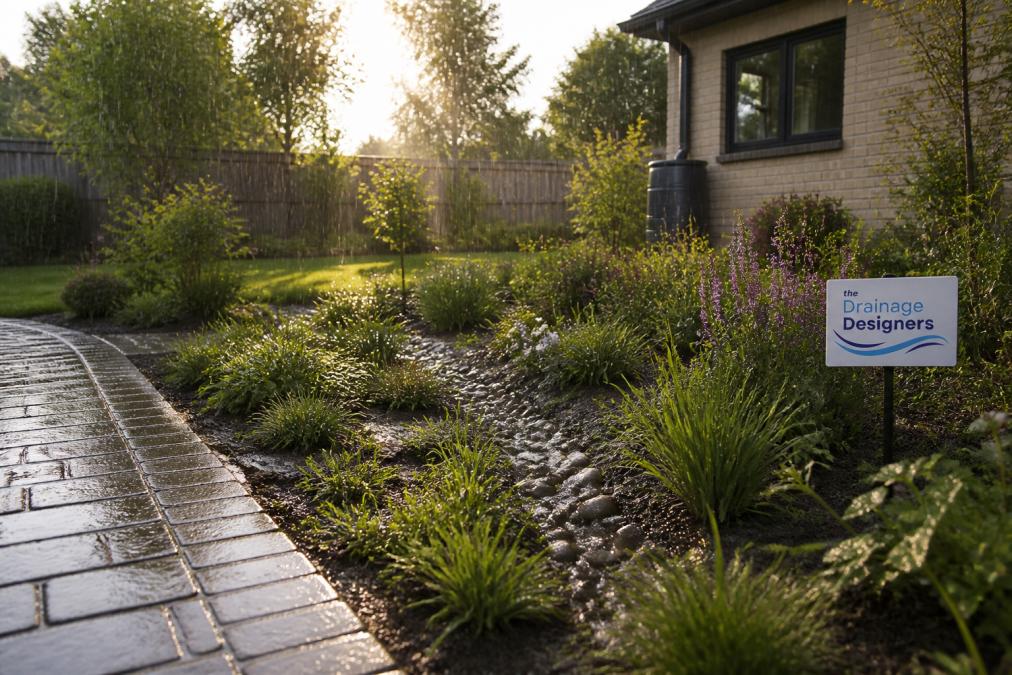
The management train typically includes source control measures like permeable surfaces and green roofs, followed by site control features such as swales and detention basins, and finally discharge to watercourses or groundwater. This hierarchical approach ensures that water is managed at the point where it falls, reducing the burden on downstream infrastructure and natural systems.
Flood Risk Management Through Sustainable Drainage
Flooding represents one of the most significant risks to residential developments. Traditional drainage systems concentrate surface water runoff into pipes and channels, which can overwhelm capacity during intense rainfall events. SuDS fundamentally change this dynamic by distributing water management across the entire development footprint.
When you implement sustainable drainage systems for residential properties, you reduce peak runoff rates that would otherwise strain local infrastructure. Permeable surfaces, swales, and detention features slow water movement and allow infiltration. This attenuation effect means that rainfall events that previously caused localised flooding can now be managed safely within the site boundary.
The flood risk assessment for residential planning is a critical first step. Your local authority and Lead Local Flood Authority require evidence that the proposed drainage strategy will not increase flood risk downstream. SuDS inherently provide this assurance because they reduce the volume and rate of water leaving the site. During a 1-in-100 year rainfall event, a well-designed SuDS scheme will attenuate water to pre-development runoff rates or better (peer-reviewed research).
Consider a typical residential extension or new build scenario. Without SuDS, increased hard surfaces create additional runoff that enters the public sewer system. With SuDS, permeable paving and rain gardens capture and filter that water on-site. The difference in flood risk is measurable and defensible in planning applications.
The drainage hierarchy established by planning policy requires developers to consider infiltration first, then attenuation and discharge to watercourses, with connection to combined sewers as a last resort. This hierarchy exists precisely because SuDS manage flood risk more effectively than traditional piped systems. Properties designed with this principle in mind benefit from greater long-term resilience.
SuDS Planning Requirements and Regulatory Compliance
Planning authorities now expect sustainable drainage systems to be integral to residential development proposals. Building Regulations Part H and the National Planning Policy Framework both require consideration of SuDS, and most Local Plans include specific policies requiring their implementation (gov.uk). This is not optional guidance; it is a regulatory expectation that affects planning permission success.
The compliance framework operates at multiple levels. Your Local Authority will review whether the SuDS scheme aligns with local drainage strategies and flood risk management plans. The Lead Local Flood Authority will assess whether the scheme meets statutory requirements for flood risk reduction. Building Control will verify that the detailed design complies with technical standards for safety and performance.
Navigating this complexity requires expertise in local requirements. Each authority has different expectations regarding infiltration testing, attenuation calculations, and maintenance arrangements. Some authorities favour green infrastructure approaches; others prioritise hydraulic performance. Understanding these nuances before submitting your application significantly improves approval chances.
Common planning objections relate to maintenance responsibility, long-term performance guarantees, and whether SuDS will function effectively on the specific site. These concerns are entirely valid and require detailed evidence to address. Hydrogeological surveys, infiltration testing, and modelled hydraulic performance data all form part of a strong planning submission.
The Drainage Designers (Woodvale consulting Ltd) specialise in translating regulatory requirements into practical designs that planning officers understand and support. Our team prepares the technical documentation that satisfies Local Authority and Lead Local Flood Authority expectations, reducing the risk of refusal or expensive conditions imposed after approval.
Water Quality and Pollution Control Benefits
Surface water runoff from residential areas carries diffuse pollution: oil residues from driveways, sediment from construction, nutrients from gardens, and particulates from roof surfaces. Traditional piped drainage simply transports this contaminated water to watercourses or treatment plants. SuDS intercept and treat this water before it reaches the environment.
Bio-retention features, swales, and wetlands function as living filters. As water percolates through soil and vegetation, pollutants are trapped, broken down, or absorbed. Sediment settles in detention areas. Vegetation uptakes excess nutrients. The result is water quality improvement that benefits both the immediate environment and downstream ecosystems.
This water quality benefit is increasingly recognised in planning policy. Many authorities now require evidence that the SuDS scheme will reduce pollution loads to receiving watercourses. This requirement stems from Water Framework Directive obligations and local environmental targets (europa.eu). For residential developments near sensitive watercourses or designated conservation areas, water quality improvement becomes a planning requirement rather than an optional benefit.
The sedimentation and filtration processes also protect groundwater. Where infiltration occurs, the soil acts as a final treatment layer, preventing contaminants from reaching aquifers. This is particularly important in areas with high groundwater tables or where groundwater is used for drinking water supply.
Permeable surfaces represent a straightforward example. Permeable paving allows rainfall to infiltrate through the surface layer into a sub-base where sediment settles and biological activity breaks down pollutants. The filtered water then either infiltrates to groundwater or is discharged to a watercourse in a cleaner state than it would have been under conventional drainage.
Biodiversity and Ecological Enhancement
Residential developments typically reduce biodiversity through habitat loss and fragmentation. SuDS reverse this trend by creating new habitats and ecological corridors within the development itself. Wetlands, swales, and detention basins support aquatic and terrestrial wildlife. Native planting associated with these features provides food and shelter for birds, insects, and small mammals.
This ecological benefit is now a planning requirement in many authorities. Biodiversity net gain policies require developments to increase biodiversity value compared to the baseline. SuDS contribute significantly to meeting these targets because they introduce diverse vegetation and habitat features that would otherwise be absent from residential schemes.
The ecosystem services provided by these features extend beyond biodiversity value. Vegetation reduces the urban heat island effect through evapotranspiration and shading. Native plants support pollinators essential for local food production. Wetland features improve air quality through biological processes. These benefits accumulate across the development and into the surrounding community.
When you design sustainable drainage systems for residential properties with ecological enhancement in mind, you create landscapes that support wildlife throughout the year. Spring flowering plants provide early nectar sources. Summer vegetation offers shelter and breeding habitat. Autumn seeds and berries sustain migrating birds. Winter structure from dead plant material supports overwintering insects.
The cost of achieving biodiversity net gain through conventional landscaping often exceeds the cost of integrating ecological value into SuDS design. This represents a significant planning advantage. Developments that achieve both flood risk reduction and biodiversity enhancement are more likely to secure planning approval and community support.
Flood Risk Assessment for Residential Planning
A flood risk assessment for residential planning is the technical foundation for demonstrating that your development will not increase flood risk. This assessment examines multiple hazards: fluvial flooding from watercourses, surface water flooding from intense rainfall, groundwater flooding from rising water tables, and sewer flooding from system capacity exceedance.
The assessment considers the site’s location within flood zones defined by the Environment Agency. Properties in Flood Zone 1 (lowest risk) typically require a simpler assessment than those in Flood Zones 2 or 3. However, even low-risk sites must demonstrate that proposed drainage arrangements will not worsen conditions elsewhere.
Hydraulic modelling forms the core of this assessment. Software calculates how rainfall of various intensities will behave on your proposed site layout. The model tests whether SuDS features have sufficient capacity to attenuate the critical storm event (typically a 1-in-100 year rainfall event with a climate change uplift factor). If modelling shows that runoff rates exceed safe discharge limits, the design is refined with additional attenuation features.
Infiltration testing determines whether groundwater conditions allow water to soak into the soil. A site with high water tables or clay soils may not support infiltration-based SuDS. In these cases, attenuation to surface water sewers or watercourses becomes the appropriate strategy. Testing must occur before detailed design to avoid costly redesigns later.
The assessment also evaluates site-specific hazards. Proximity to watercourses, historical flood records, and local flood defence schemes all influence the assessment conclusions. For residential extensions, the assessment is typically simpler than for new build developments, but the principle remains: demonstrate that the proposed drainage will not increase flood risk.
SuDS Maintenance Responsibilities and Long-Term Value
A common misconception is that SuDS require complex, expensive maintenance. In reality, well-designed systems integrate maintenance into routine landscape management. Swales are maintained like gardens. Permeable paving is cleaned like conventional paving. Detention basins are managed as amenity features.
The long-term value of SuDS becomes apparent when you consider lifecycle costs. Traditional piped drainage requires replacement after 50-80 years at substantial cost. SuDS features, if properly maintained, function indefinitely. The vegetation may require periodic renewal, but the underlying infrastructure is permanent.
Maintenance responsibility must be clearly defined in planning submissions. For residential developments, responsibility typically falls to the property owner, residents’ association, or a designated maintenance company. Local Authorities increasingly require formal maintenance agreements and financial contributions to ensure long-term performance.
The cost of maintenance is modest when considered against the benefits. Vegetation management, sediment removal from detention features, and periodic inspection represent the main activities. Many residents view these features as amenity enhancements rather than maintenance burdens, particularly when landscaping is designed to be visually attractive.
Property value implications are significant. Developments with high-quality SuDS features can appeal to buyers because they recognise the benefits: reduced flood risk, attractive green space, lower drainage-related costs, and environmental credentials. This value uplift can exceed the cost of SuDS implementation, making them financially beneficial even before considering flood risk reduction and regulatory compliance.
Amenity Value and Community Wellbeing
Sustainable drainage systems create landscapes that enhance residential amenity and support community wellbeing. Rain gardens, wetlands, and swales are not purely functional features; they are designed as attractive green spaces that residents enjoy and value.
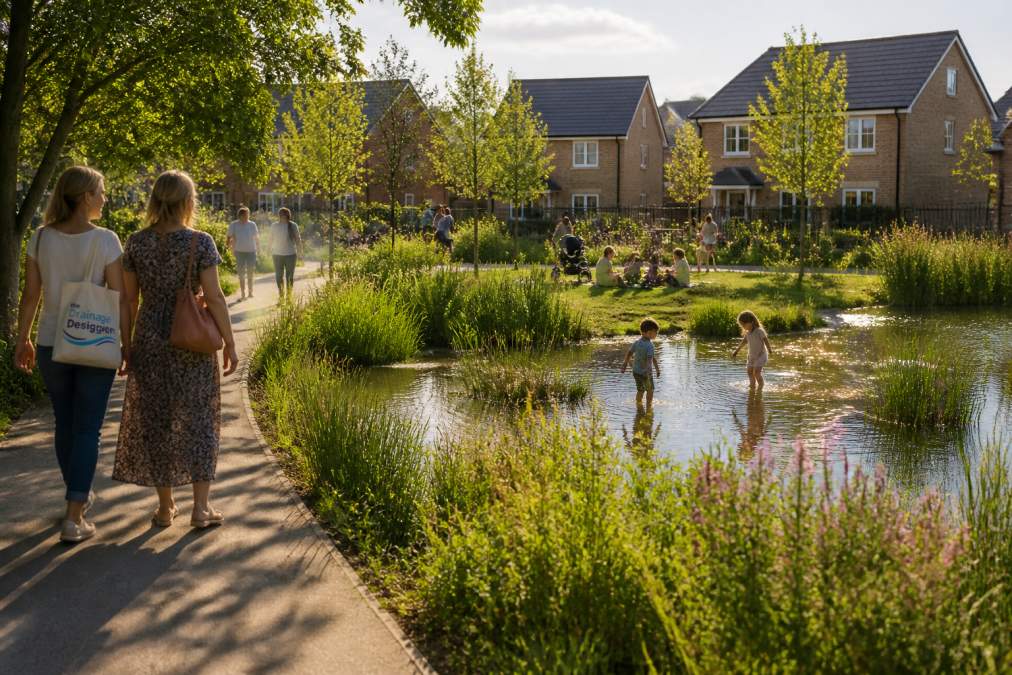
The psychological benefits of green space are well established. Access to nature reduces stress, supports mental health, and encourages physical activity. Residential developments with integrated SuDS provide these benefits within the immediate living environment. Children grow up with direct experience of natural water processes. Adults enjoy outdoor space that connects them to ecological systems.
Community engagement increases when residents understand that SuDS features serve their interests. A detention basin that doubles as a wildflower meadow becomes a community asset rather than a drainage requirement. Residents participate in habitat management, wildlife watching, and seasonal monitoring. This engagement strengthens community cohesion and environmental awareness.
The landscape-led design approach positions SuDS as the primary design driver rather than an afterthought. This means that the most prominent and valuable spaces within the development are often SuDS features. Central green spaces with wetland characteristics, attractive swales that frame building groups, and permeable surfaces that define public areas all contribute to a sense of place and belonging.
Educational value extends beyond the immediate community. Schools and colleges use residential SuDS as outdoor classrooms for environmental education. Residents learn about water cycles, ecology, and climate adaptation. This educational function reinforces the social value of the development and builds long-term community support for sustainable practices.
Sustainable placemaking integrates environmental performance with human experience. Developments designed with this principle create places where people want to live, where children play safely, and where environmental responsibility is visible and tangible. This represents the highest expression of what SuDS can achieve: not merely meeting regulatory requirements, but actively improving quality of life.
Residential developments face increasing pressure to demonstrate environmental responsibility and climate resilience. Sustainable drainage systems address multiple challenges simultaneously: flood risk reduction, water quality improvement, biodiversity enhancement, and community wellbeing. The regulatory environment now expects these systems to be central to development design, not peripheral features.
The Drainage Designers (Woodvale consulting Ltd) helps residential developers, architects, and homeowners navigate this complex landscape. From initial flood risk assessment through detailed design and planning submission, our team ensures that SuDS are implemented to deliver both regulatory compliance and genuine environmental benefit. Get in touch to discuss how sustainable drainage can enhance your residential project.
Frequently Asked Questions
What are the primary benefits of sustainable drainage systems for new residential developments?
Sustainable drainage systems reduce surface water runoff, lower flood risk, and improve water quality. They enhance biodiversity by creating habitats for wildlife, increase property amenity value through green spaces, and support climate resilience. For developers and homeowners, SuDS deliver regulatory compliance, reduce the need for costly conventional drainage infrastructure, and create attractive landscapes that appeal to residents and buyers.
Are sustainable drainage systems a legal requirement for new homes?
Building Regulations Part H requires that surface water drainage be managed sustainably where practicable. Most Local Planning Authorities and Lead Local Flood Authorities expect SuDS planning requirements to be met in new residential developments. The specific requirements vary by location and catchment area, so early engagement with your local authority is essential to understand what applies to your project.
How does a flood risk assessment for residential planning protect homeowners?
A flood risk assessment evaluates surface water runoff, diffuse pollution risks, and groundwater recharge potential on your site. It identifies whether your property sits in a flood-prone catchment area and determines how SuDS components like swales, detention basins, or permeable surfaces will manage that risk. This assessment is required by planning authorities and protects your investment by demonstrating that your drainage design meets regulatory standards and minimises future flooding.
What are the main SuDS maintenance responsibilities for homeowners and developers?
SuDS maintenance responsibilities typically include regular inspection of permeable surfaces, clearing vegetation from swales and bio-retention features, and monitoring detention basins for sediment buildup. Most residential schemes establish a management plan that outlines who is responsible for each component. Proper maintenance ensures hydraulic performance, prevents combined sewer overflow events, and extends the lifecycle of your drainage system, protecting both water quality and property value.
This article was written using GrandRanker