Avoiding Drainage Conditions on Planning: 2026 Guide
Table of Contents
- What Are Drainage Conditions and Why Do They Get Attached?
- How a Flood Risk Assessment for Planning Permission Prevents Drainage Conditions
- SuDS Requirements for Residential Planning: What You Need to Submit Upfront
- The Discharge of Planning Conditions Process: What Happens If You Miss It
- Pre-Application Strategy: The Cheapest Way to Avoid Drainage Conditions
- Cost-Benefit Analysis: Spending More on Drainage Design vs. Paying for Discharge
- Checklist for Self-Builders: Documents That Stop Drainage Conditions
- Frequently Asked Questions
Last Updated: September 22, 2026
What Are Drainage Conditions and Why Do They Get Attached?
Drainage conditions are requirements attached to a planning permission that force you to submit and secure approval for drainage details before or after work begins. Councils need proof that surface water and foul water from your site will not cause flooding or pollution elsewhere.
Pre-commencement vs. post-commencement conditions
Pre-commencement conditions must be discharged before you start any work on site. Break ground early and the whole permission can become invalid, meaning enforcement action and a fresh application.
Starting site work before discharging a pre-commencement drainage condition can void your permission entirely. The council can issue an enforcement notice and require you to apply again, costing both time and professional fees.
How a Flood Risk Assessment for Planning Permission Prevents Drainage Conditions
A flood risk assessment for planning permission identifies your site’s flood risk and sets out how you will manage surface water. Done properly, it answers the drainage questions before the officer has to ask them.
A strong assessment does three things:
- Confirms the flood zone and any history of local flooding
- Calculates existing and proposed runoff rates
- Proposes how surface water will be managed on site
SuDS Requirements for Residential Planning: What You Need to Submit Upfront
SuDS requirements for residential planning centre on one principle: surface water should be managed as close to where it falls as possible. Sustainable drainage systems use attenuation tanks, permeable paving, swales, ponds and flow controls to slow water down rather than pushing it straight into the sewer.
The four pillars officers assess
Most SuDS designs are judged against four criteria, and a submission addressing all four is far harder to condition:
- Quantity – can the system manage runoff rates and volumes for the design event, typically matching greenfield runoff rates for the site?
- Quality – can it intercept and treat pollutants before discharge, usually through a treatment train of two or three stages?
- Amenity – does the design contribute something usable or visually acceptable, rather than a hidden tank under a car park?
- Biodiversity – does it create or protect habitat, even in a modest way?
Adoption and maintenance: the question that triggers conditions
The most common trigger for a drainage condition is uncertainty over who owns and maintains the system after completion. Officers have seen too many swales silt up and attenuation tanks go unemptied. If your submission is silent on maintenance, a condition is almost guaranteed.
There are three common routes:
- Adoption by the local authority or a water company – possible in some areas, but not universal, and the design must meet the adopting body’s specification.
- Adoption by a management company – common on larger sites, funded by an estate charge, with a legal agreement in place before occupation.
- Private maintenance by the homeowner or a residents’ association – acceptable for single dwellings and small schemes, provided a clear schedule is submitted.
Design choices that reduce condition risk
Some design decisions make approval easier. Permeable paving is often accepted with minimal calculation because its performance is well understood and it manages water at source. An attenuation tank with a hydrobrake needs more detailed calculations and a clear maintenance plan, but fits a tight site. Swales and basins need land, but are visible and easy for officers to understand.
| Document | What It Shows | Why It Prevents a Condition |
|---|---|---|
| Drainage layout | Pipe routes, levels, connections | Proves a workable design exists |
| Attenuation sizing | Storage volume and discharge rate | Shows runoff is controlled |
| Infiltration test results | Whether the ground can absorb water | Confirms SuDS feasibility |
| Maintenance schedule | Who maintains features and how often | Answers long-term concerns |
| Topographical survey | Existing levels and falls | Demonstrates the design fits the site |
| Water quality treatment train | How pollutants are intercepted | Addresses the quality pillar |
If your site is in an area where the lead local flood authority has published its own SuDS design guidance, read it before you brief a designer. Designing to the local standard from the outset is faster than redesigning after a query.
The Discharge of Planning Conditions Process: What Happens If You Miss It
The discharge of planning conditions process is straightforward on paper: submit an application to discharge, pay the fee, provide the evidence, and wait for written approval. In practice, it is where projects stall, and the consequences go well beyond a delay.
Here is how it runs:
- Read the condition wording carefully and note the deadline
- Prepare the documents the condition asks for, no more and no less
- Submit a discharge application through the Planning Portal
- Respond to any queries from the planning officer
- Receive written approval before starting the restricted work
What ‘lawful implementation’ actually means
A planning permission is not lawfully implemented until every pre-commencement condition attached to it has been discharged. This is not a technicality. It is the point at which the permission becomes real in law.
- The development is unauthorised, even though you hold a decision notice
- The local planning authority can issue an enforcement notice requiring you to stop and remedy the breach
- You may need to submit a fresh application, and there is no guarantee it will be granted on the same terms
- Any future sale of the site or the completed property can be held up because solicitors cannot confirm lawful implementation
Post-commencement conditions and the occupation trap
Post-commencement conditions are less severe but still binding. They typically require details before first occupation or within an agreed timescale. Occupy a dwelling before discharging a pre-occupation condition and you are in breach, and the council can take enforcement action even though the building is complete.
Timescales and the query round
Local planning authorities aim to determine discharge applications within eight weeks, but the clock pauses while they wait for further information. A straightforward discharge with complete evidence may be approved in four to six weeks; one that prompts queries can take three months or more.
The finance and sale knock-on
Delay is not just a programme issue. Self-build mortgages and development finance often release funds in stages tied to conditions being discharged. A stalled discharge can freeze a drawdown, leaving you paying interest on money you cannot access.
Submit your discharge application the day you receive the decision notice, not the week before you plan to start. Councils can take eight weeks or more, and query rounds add to that. Early submission costs nothing and buys you schedule.
What to do if you have already started
If work has begun before a pre-commencement condition was discharged, the position is serious but not always fatal. Options include applying to discharge retrospectively, submitting a fresh application, or applying for a lawful development certificate if the breach can be regularised. Each route carries risk and cost, so take advice early.
Pre-Application Strategy: The Cheapest Way to Avoid Drainage Conditions
Pre-application engagement is the most effective way to avoid drainage conditions. A pre-app meeting or written enquiry lets you test your drainage approach with the planning officer before committing to a full application.
A useful pre-application submission for drainage includes:
- A sketch drainage strategy showing surface water and foul water routes
- Outline attenuation calculations based on greenfield runoff rates
- Any known constraints, such as a high water table or a sewer with limited capacity
- A direct question: “Would the council accept this approach without a drainage condition?”
Cost-Benefit Analysis: Spending More on Drainage Design vs. Paying for Discharge
Paying for a proper drainage design upfront is almost always cheaper than dealing with a discharge application later, and it is not close once you count everything.
The cost of a drainage condition includes:
- The discharge application fee, paid per submission
- Professional fees to prepare the discharge documents
- Delay while the council reviews, often two to three months
- Interest, rent or holding costs during that delay
- Redesign costs if the officer rejects the first submission
The cheapest drainage condition is the one that never gets written. Spending on a complete drainage strategy at application stage costs less than a single discharge round, and it protects your build programme.
Checklist for Self-Builders: Documents That Stop Drainage Conditions
Self-builders can prevent most drainage conditions by submitting a complete pack with the original application. Here is a plain checklist.
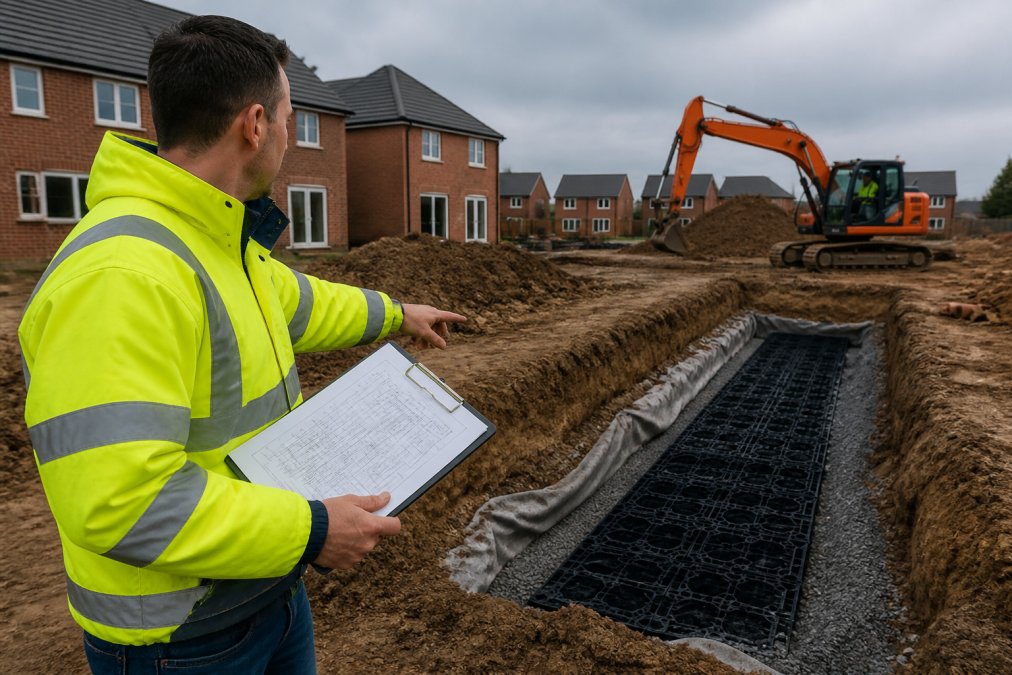
Work through this before you submit:
- Topographical survey with existing site levels
- Infiltration testing results, or a reasoned justification if not possible
- Outline drainage layout showing all pipe routes and connections
- Surface water attenuation sizing with calculations
- Proposed discharge rate, matched to greenfield runoff
- Foul water connection point confirmed with the sewerage undertaker
- SuDS features identified with a maintenance schedule
- Flood risk assessment, if the site is in Flood Zone 2 or 3
- A short covering statement explaining the drainage strategy in plain terms
Nine items. Most self-builders submit two or three.
Frequently Asked Questions
Can you avoid drainage conditions by submitting a detailed strategy upfront?
Yes. A detailed drainage strategy submitted with your planning application gives the local planning authority and the Lead Local Flood Authority confidence that surface water and foul water drainage are already resolved. Include a topographical survey, infiltration testing results, a drainage layout drawing, and calculated discharge rates. When this information is complete, planning officers often remove proposed drainage conditions or reduce them to a single compliance check. It is one of the most effective ways of avoiding drainage conditions on planning applications.
What happens if you fail to discharge planning conditions before starting work?
Starting work before discharging a pre-commencement condition breaches the planning permission. The local planning authority can issue an enforcement notice requiring you to stop work, and in serious cases you may need to demolish or reverse unauthorised works. You may also face a requirement to submit a retrospective application. The safest approach is to treat the discharge of planning conditions process as a gate: no groundworks, no foundations, and no drainage installation until you have written approval from the planning officer.
How do SuDS requirements for residential planning affect the conditions I receive?
SuDS requirements for residential planning typically mean you must show how surface water will be managed on site using sustainable drainage systems. If your application lacks a clear SuDS plan, the Lead Local Flood Authority may recommend conditions requiring attenuation features, flow control, or ongoing maintenance schedules. Providing a SuDS-compliant drainage strategy upfront, including calculations for discharge rates and evidence of infiltration testing, can significantly reduce the number of drainage conditions attached to your permission.
Is it possible to appeal a drainage condition attached to planning permission?
Yes, you can appeal a drainage condition if you believe it is unreasonable, unnecessary, or lacks a clear planning purpose. Appeals are made to the Planning Inspectorate and must be submitted within the deadline stated on your decision notice. However, appeals take time and can delay your project. A faster route is often to negotiate with the planning officer or submit additional drainage information before the decision is issued. If you have a flood risk assessment for planning permission already prepared, it may resolve the issue without an appeal.