
When Soakaways Fail: Alternative Attenuation Methods for Clay Soils
We should be aware now that soakaways are often the go-to solution for surface water drainage, but they have one critical weakness: they simply don’t work in clay soils. If you’re a homeowner, architect, or developer facing this challenge, you’re not alone. Clay’s low permeability means water has nowhere to go, leaving you with a failed drainage system and potential flooding issues.
The good news? There are several proven alternative attenuation methods that work brilliantly even when soakaways fail. Let’s explore your options.
Why Soakaways Fail in Clay Soils
Before we dive into solutions, it’s worth understanding why clay soils are so problematic. Clay particles are incredibly small and tightly packed, which means water cannot infiltrate through them at a sufficient rate. A successful soakaway requires soil with good permeability, typically sand or gravel. When you try to install a soakaway in clay, the water simply sits there with nowhere to drain, defeating the entire purpose of the system.
This is particularly frustrating because many sites across England have clay-heavy ground conditions. But don’t worry, there are excellent alternatives.
Alternative Attenuation Methods
1. Oversized Pipe Systems
One of the most straightforward solutions is to upsize your drainage pipes significantly. Instead of standard diameter pipes, you can use much larger pipes that act as temporary storage for surface water. The water is held within the pipe system until it can be released at a controlled rate into the public sewer or watercourse.
This method works particularly well because it doesn’t rely on infiltration. The pipes simply hold the water temporarily, mimicking what an attenuation tank would do, but using the pipe network itself as the storage vessel.
2. Attenuation Tanks
Attenuation tanks are purpose-built underground storage systems designed to hold large volumes of surface water temporarily. These tanks collect rainwater during heavy rainfall and release it slowly into the drainage network at a controlled rate, preventing the system from being overwhelmed.
Modern attenuation tanks come in various sizes and can be installed beneath car parks, driveways, or landscaped areas. They’re robust, long-lasting, and highly effective in clay soil conditions because they don’t depend on infiltration at all.
3. Green Roofs
Green roofs offer an innovative approach to surface water management by reducing the amount of water that needs to be drained in the first place. A properly designed green roof can absorb significant rainfall, with the vegetation and growing medium acting as a natural sponge.
The water is either used by the plants, evaporates naturally, or is released very slowly into the drainage system. This dramatically reduces peak flow rates and can eliminate the need for large underground attenuation systems. Plus, green roofs provide additional benefits like improved insulation, biodiversity, and aesthetic appeal.
4. Blue Roofs
Similar to green roofs but with a different approach, blue roofs temporarily store water on the roof surface itself. These systems use specially designed outlets that restrict flow, allowing water to pond on the roof to a safe depth before draining slowly.
Blue roofs are particularly effective on flat or low-pitched roofs and can store substantial volumes of water. They’re often more cost-effective than green roofs and require less maintenance, making them an attractive option for commercial developments.
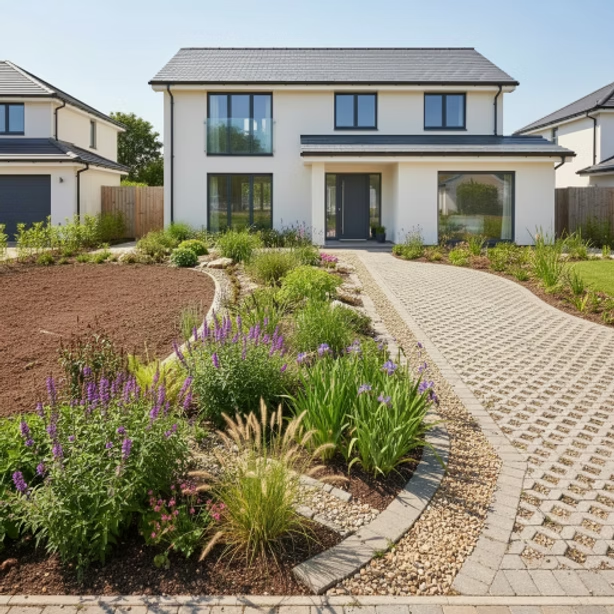
5. Permeable Paving with Storage Layers
Whilst the surface water cannot infiltrate into clay soil, permeable paving can still be used effectively when combined with an impermeable membrane and storage layer beneath. The water passes through the permeable surface into a stone-filled storage layer below, where it’s held temporarily before being released at a controlled rate.
This approach is excellent for driveways, car parks, and pathways. It maintains the aesthetic and functional benefits of permeable paving whilst working around the clay soil limitation.
6. Rain Gardens and Swales
Rain gardens and swales are landscaped features designed to temporarily hold and slow down surface water. In clay soils, these features work by providing temporary storage and allowing water to evaporate or be taken up by plants, rather than relying on infiltration.
A well-designed rain garden can be an attractive landscape feature that also serves a crucial drainage function. Swales, which are shallow vegetated channels, can convey and temporarily store water whilst adding visual interest to a site.
7. Rainwater Harvesting
Rainwater harvesting systems collect roof runoff and store it for later use in toilets, washing machines, or garden irrigation. This approach reduces the volume of water entering the drainage system altogether, which can be particularly valuable on sites with limited drainage options.
Modern rainwater harvesting systems can be installed underground with minimal visual impact, and they provide the added benefit of reducing water bills.
Combining Solutions for Maximum Effectiveness
Often, the best approach isn’t to rely on a single method but to combine several techniques. For example, you might use a green roof to reduce overall runoff, permeable paving with storage for ground-level drainage, and an attenuation tank for any remaining excess water.
This layered approach, often called a “treatment train” in drainage design, provides resilience and ensures your system can handle even exceptional rainfall events.
Getting the Design Right
Whilst these alternatives are proven solutions, getting the design right is crucial. Each site has unique characteristics including rainfall patterns, available space, connection points to the public sewer, and discharge rate restrictions imposed by the local authority or water company.
A professional drainage designer will calculate the required storage volume, design appropriate flow control devices, and ensure your system meets all regulatory requirements. They’ll also coordinate with your architect and structural engineer to integrate the drainage solution seamlessly into your project.
Planning and Approval
All of these alternative attenuation methods are well-established and widely accepted by local authorities and water companies. In fact, many planning authorities actively encourage sustainable drainage solutions like green roofs and rain gardens because they provide multiple benefits beyond just drainage.
Your drainage designer will prepare the necessary calculations, drawings, and supporting documentation to secure approval from the relevant authorities. With proper design and documentation, approval is typically straightforward.
The Bottom Line
Clay soils don’t have to derail your drainage plans. Whilst soakaways won’t work, there are numerous alternative attenuation methods that are just as effective, and in many cases, offer additional benefits.
The key is to work with an experienced drainage designer who understands these alternatives and can tailor a solution to your specific site conditions. With the right approach, you can achieve compliant, effective surface water drainage regardless of your ground conditions.
If you’re facing drainage challenges on a clay soil site, don’t assume it’s an insurmountable problem. The solutions exist, they’re proven, and they work. You just need the right expertise to implement them properly.