Is SuDS Worth It for Small Housing Projects?
Table of Contents
- What Does SuDS Mean for a Small Housing Project?
- The Real Cost-Benefit Analysis of Sustainable Drainage
- How SuDS Affects Your Planning Approval Chances
- LLFA SuDS Planning Application Requirements Explained
- SuDS Maintenance Responsibilities for Developers
- Space-Saving SuDS Designs for Small Sites
- Is SuDS Worth It? A Practical Verdict for Your Project
- Frequently Asked Questions
Last Updated: September 4, 2026
What Does SuDS Mean for a Small Housing Project?
Sustainable drainage systems, or SuDS, are a legal expectation for most new housing developments in the UK, not an optional extra (gov.uk). They manage surface water runoff on site rather than sending it to overloaded sewers, using infiltration, attenuation, and nature-based techniques.
For a single dwelling or a small housing project, this usually translates into permeable paving, a soakaway, or a bioretention area. Whether SuDS is worth it depends on how you weigh upfront design work against planning success and long-term flood resilience.
Local planning authorities now expect a drainage strategy as standard. A small project that ignores this will likely face conditions, delays, or outright refusal. Below, we show how SuDS affects your costs, approval chances, and maintenance obligations.
The Real Cost-Benefit Analysis of Sustainable Drainage
For a small housing project, the decision comes down to specific line items on an invoice. Here is a practical breakdown for a development of one to five units.
The upfront cost picture
For a typical small site, the design and installation costs of a simple, well-integrated SuDS scheme are often comparable to, or slightly less than, a traditional piped system. SuDS replaces buried infrastructure with surface features you were already planning to build.
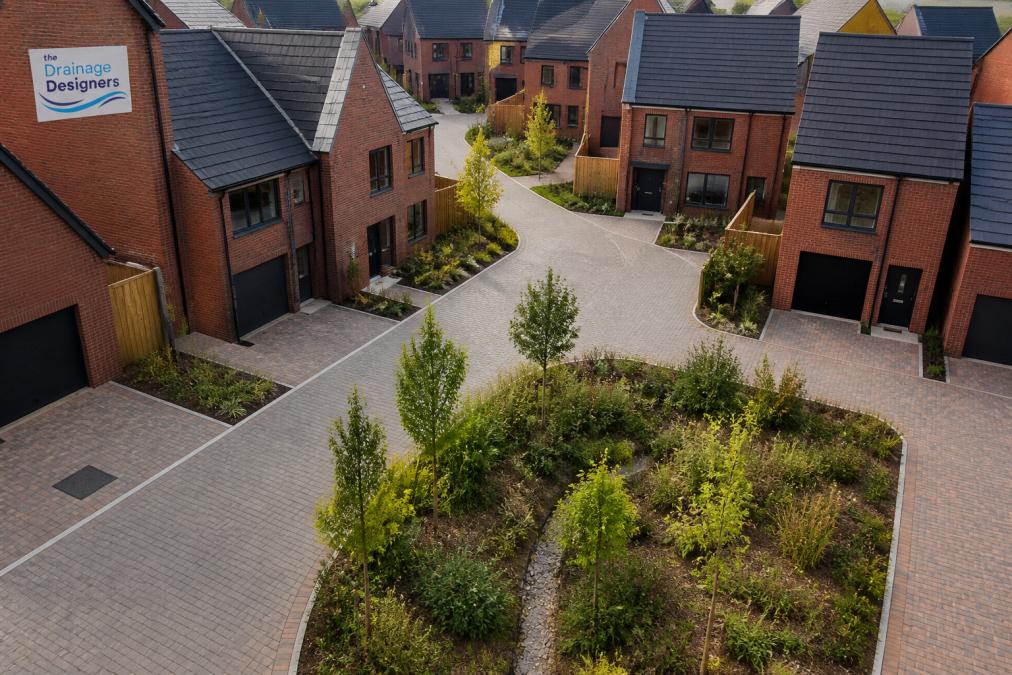
For a standard two-bedroom house, the traditional route might involve a new sewer connection, a manhole, and underground pipework. The SuDS route could be a permeable paved driveway and a shallow rain garden, replacing ornamental shrubs you would have planted anyway.
Where the real savings appear
A cost-benefit analysis of sustainable drainage for a small project typically shows the following savings:
- No sewer connection charge: Water companies charge a fee for connecting surface water drainage to the public sewer (ofwat.gov.uk). Keeping surface water on site avoids this cost entirely.
- Reduced excavation and pipework: Permeable paving and soakaways require less deep excavation than piped systems, reducing muck-away and material costs.
- No adoption fee: If you build a traditional drainage system, you may need to secure its adoption by the water company or local authority, which involves an application fee and a commuted sum for future maintenance. A privately maintained SuDS scheme avoids this.
- Faster construction programme: Surface-level SuDS features are quicker to install than deep drainage runs, which can shave days off the build schedule. On a small project, a week saved on site can be worth more than the entire drainage design fee.
The cost of getting it wrong
A refused planning application or a redesign condition after approval is the single most expensive outcome for a small developer. A drainage consultant at the outset costs a fraction of a single month of delay.
A common pattern is a developer who submits a basic flood risk assessment without a proper drainage strategy, receives a holding objection from the Lead Local Flood Authority, and then pays for an urgent redesign. The redesign fee is often double the cost of getting it right first time.
A practical way to frame the decision
For a small project, the question is rarely whether SuDS is more expensive than traditional drainage. It is whether the additional cost is justified by planning security and long-term resilience. In most cases, the answer is yes, because the feature replaces something you were going to build anyway.
SuDS genuinely costs more on sites with poor infiltration where the only compliant option is an underground attenuation tank with a pumped discharge, covered below. For most small sites with reasonable ground conditions, the cost difference is modest and the planning benefit is substantial.
How SuDS Affects Your Planning Approval Chances
Planning approval is where SuDS moves from a technical detail to a decisive factor. Most local planning authorities treat a compliant drainage strategy as a core requirement, and applications without one are routinely refused or sent back for major amendments.
The planning policy framework makes sustainable drainage the default for major developments, and many councils apply the same expectation to smaller sites. A well-prepared drainage strategy demonstrates that your project manages flood risk responsibly.
From our experience, the difference between an application that sails through and one that attracts multiple conditions is almost always the quality of the technical documentation. A clear understanding of the site’s hydrology and runoff control removes the most common grounds for objection.
LLFA SuDS Planning Application Requirements Explained
The Lead Local Flood Authority, or LLFA, reviews the drainage aspects of your planning application, and its requirements are specific and non-negotiable. It expects a strategy demonstrating how runoff will be managed for events up to and including a 1 in 100 year storm with an allowance for climate change adaptation (gov.uk).
Your submission typically needs a site-specific flood risk assessment, a drainage strategy setting out the proposed SuDS including infiltration testing and performance during extreme rainfall, and a plan for maintenance over the system’s lifetime.
LLFA guidance is published for each authority, and while principles are consistent, local requirements vary. Some councils insist on source control, others accept attenuation with a restricted discharge rate. A consultant who understands individual LLFAs is often the difference between a smooth approval and a drawn-out dispute.
SuDS Maintenance Responsibilities for Developers
The maintenance question is the single biggest barrier to SuDS adoption on small housing projects. For one to five units, there is rarely a management company in place, so responsibility falls on the homeowner or a small group of neighbours.
The default position for small sites
SuDS features on a small project are almost always privately owned and maintained. The local authority and water company will not adopt a rain garden or permeable driveway on a private plot. The maintenance obligation passes to the homeowner when the property is sold, so the design must be manageable by an ordinary person.
A realistic maintenance schedule for common features
A maintenance schedule should be part of your drainage strategy and realistic about who will carry out the work. A typical pattern is:
- Permeable paving: Requires an annual sweep to remove leaves and debris, and a visual check after heavy storms to confirm water is still infiltrating. Every few years, a jet wash or vacuum may be needed to clear silt from the joints. This is a low-skill task that most homeowners can manage.
- Rain garden or bioretention area: Requires seasonal weeding, watering during the first year while plants establish, and replacement of any plants that die. The key maintenance task is clearing the inlet and outlet points to prevent blockages. This is comparable to maintaining any garden border.
- Soakaway: Buried underground and requires minimal attention, but it is difficult to inspect. The main risk is that fine sediment washes into it over time and reduces its capacity. A simple inspection chamber at the inlet allows a visual check, and a downstream overflow should be included in the design to protect the property if the soakaway becomes blocked.
- Attenuation tank: Buried and largely maintenance-free, but it relies on a flow control device that can block. An annual inspection of the chamber and a check of the outlet pipe is advisable.
The design principle that solves most problems
A common pattern in successful projects is to design for the maintenance that will actually happen, not the maintenance that should happen. If the homeowner will not jet-wash the paving every year, design with a larger safety margin. If the garden will be low-maintenance, choose a grassed swale over a planted rain garden.
Write the maintenance schedule as a simple one-page document handed to the homeowner at completion, listing tasks, frequency, and signs of failure. This small design-stage effort prevents a significant problem later.
The shared maintenance question for small clusters
For three to five units, there is a question of who maintains a shared SuDS feature, such as a communal attenuation area or a shared permeable parking court. The options are:
- A simple deed of covenant: Each homeowner is responsible for a share of the maintenance, and the covenant ensures the work is done. This is low-cost to set up but relies on neighbours cooperating.
- A management company: A professional management company takes on the maintenance for a fee. This is reliable but adds an ongoing cost for the homeowners, which can affect the marketability of the properties.
- Adoption by the local authority: Some councils will adopt certain types of SuDS, particularly if they serve a public road or open space, but this is becoming less common due to budget pressures.
The most practical solution for a small cluster is usually a deed of covenant with a clear schedule of responsibilities. The key is to design a shared system requiring minimal maintenance, such as an underground attenuation tank with a single inspection point.
Why this matters for your planning application
The Lead Local Flood Authority will not approve a drainage strategy without a credible maintenance plan naming the responsible party, describing the tasks, and confirming funding. For a small project, the most credible plan shows the burden is minimal and the homeowner can carry it out without specialist equipment or significant cost.
Space-Saving SuDS Designs for Small Sites
Space is the biggest objection to SuDS on small projects, but compact designs fit even the tightest plots. Space-saving SuDS use every available surface to manage runoff without sacrificing usable garden area or parking.
Permeable paving is the workhorse for small sites because it doubles as a driveway or path while managing runoff from hard surfaces. A small rain garden or bioretention area can occupy a narrow strip along a boundary or a corner of the front garden.
On constrained plots, consider combining SuDS features. Direct roof runoff into a perforated pipe running beneath a permeable driveway, or route it into a shallow planted channel that doubles as a landscaped border. This approach manages water without taking up any additional footprint.
Underground attenuation tanks and crate systems are another option where space is genuinely limited, storing runoff beneath a lawn or parking area and releasing it slowly. They cost more than above-ground SuDS but preserve the entire surface for other uses.
Is SuDS Worth It? A Practical Verdict for Your Project
The practical verdict is that SuDS is worth it for nearly every small housing project, but the form must match your site, budget, and maintenance capacity. For a single dwelling, a permeable driveway and a small rain garden often deliver planning approval, flood resilience, and an attractive landscape feature for a modest additional cost.
SuDS becomes genuinely questionable on sites with poor infiltration or where the only option is a complex underground system with significant maintenance demands. In those cases, the cost-benefit analysis may favour a different approach, and an honest drainage consultant will tell you so.
The table below summarises the key considerations for small projects:
| SuDS Approach | Best For | Maintenance Level | Space Required |
|---|---|---|---|
| Permeable paving | Driveways and paths | Low to moderate | No extra space needed |
| Rain garden / bioretention | Landscaped borders | Moderate (seasonal) | Narrow strip or corner |
| Soakaway | Sites with good infiltration | Low (buried) | Small excavation |
| Attenuation tank | Constrained sites | Low (buried) | Below-ground only |
The Drainage Designers (Woodvale consulting Ltd) provides drainage design services across the UK, from site visits and flood risk assessments to securing local council approvals. We handle both commercial and domestic projects, and we commit to a transparent and ethical customer charter that keeps you informed at every stage.
Drainage is rarely the most exciting part of a build, but it is often the reason applications fail. Getting the SuDS design right from the start maximises your planning permission success and protects your programme. Get in touch with The Drainage Designers (Woodvale consulting Ltd) to receive a compliant drainage strategy that gets you approved first time.
Frequently Asked Questions
Is SuDS a legal requirement for small housing projects?
Since 2023, Schedule 3 of the Flood and Water Management Act 2010 has been enacted, making SuDS mandatory for most new developments in England. Small housing projects are not exempt. Your planning application must demonstrate that sustainable drainage systems have been considered and incorporated where practical. The Lead Local Flood Authority (LLFA) will review your drainage strategy as a statutory consultee, so engaging with the requirements early is essential to avoid delays.
Does SuDS drainage actually work in practice?
Yes. SuDS manage surface water runoff at its source, mimicking natural drainage processes. Techniques like permeable paving, soakaways and bioretention areas have been proven to reduce flood risk, improve water quality and support biodiversity. On small sites, a well-designed system can manage most rainfall events effectively, reducing pressure on local sewers. The key is a proper design based on site-specific ground conditions and a clear maintenance plan, which is where a drainage engineer adds value.
What are the four pillars of SuDS design?
The four pillars, also known as the SuDS triangle, are water quantity, water quality, amenity and biodiversity. Water quantity focuses on controlling runoff rates and volumes. Water quality involves treating pollution through natural processes. Amenity considers the visual and recreational value of the drainage features. Biodiversity aims to create habitats and enhance ecology. A successful scheme balances all four, but planning authorities may prioritise quantity and quality for a small infill project.
Can SuDS increase the property value of small developments?
Evidence suggests well-designed SuDS can have a positive impact on property value and marketability. Features like rain gardens and ponds are attractive and can be marketed as lifestyle benefits. More importantly, a SuDS scheme demonstrates to buyers that the property is resilient to flooding, which is a growing concern. Developments with clear, low-maintenance SuDS can stand out in the market, potentially supporting premium pricing compared to homes with no flood mitigation.
Are there long-term maintenance costs associated with SuDS?
Yes, all drainage systems require maintenance, and SuDS is no different. However, the burden is often lighter than people expect. Simple features like permeable paving may only need annual sweeping and inspection. The SuDS maintenance responsibilities for developers typically pass to a management company or homeowners once the development is complete. Your planning approval will include a handover plan, so it is wise to factor in a modest annual budget for inspections and upkeep to keep the system working as designed.
This article was written using GrandRanker